 Soham Chakraborty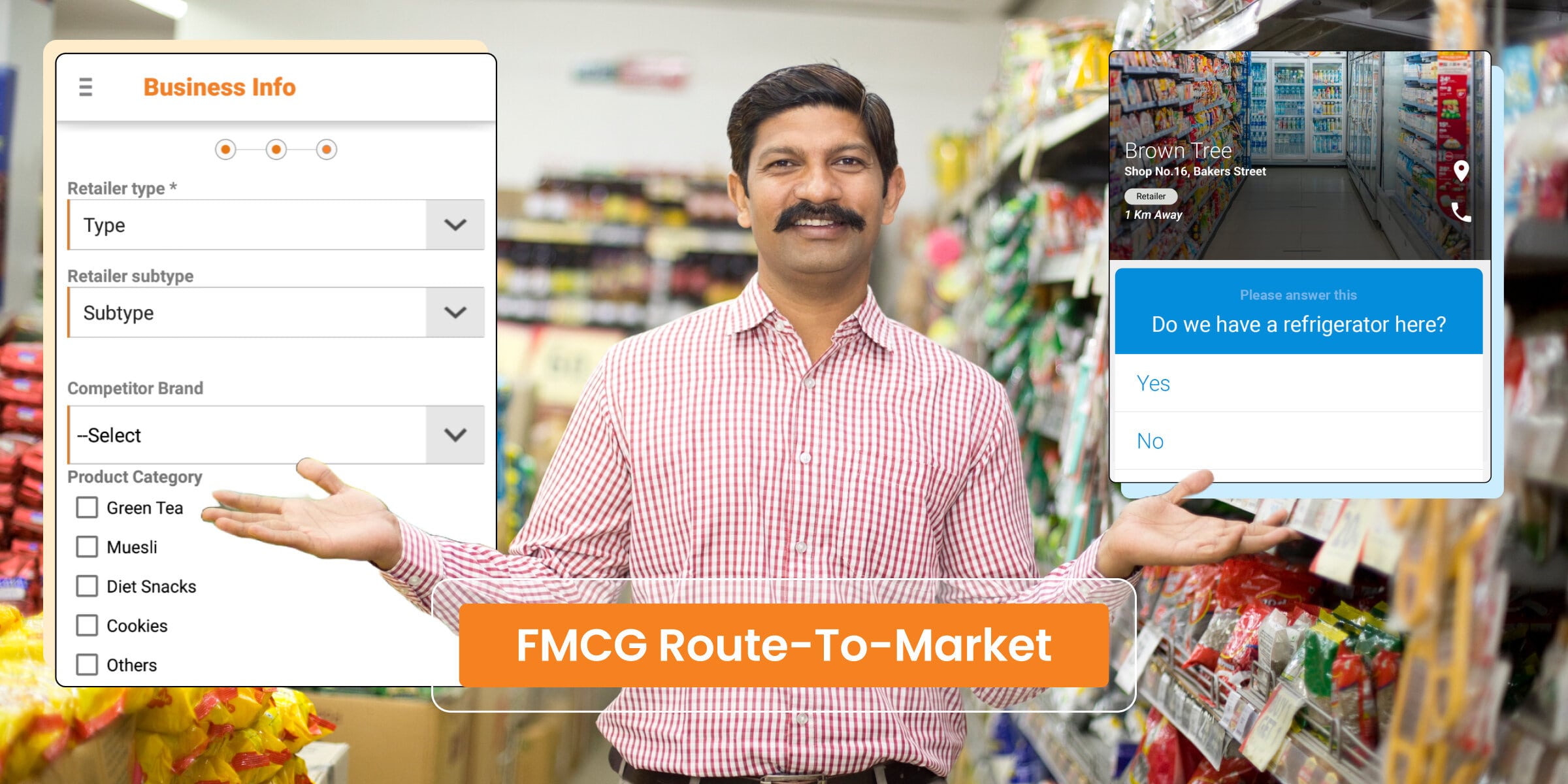
TL;DR This guide is for FMCG sales leaders and distribution heads managing route-to-market execution across sales teams, distributors, and retailers. It maps both automation and behavioural gaps at each layer and shows how BeatRoute’s unified platform grows sales per outlet, reduces cost of serving, and increases offtake.
FMCG route to market breaks down when sales reps, distributors, and retailers work in silos. Reps cannot capture stock or complaints reliably. Distributors cannot self-order. Retailers lose visibility into schemes and sales goals. This article maps the specific automation and behavioural problems at each layer and the system fixes that unify all three on one platform.
There are two issue types to address when solving FMCG route-to-market problems: automation gaps and behavioural gaps.
For an FMCG brand, failure for all stakeholders to converge on sales goals means growth slows and there are limited real-time insights for corrective actions. BeatRoute addresses both gap types by providing a unified, Goal-Driven AI platform that connects sales teams, distributors, and customers on a single system. Brands that prioritise end-to-end collaboration are stronger for it, whether for daily operations or recalibrating for new market developments.
Sales team problems in FMCG route to market
Blind onboarding without store profiling
Store profiling considers location, sales potential, shelf space, and product types sold. Without it, incompatible stores get onboarded. Placing biscuits in a medical store offering only 5% shelf space to non-medical items will not generate volume. Blind onboarding drags down repeat-order rates at scale.
Poor asset management
Assets like electronic displays and visi-coolers are expensive investments that directly support sales. Maintenance requires regular audits and prompt complaint registration. Without a system to capture, assign, and track resolution status, malfunctions persist and competitors fill the gap.
Wrong order baskets per store
Pushing premium SKUs to a kirana store in a middle-class neighbourhood will not work. Retailers know what sells and refuse stock that does not match their customers. Without AI suggesting store-appropriate product combinations and a scheme engine applying the right incentives, orders underperform.
No systematic competitor analysis
If you do not know what competitors are doing with promotions or pricing, you cannot respond. Without a reliable system for in-store audits and efficient workflows for re-strategizing, your schemes and pricing stay less attractive to retailers.
Stock norm violations going undetected
Product turnover in FMCG is high. It is easy to fall below stock norms without realizing until severe understocking occurs. Without systematic stock capture by promoters and sales reps, sudden sales loss follows. Overstocking is equally damaging, as unsold stock erodes retailer trust.
Visual merchandising gaps
Standees, shelf dividers, and planograms get moved or affected. Without a system for product promoters and sales reps to capture discrepancies via photo-based audits, all reporting depends on paper notes or assumptions. Many brands still use third-party agencies for VM audits, which is costly and slow. Getting audits done by your own team already visiting stores is more cost-effective and gives you faster iteration control.
Undertrained product promoters
Product promoters at Modern Trade outlets need product knowledge and motivation. Without regular learning content on their apps and a rewards structure tied to milestones, promoters underperform. They also need a system to capture stock norm deviations and flag product de-listings immediately.
Fragmented HORECA workflows
The HORECA channel (Hotels, Restaurants, and Cafes) requires lead management through onboarding and then switches to relationship management. Most CRM systems meet only one of these requirements. Teams either use two separate tools or leave part of their workflow undigitized.
Managers stuck in a supervisory role
Sales managers monitoring attendance but lacking actionable insights become simple supervisors with no real stake in sales goals. Complicated dashboards that fail to surface underperforming stores or credit issues keep managers from becoming problem solvers.
Solutions to sales team problems
BeatRoute’s Sales Force Automation for FMCG addresses each gap through a unified mobile-first platform.
Make onboarding data-driven
BeatRoute’s onboarding forms let sales reps capture customer profile details (sales potential, region, consumer demographics, shelf space) and send them to the onboarding team for approval. This eliminates assumption-based decisions. Measure reps on stores that place a second or third order, not total onboarding count.
Systemize asset management
Regular audits and prompt complaint registration through BeatRoute’s mobile app, combined with the Integración con Freshdesk via BeatRoute Matrix, give all stakeholders visibility on resolution status. Asset issues detected during merchandising audits are handled systematically.
Use AI for right product combinations
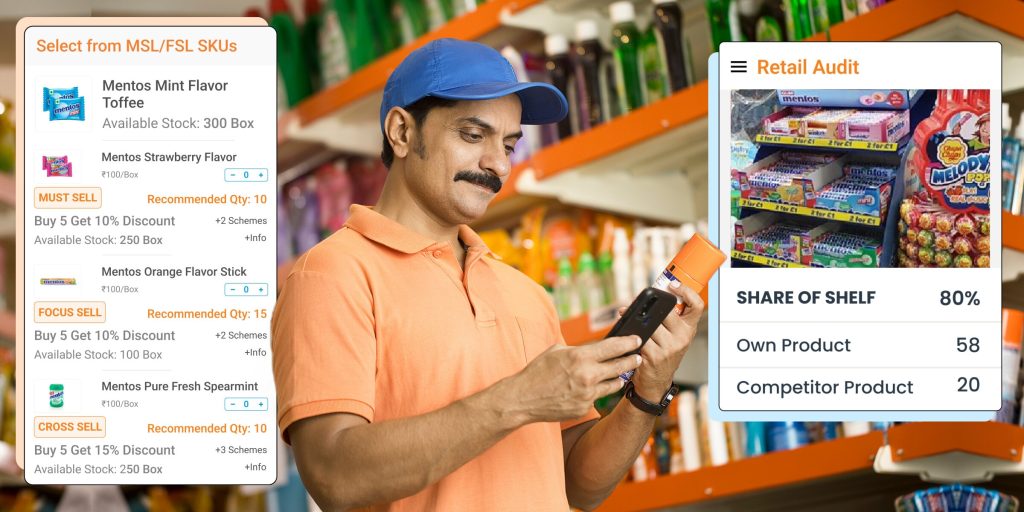
BeatRoute’s Order AI Agent recommends the most tailored order baskets for each customer by analyzing buying trends and store potential. The scheme engine drives cross-sell and upsell at each store. This delivers 4-6% sales uplift from order recommendations alone.
Capture competitor strategies in-store
Sales reps carry out store audits using BeatRoute’s multimedia-capable sales app. They capture competitor pricing, promotions, and shelf positioning via relevant KPIs. Managers and strategy teams receive structured data for timely recalibration.
Automate stock norm alerts
Set a minimum number of units per SKU per store. BeatRoute triggers automatic notifications to the sales team and managers the moment stock drops below the norm. Regular stock reporting in stores without product promoters ensures fast identification and remedy.
Run VM audits with your own team
BeatRoute’s Visual Merchandising & Retail Audits module lets merchandisers, sales reps, and promoters capture shelf images. The VM Audit AI Agent converts these into planogram compliance scores, share of shelf, and competitor benchmarks without pretraining. Audit forms can be modified quickly to keep pace with changing VM campaigns across territories.
Enable product promoters
Regular multimedia learning content on BeatRoute’s app keeps promoters confident. Rewards tied to milestones drive extra effort. The system also supports stock deviation notifications and de-listing flags so promoters contribute to availability, not just tertiary sales.
Unify HORECA workflows
BeatRoute combines lead management and relationship management in one platform. Sales reps manage the entire customer lifecycle from a single app. A co-working mechanism lets reps assign product specialists to demos directly, eliminating phone-call delays.
Turn managers into problem solvers
BeatRoute Copilot analyses data in the background and alerts managers when it detects anomalies. If sales drop at certain stores in a territory, Copilot sends a proactive nudge. Managers correlate slumps with visit frequency and take corrective steps (personal visits, increased rep frequency) rather than parsing raw dashboards.
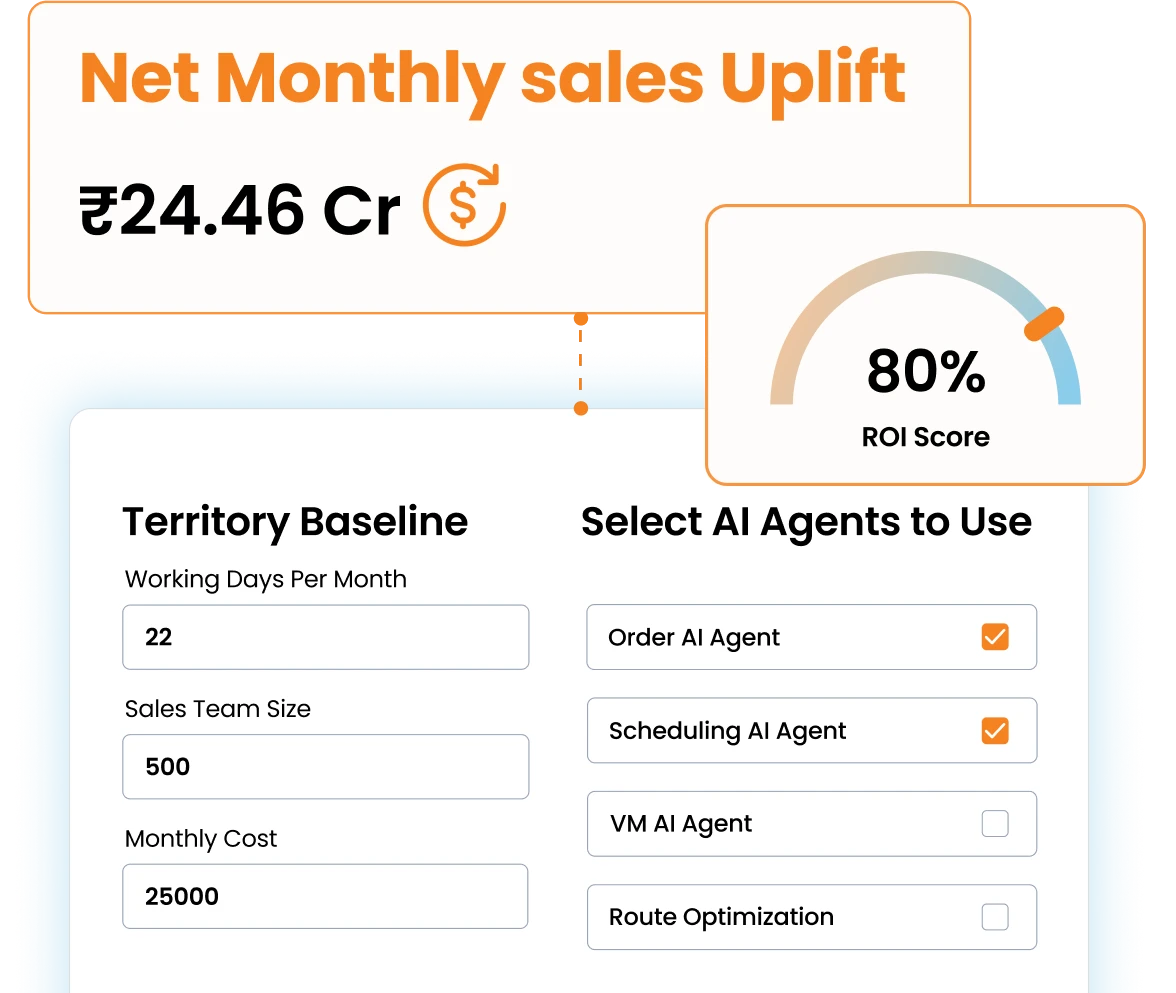
The Scheduling AI Agent further supports managers by prioritizing visits based on sales trends, overdue payments, and territory goals. Productive visits climb from 45% to 78%, with ticket sizes increasing from 1,200 to 1,900.
Distributor problems in FMCG route to market
Unreliable claims process
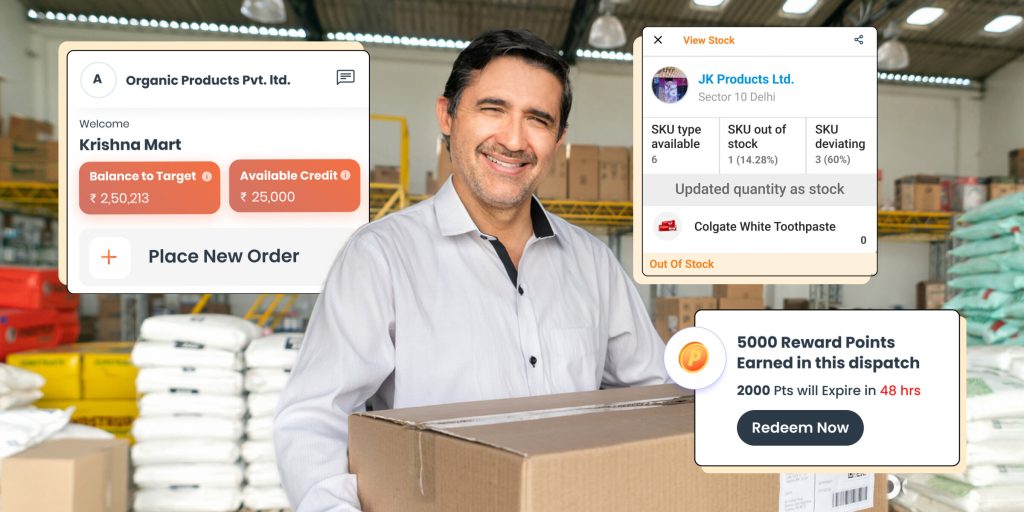
Distributors encounter damaged items, expired products, and chargebacks from retailer-focused promotions. Without a systemized claims workflow, filings get delayed or lost. Distributor dissatisfaction leads to strained relationships and lost sales.
No secondary visibility for brands
Distributors who prefer Tally or their own accounting systems cut brands off from secondary sales data. Without visibility, brands cannot verify invoicing or detect when distributors combine invoice amounts to claim rewards meant for single transactions.
Sales teams lacking distributor insights
When sales teams cannot see a distributor’s stock levels, credit status, or order patterns, they cannot take preemptive action. A distributor may run out of stock and choose a competitor’s products instead of ordering from you.
Distributors without analytical capabilities
Simply having access to data is not enough without the ability to analyze it. Distributors working with simple accounting systems cannot identify underperforming retailers or SKUs. Their role stays limited to logistics when it could be much more valuable.
Inability to self-order
Distributors who see diminishing stock but cannot place orders immediately depend on sales rep visits or phone calls. Both cause delays. Without timely nudges, distributors may not even realize stock is low until it is too late.
Unclear account statements
Distributors refuse to pay dues when confused about past payments. Without clear statements of account showing credit notes, debit notes, and transaction history, time is wasted on reconciliation instead of productive work.
Hidden schemes reducing purchase volume
Distributors need visible, attractive schemes to buy in volume and range. If schemes are not displayed at the point of ordering, primary sales slump regardless of how well the schemes are designed.
Solutions to distributor problems
BeatRoute’s Sistema de gestión de distribuidores addresses each gap with a configurable, multi-device platform.
Streamline claims processing
BeatRoute’s DMS allows claim registration with digital proofs and informs all stakeholders about resolution status. Product returns, chargebacks, and expiry claims flow through automated approval workflows. This builds dependability and keeps distributors engaged.
Gain secondary visibility through integration
Get distributors onto a brand-approved DMS, or integrate with Tally and Busy Plugins to sync invoicing and secondary transactions. BeatRoute Matrix (300+ integrations) ensures real-time secondary visibility without forcing distributors off their preferred systems.
Give sales teams distributor insights
BeatRoute unifies DMS data and the sales app so reps see stock levels, credit status, and order patterns for each distributor. They take preemptive action on impending stockouts or credit issues before they impact primary sales.
Equip distributors with analytical insights
BeatRoute’s DMS not only collects data but develops actionable insights. Distributors identify which SKUs are not selling optimally or which retailers are slumping. They become problem solvers rather than just logistics handlers.
Enable self-ordering via WhatsApp and mobile
BeatRoute nudges distributors to reorder when stock is low and gives them easy access via WhatsApp, Viber, or the mobile app. Distributors check products, see applicable schemes, and place orders independently of sales rep schedules.
Provide clear account statements
BeatRoute’s DMS offers complete visibility of credit and debit notes and statements of account. Configurable invoicing supports local language, specific currencies, and compliance with GST/VAT and statutory requirements. Payment clarity prevents disputes before they arise.
Make schemes visible at the point of ordering
BeatRoute displays all applicable schemes within the ordering interface (WhatsApp, Viber, or app). Distributors see exactly what they gain from each purchase, driving primary sales volume and range.
Retailer and customer problems in FMCG route to market
Retailers not motivated to push your products
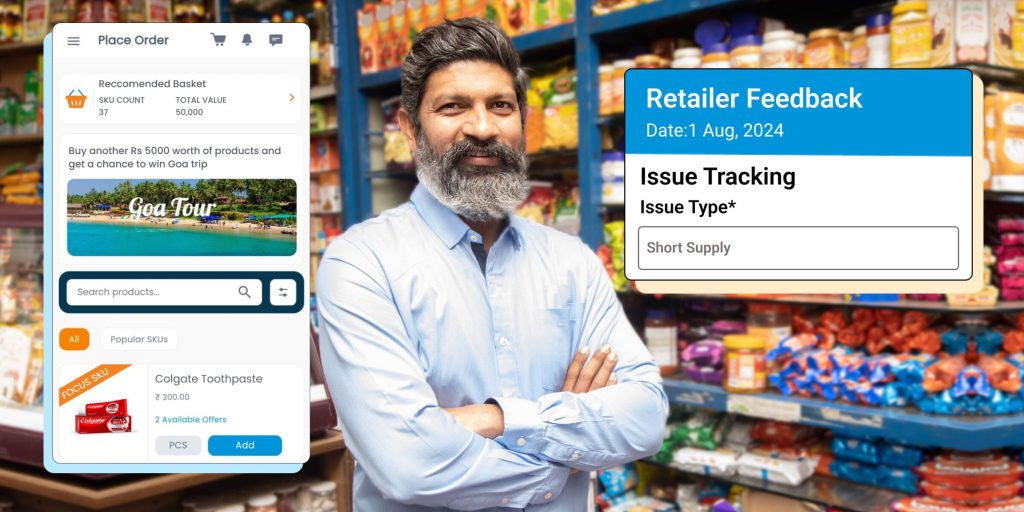
Without a proper rewards system visible on their screens, lucrative schemes for volume and range purchases, and regular product updates, retailers default to pushing a competitor’s more familiar offerings. This applies especially to general trade stores without dedicated product promoters.
Customers unable to self-order
Sales reps follow beat plans and do not visit daily. Between visits, stock depletion or demand spikes create gaps. Without a digital ordering channel, customers depend entirely on rep visits, increasing stockout risk and lost sales.
Inefficient complaints workflow
Without a robust complaint management process, both the customer and the sales rep remain in the dark about resolution status. Customers with no awareness of how their issue is being handled become dissatisfied and reduce repeat purchases.
Solutions to retailer and customer problems
BeatRoute’s Retailer & Influencer App puts ordering, schemes, and complaint management directly in retailers’ hands.
Stimulate purchases with AI and schemes
The Order AI Agent recommends tailored product combinations, and BeatRoute’s scheme engine applies the right incentives at the point of ordering. A structured rewards system incentivises retailers to meet sales targets. The result is uplift in volume, range selling, and tertiary sales.
Set up continuous learning for retailers
BeatRoute’s Retailer & Influencer App uploads regular multimedia learning content. Retailers, incentivised by rewards, become knowledgeable enough to educate consumers on products. This is especially valuable in general trade stores without dedicated promoters.
Enable self-ordering between beat visits
BeatRoute provides self-ordering via the Retailer & Influencer App and WhatsApp with AI-recommended baskets and visible schemes. Retailers order independently whenever stock runs low or demand spikes. This prevents competitor substitution and surfaces upsell opportunities at the moment of order placement.
Systemize complaint registration and escalation
BeatRoute’s complaint workflow captures issues digitally and provides timely status updates to retailers. All customers see transparency into resolution progress. Sales reps can communicate status at any time, preventing dissatisfaction from escalating.
Where FMCG route to market goes next
FMCG distribution is shifting from passive tracking to active execution guidance. The brands that will win are those that connect sales teams, distributors, and retailers under shared goals with AI driving daily decisions. BeatRoute delivers this through Goal-Driven AI, with the Scheduling AI Agent, Order AI Agent, Customer Insights AI Agent, and BeatRoute Copilot all working together to ensure strategy gets executed on the ground.
BeatRoute has helped numerous top brands achieve their route-to-market goals with seamless configurability and functional scalability across 20+ countries.
Learn how BeatRoute can unify your FMCG route to market with a demostración gratuita.
Preguntas más frecuentes
What are the main problems in FMCG route to market?
Problems split into automation and behaviour. Automation gaps include complicated apps, inflexible workflows, and tracking-only systems. Behavioural gaps include sales reps skipping SOP steps, uneven tech adoption across users, and unmotivated promoters. Both layers need addressing together, because fixing only one leaves the other dragging down execution.
Why does blind onboarding hurt FMCG sales?
Onboarding stores without profiling for location, sales potential, shelf space, or product fit places SKUs in incompatible outlets. Measuring sales reps on stores that place a second and third order (not onboarding count alone) fixes the incentive structure and improves repeat-order rates.
How do you get secondary sales visibility from distributors?
Either get distributors onto a brand-approved DMS, or integrate with accounting systems like Tally through BeatRoute’s Tally and Busy Plugins. Real-time sync gives brands accurate sell-through numbers and removes room for disputed claims or combined-invoice manipulation.
How can retailers self-order without waiting for sales reps?
Give retailers BeatRoute’s Retailer & Influencer App or WhatsApp-based ordering with AI-recommended baskets and visible schemes. This handles sudden stock depletion between beat-plan visits, prevents competitor substitution, and surfaces cross-sell options at the moment of order placement.
What role do sales managers play beyond supervision?
With BeatRoute Copilot providing proactive nudges on underperforming stores, credit issues, or degrowing routes, managers become problem solvers instead of attendance supervisors. They correlate slumps with visit frequency and act on real insights rather than parsing raw dashboards for patterns.