Nikhil Chaudhary
Most field sales app projects fail for the same reason: the buying decision optimises for features, not for the business goals the tool is supposed to move. Reps log in, data flows, dashboards exist — and the sales numbers do not budge. A good evaluation starts the other way around.
For brands evaluating options, BeatRoute combines SFA with DMS, Goal-Driven AI, and trade promotion workflows to serve both brands and distributors.
This article walks through six concrete checks to run before signing on a aplicación de ventas sobre el terreno: goal fit, expected output, ROI, configurability, ease of use, and real-world user reviews.
Key takeaways
- Start with the business goals the tool must move — not with a feature checklist — or you will end up with an automated version of your old problems.
- Evaluate expected impact on field output: visit adherence, order size, customer coverage, and revenue from priority stores.
- ROI should factor in subscription, setup, deployment timeline, and the opportunity cost of a slow rollout.
- A zero-code, configurable platform shortens deployment from months to weeks and adapts as processes change.
- BeatRoute is the only SFA-DMS built to execute your sales goals, with configurability and a rep-friendly UI that survive past pilot.
1) Key business goals and growth levers
A successful field sales app deployment starts with defining the company”s goals and growth levers, and checking whether the tool actually moves them. Typical goals FMCG and CPG buyers consider:
- Streamline sales processes end to end
- Increase sales per outlet and per rep
- Expand into new markets and segments
- Reduce cost to service territories
- Better utilise available manpower and financial resources
- Grow sales across general trade, modern trade, and B2B
The test is not whether the tool automates. It is whether each feature ties back to one of these goals on the ground.
2) Expected impact on field sales team output
Buyers usually have a checklist of functionality — intelligent store profiling, order capture, VM audit, lead management, route optimisation — tuned to GT, MT, or B2B/HoReCa needs. Weight that list by impact, not count. An app that creates rigour around achieving company goals on the ground beats a feature-rich app with no visible impact on sales.
3) Return on investment analysis
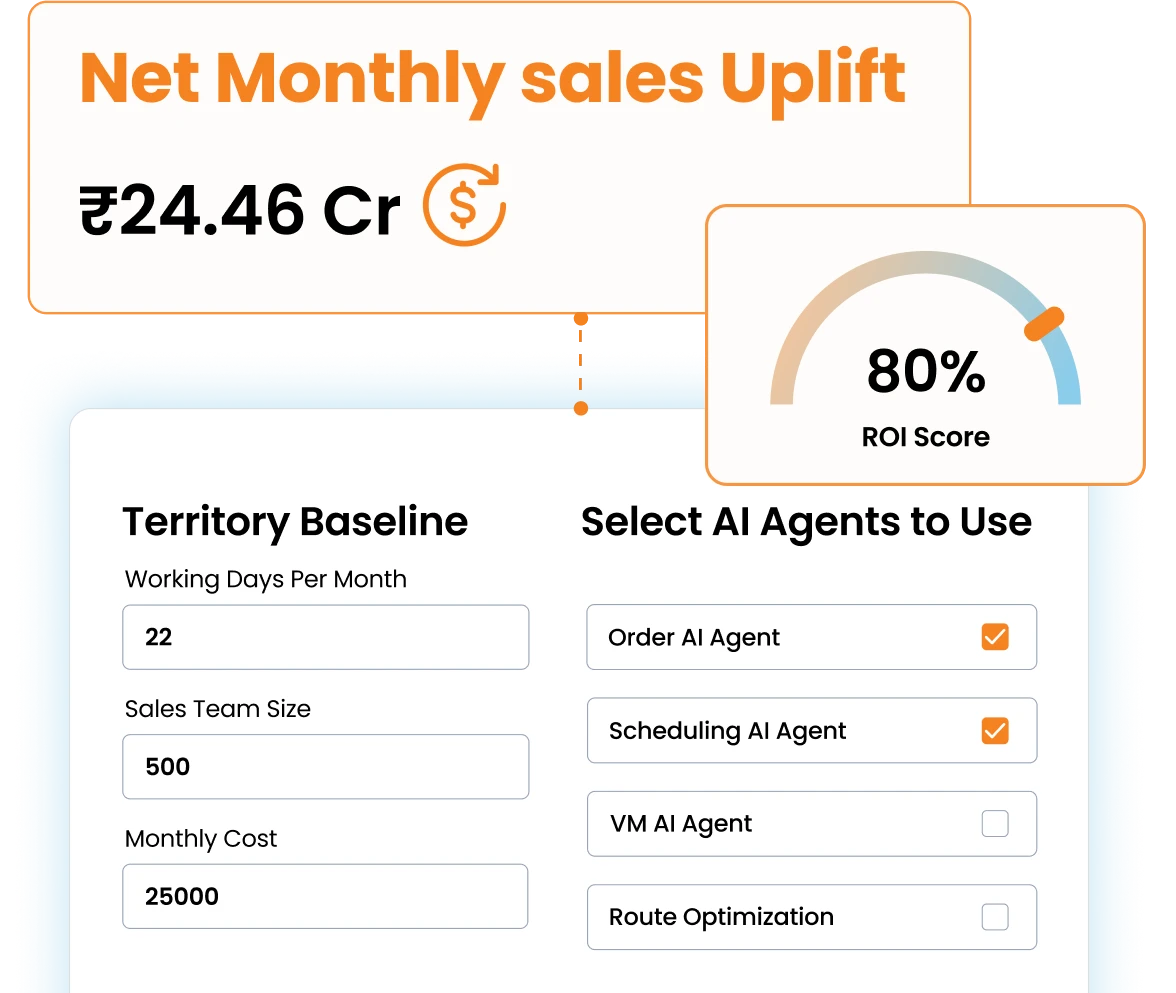
Rather than automating blindly, a leader should compare expected ROI against business impact and the timeline to realise it. Model the uplift in sales, the reduction in cost, and the efficiency gain — and be honest about how many cycles it will take to show. An app that promises everything but delivers in twelve months has a different value than one delivering partial gains in six weeks.
4) Configurabilidad de la herramienta
Processes change. A configurable tool absorbs change without a new development cycle every quarter. A field sales app that needs custom code drags on six months of deployment and another round every time a process shifts. A zero-code platform like BeatRoute can be rolled out in weeks and adjusted by the business team as the go-to-market evolves.
5) Ease of usability of the field sales app
Adoption is where most SFA projects quietly stall. Studies consistently show only 50–60% of reps use the full feature set, and companies lose productivity to workarounds and half-used modules. A robust, intuitive app raises adoption, which is what actually drives the business impact the ROI model assumed.
6) Consider real-world user reviews
Ratings and reviews on public app stores and software review sites are not just noise. Look at how sales executives at comparable FMCG companies describe the daily experience — offline reliability, sync speed, form complexity, nudges that actually help. That tells you more about the usability than any sales demo will.
Deploying a field sales app purely for automation — without hitching it to business goals — is not a successful project. In a competitive market, the gap between a growing FMCG company and an average one is narrow, and the choice of field sales app is one of the levers that widens it.
BeatRoute is an SFA-DMS built with Goal-Driven AI: the platform puts your business goals first, then ensures those goals get executed on the ground month after month. It is configurable without coding, ships on Android and iOS, and is designed so adoption sticks beyond the pilot.
Reservar una demostración to see how BeatRoute uses Goal-Driven AI to ensure your field sales goals get executed.
Preguntas frecuentes
How do I analyse the returns on a field sales app?
Compare expected revenue and efficiency gains against all-in investment — subscription, setup, integration, internal project team, and opportunity cost of a long rollout. Model uplift per outlet, per rep, and per territory across the first 2–4 cycles. An honest ROI model accounts for timelines, not just the eventual steady-state impact.
How do I define goals in a field sales app?
Pick goals that serve the long-term vision, not quarterly fixes. Common examples: increase sales per outlet, per rep, or per territory; improve visit adherence on priority stores; grow order size through the right cross-sell; cut cost-to-serve. Each goal should translate into a specific KPI the app actually measures and influences daily.
How do I judge the configurability of a field sales app?
A configurable field sales app is zero-code: business teams add or change processes without developer involvement. Ask to configure a new workflow live during evaluation — a new form, a new role, a new KPI. If it takes engineering tickets to do that, you will pay for every change for the life of the contract.
What questions should I ask before implementing a field sales app?
Three that cut through most demos: Can it capture real-time information at the point of visit, including offline? How quickly can a new process be added to the system by a non-developer? And how fast does collaboration between reps, managers, and distributors actually happen inside the platform?