Sistema de gestión de distribuidores para Nigeria y otros mercados africanos
 Soham Chakraborty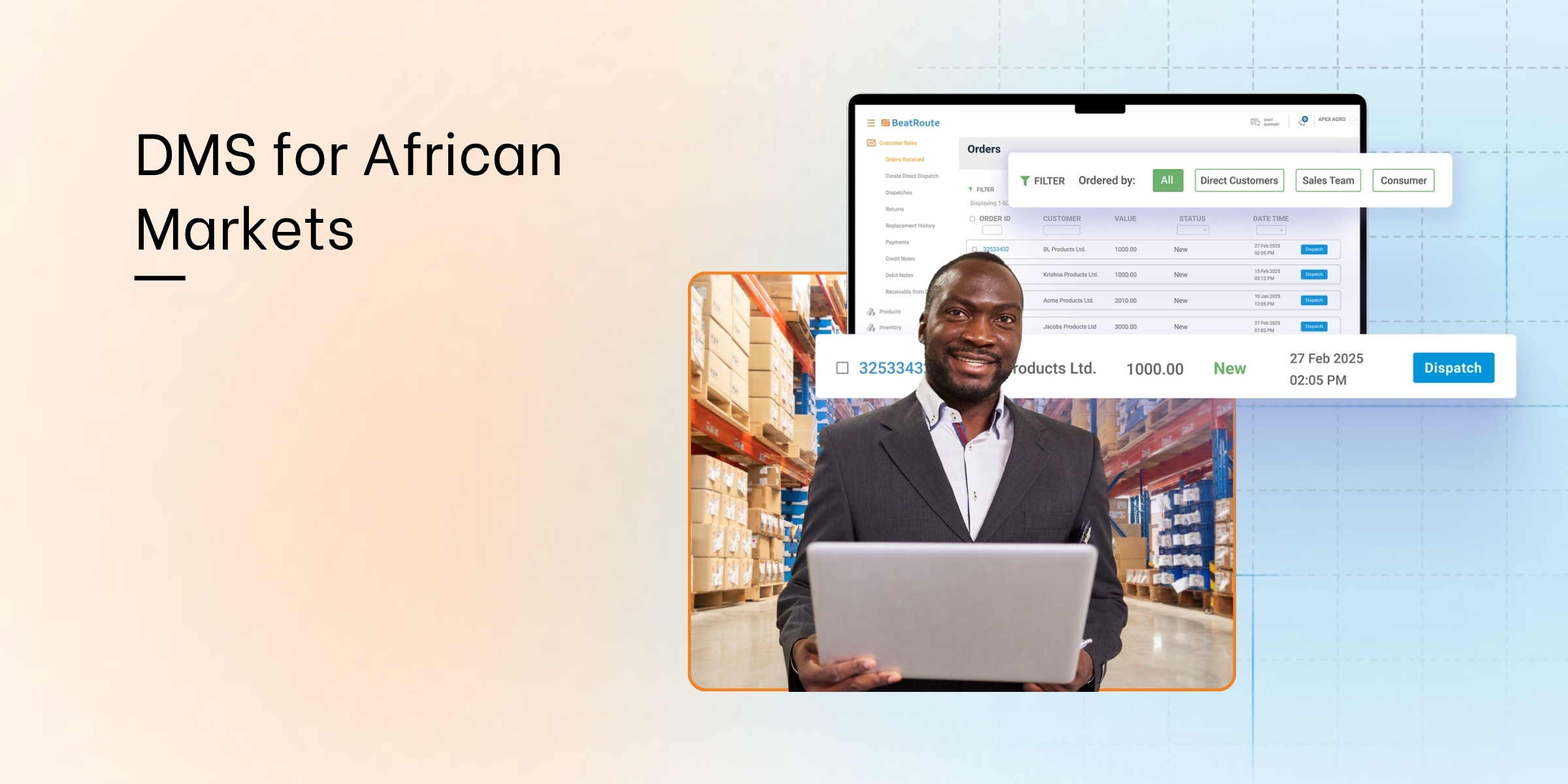
Table of Content
TL;DR Distribution and supply chain leaders in Nigeria, Kenya, Ghana, and South Africa need a DMS that covers both primary and secondary sales on one platform. BeatRoute connects brands, distributors, and retailers with Goal-Driven AI, WhatsApp ordering, and Tally and Busy Plugins integration.
African FMCG brands need a distributor management system that covers both primary sales (brand to distributor) and secondary sales (distributor to retailer) on one platform. Distribution networks across Nigeria, Kenya, Ghana, and South Africa are fragmented, and traditional trade drives most volume. BeatRoute’s DMS connects brands, distributors, and retailers with Goal-Driven AI, WhatsApp ordering, and Tally and Busy Plugins integration. AAVA Brands (Nigeria) recorded 30% higher sales productivity after adoption.
What is a distributor management system
A distributor management system (DMS) is software that manages the flow of orders, stock, claims, and payments between a brand, its distributors, and the retailers they serve. A complete DMS has two parts that work together.
Primary DMS covers the brand-to-distributor transaction. Distributors place orders, raise claims, track credit notes, and view schemes on their own. This reduces dependency on sales reps and prevents stockouts caused by delayed rep visits.
Secondary DMS covers the distributor-to-retailer transaction. It captures secondary invoicing, stock movement at distributor warehouses, and retailer-level offtake. Without visibility into this leg, brands cannot see what is actually moving at the store level.
Most DMS vendors sell only one half, which leaves a gap in your ruta al mercado. A distributor management system built for Africa needs both, because the continent’s distributor networks are large, fragmented, and directly tied to retail availability. BeatRoute is the only SFA-DMS that covers both on one platform.
Distribution challenges in African markets
African distribution has specific pain points that generic distributor management software was not designed to handle. Understanding these challenges helps you evaluate what your DMS must deliver.
No secondary sales visibility. Without visibility into the distributor-to-retailer leg, brands cannot see what is selling at store level. That means missed signals on slow-moving SKUs, wrong trade schemes, and stockouts that nobody catches in time. BeatRoute’s secondary DMS captures this data and surfaces it to brand managers in real time.
Weak claims process. Distributors across Africa often deal with damaged or expired products and chargebacks from retailer promotions. Paper-based claims get lost, and distributors lose trust in the brand. BeatRoute’s DMS includes a digital claims workflow that tracks each claim from filing to settlement.
Unclear payments. Without a digital statement of account and credit or debit notes, distributors stay in the dark about their credit position. Paper statements get misplaced or delayed. BeatRoute provides digital payment transparency that prevents most of these disputes.
Rigid, hard-to-scale software. Business strategies change often. A rigid DMS forces you to rebuild the application every time you add a new scheme, a new region, or a new channel. BeatRoute’s configurable Brand Panel lets you adapt dashboards and workflows without re-development.
No self-service for distributors. When a distributor runs low on stock and the next rep visit is days away, the result is a stockout at retail. BeatRoute enables distributor self-ordering through WhatsApp or Viber, closing that gap without adding rep visits.
Fragmented distributor networks. Africa’s distribution is highly fragmented, with many small, independent wholesalers and retailers. That fragmentation causes delays, stock confusion, and uneven coverage. A distributor management system pulls real-time inventory and sales data into one view so brands can act on it.
Training gaps. Distributor staff in many African markets have limited exposure to complex software. BeatRoute’s simple, mobile-first interface and WhatsApp-based ordering reduce the learning curve so distributors adopt the system faster.
Benefits of a DMS in African markets
A distributor management system is a powerful tool to manage promotions, inventory, and invoicing. The benefit multiplies when primary and secondary sales live on one platform. Here is what a complete DMS should deliver for African brands.
- Primary enablement. Distributors place their own orders, view schemes, and raise claims through WhatsApp, Viber, or a dealer interface. This reduces dependency on sales reps and prevents stockouts.
- Secondary visibility. Brands see what is selling at retail, which SKUs need push, and where to recalibrate trade schemes.
- Integración con SFA and the Retailer & Influencer App. When SFA, DMS, and the retailer app are connected, retailer orders flow straight to the distributor without phone calls. BeatRoute connects all three on one platform.
- Payment transparency. Digital statements of account and credit or debit notes keep every stakeholder on the same page. Payment collection has improved from 72% to 91% in reported deployments.
- Analytics for distributors. Distributors who see their own performance data move from logistics to problem solving. They identify low-performing retailers and SKUs, and act on them.
- Claims management. A digital workflow for returns, damages, and chargebacks builds distributor trust and prevents revenue leakage.
The Order AI Agent inside BeatRoute recommends replenishment SKUs and new lines to distributors based on their sales history, driving 4 to 6% uplift on the orders it influences. BeatRoute Copilot lets managers and distributors ask natural-language questions about stock, claims, and performance in local languages.
Key features of BeatRoute’s distributor management system
Primary sales management
Distributors place orders directly through BeatRoute’s dealer interface, WhatsApp, or Viber. They view available schemes, track order status, and raise claims without waiting for a rep visit. Credit limits and payment terms are managed digitally, reducing default risk. BeatRoute integrates with Tally and Busy Plugins so invoices, credit notes, and statements of account stay aligned between distributor accounting and brand sales data.
Secondary sales and billing
BeatRoute’s DMS captures secondary invoicing and stock movement at distributor warehouses. Brands see retailer-level offtake and can monitor secondary sales at SKU level to identify top performers and those needing more support. This visibility is what separates brands that react from brands that lead their categories in African markets.
Scheme and promotion automation
Trade promotions and discounts are automated for consistency across distributors. Distributors see up-to-date information on current schemes, so they maximize benefits and pass the right offers to retailers. This removes the guesswork that often leads to scheme non-compliance.
Reporting and analytics
BeatRoute tracks sales performance across distributors and regions, giving insight into trends and distributor effectiveness. The configurable Brand Panel supports custom dashboards with drill-down, filtering, and sorting. BeatRoute Copiloto answers natural-language queries and sends proactive nudges when accounts slip or schemes are underutilized.
Accounting and ERP integration
BeatRoute supports Tally and Busy Plugins out of the box. BeatRoute Matrix adds 300+ enterprise connections to your existing stack, covering ERP, accounting, and analytics platforms. This means your distributor management system fits into your technology ecosystem without custom development.
Get a free demo of BeatRoute’s DMS to see how it fits your African distribution network.
Why BeatRoute for distributor management in Africa
BeatRoute is the only SFA-DMS built to execute your sales goals. Goal-Driven AI guides every rep and channel partner toward the outcomes your goals define. The DMS covers both halves of distribution on one platform and connects to the aplicación de ventas sobre el terreno and Retailer & Influencer App for end-to-end visibility from brand HQ to retail shelf.
African FMCG brands including AAVA Brands (Nigeria), BUA Foods, and Dangote Cement use BeatRoute to tie brand, distributor, and retailer activity into one Goal-Driven system. AAVA Brands recorded 30% higher sales productivity after moving to BeatRoute. Across its customer base, BeatRoute delivers a 12.6% average sales uplift in the first year, serving 200+ customers in 20+ countries.
You get better stock keeping, timely ordering, product awareness, effective claims handling, and a clearer view of offtake. That means faster product movement and stronger market presence across Nigeria and the wider African market.
Where distributor management in Africa goes next
As African FMCG markets grow, distributor networks will expand and fragment further. Brands that invest in a connected distributor management system now will build the data foundation needed for AI-powered demand planning, automated replenishment, and predictive claims management. The next wave of distributor enablement will combine voice ordering through the TeleOrder AI Agent, proactive stock alerts from BeatRoute Copilot, and deeper WhatsApp integration for distributors who are mobile-first.
BeatRoute’s Goal-Driven platform positions your distribution network to scale with your ambitions, not against them.
Preguntas más frecuentes
What is a distributor management system?
A distributor management system (DMS) is software that manages the flow of orders, stock, claims, and payments between a brand, its distributors, and retailers. In African markets like Nigeria, Kenya, and Ghana, both the brand-to-distributor and distributor-to-retailer legs matter because traditional trade dominates retail and distributor networks are fragmented.
What is the difference between primary DMS and secondary DMS?
Primary DMS covers the transaction between a brand and its distributors, including ordering, claims, and schemes. Secondary DMS covers the transaction between distributors and retailers, including invoicing and stock movement. Most vendors sell only one half. BeatRoute covers both on one platform.
How does a DMS solve fragmented distribution in Africa?
A DMS pulls real-time inventory, sales, and claims data into one view. Distributors self-order through WhatsApp or Viber when stock runs low. Brands see which SKUs move where and adjust schemes and coverage accordingly. BeatRoute prevents stockouts and closes coverage gaps in rural and peri-urban areas.
Does BeatRoute’s DMS integrate with Tally and Busy?
Yes. BeatRoute’s DMS integrates with both Tally and Busy Plugins, which are the accounting systems commonly used by distributors. The integration syncs invoices, credit notes, and statements of account so that distributor finance and brand sales data stay aligned. BeatRoute Matrix adds 300+ additional enterprise connections.
What makes BeatRoute different from other DMS vendors in Africa?
BeatRoute is the only SFA-DMS built to execute your sales goals. Goal-Driven AI guides every rep and channel partner toward defined outcomes. The DMS covers both halves of distribution on one platform and connects to the field sales app and Retailer & Influencer App. Distributors order through WhatsApp or Viber, which lowers the training barrier in African markets.