Nikhil Chaudhary
TL;DR This guide is for leaders planning a sales force automation rollout. It covers goal-setting, ROI measurement, tool evaluation, and the adoption strategies that separate SFA projects delivering 12.6% sales uplift from those that get shelved.
A successful automatización de la fuerza de ventas project starts with business goals, not software features. Leaders who tie every configuration choice to a specific sales outcome, align field teams through change management, and roll the tool out in clear phases see measurable lift in sales per rep, sales per outlet, and territory coverage.
Most SFA projects fail because the implementation treats automation as the goal rather than the means. Research shows SFA can lead to a 30% increase in deal closures, an 18% reduction in the sales cycle, and a 14% reduction in sales administration time. Those numbers only materialize when the project is built around outcomes, not features.
Why most SFA projects fail before they start
SFA failure usually begins with the buying decision. Teams select platforms based on feature checklists, demo impressions, or price alone. BeatRoute’s experience across 200+ enterprise deployments shows that the failure pattern is consistent: leaders skip goal definition, underestimate change management, and measure success by digitization milestones rather than sales impact.
The result is a tool that field reps see as extra work rather than a productivity multiplier. Adoption drops below 50%, data quality suffers, and the project stalls within the first quarter. The fix starts well before software selection, with clear business goals tied to measurable sales outcomes.
Set business goals before choosing SFA features
Defining business goals is the first step for a successful SFA project. Typical goals for FMCG and consumer goods companies include:
- Increasing sales per outlet
- Increasing sales per rep
- Expanding coverage in specific territories
- Improving manpower and resource utilization
- Growing sales across general trade, modern trade, and HoReCa channels

BeatRoute’s Goal-Driven approach builds on this principle. Instead of offering a generic feature set, the platform ties every workflow to your stated sales objectives. A rollout that digitizes forms but does not lift sales per outlet has missed the point. Features serve goals, not the other way around.
How to measure ROI on your SFA project
Measure ROI on business impact, not on how much of the workflow you have digitized. Business impact means the effect on sales, based on the goals you set and the timelines you committed to.
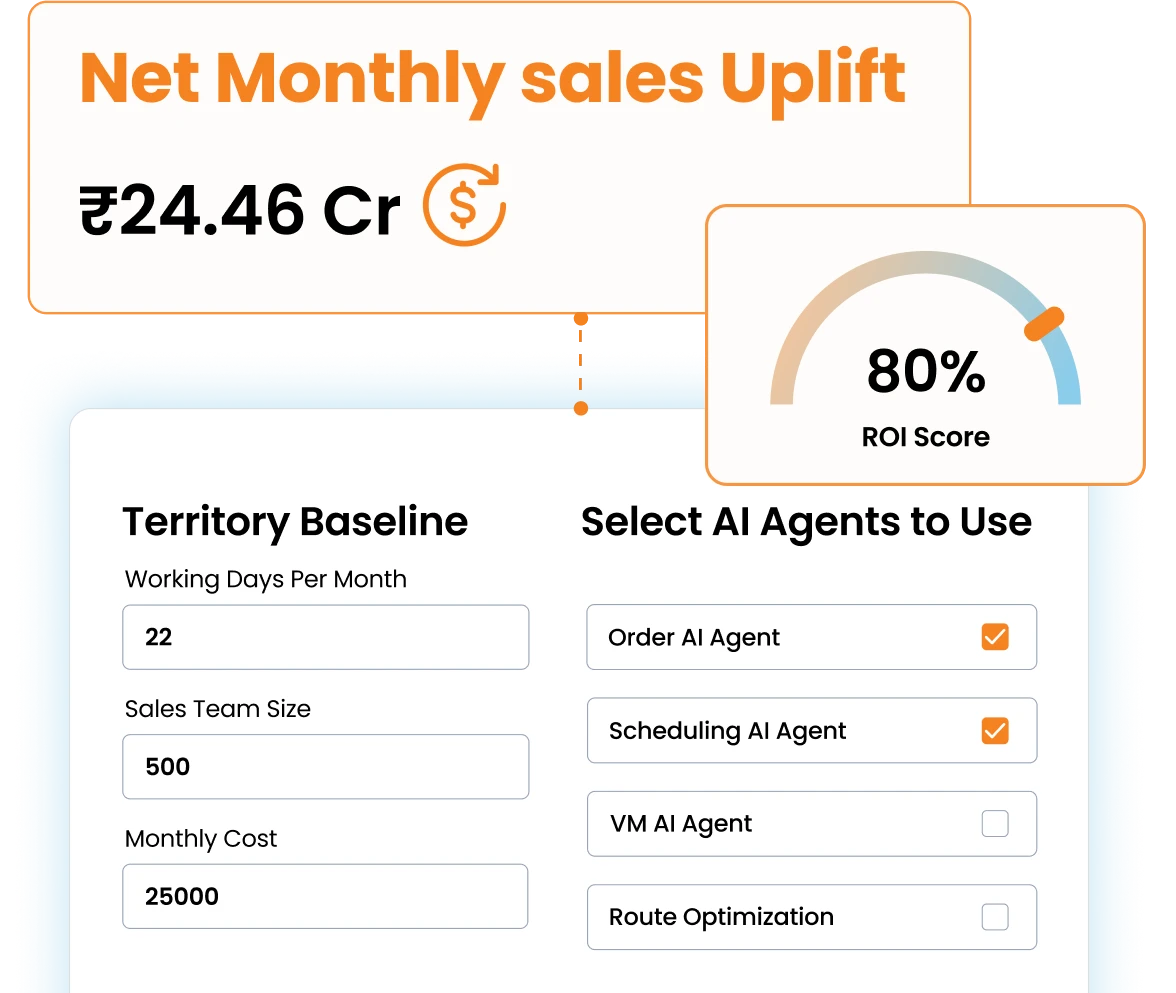
Start by quantifying expected sales uplift, cost reduction, and efficiency gains. Then compare that impact against your total investment: subscription charges, setup costs, and the IT and admin resources needed to run the project. BeatRoute customers see an average 12.6% sales uplift in the first year, with 7 to 10X ROI on the Business Pack and 10 to 16X ROI on Enterprise.
| Métrica | What to measure | Target benchmark |
|---|---|---|
| Sales uplift | Revenue increase from SFA-enabled outlets | 10 to 15% in year one |
| Rep productivity | Sales per rep per month | 20 to 30% improvement |
| Adoption rate | Percentage of reps using SFA daily | Above 80% |
| Time to value | Weeks from go-live to first measurable impact | 4 to 8 weeks |
Why configurability makes or breaks SFA adoption
If the SFA tool is easily configurable, your team will not burn resources rebuilding the software for each new workflow. Turnaround time for changes stays short, and business returns arrive sooner.
An SFA tool that needs heavy customization and coding takes months to deploy. Every week spent in custom development is a week you are not generating returns. BeatRoute’s zero-code platform lets business users configure workflows, KPIs, and dashboards without IT involvement. Most brands go live within 4 to 6 weeks because configuration replaces custom development.
How ease of use drives field team adoption
Research shows that only 50 to 60% of sales reps use their SFA tool on any given day. That gap directly hurts company productivity. If the tool is easy to use, more reps use it consistently, and the productivity gap closes.
Adoption is a change management problem as much as a product problem. Train field teams in short cycles, collect feedback from reps and distributors, and phase the rollout by region or channel so early wins build confidence. BeatRoute supports this with an intuitive mobile-first interface, local language support, and the Scheduling AI Agent that eliminates manual visit planning so reps spend time selling instead of navigating software.
Why app reliability matters for daily field use
The SFA tool must run with minimal bugs and errors in daily use. Common problems like network crashes or app failures destroy field team trust in the platform. BeatRoute maintains a 4.6-star rating on the Google Play Store and delivers 99% resolution rate, 92% SLA adherence, and 96% CSAT, which is 18 points above the industry average.
Field reps work in environments with inconsistent connectivity, limited device storage, and long working hours. BeatRoute’s offline-first architecture ensures all core functions work without an internet connection. Data syncs automatically when connectivity returns, so managers maintain full visibility without gaps.
How to evaluate SFA tools using real user reviews
Check how sales executives at other companies rate and review the tool on the Google Play Store. Reviews give you a fair idea of real-world usability before you sign a contract. Look specifically for feedback on offline reliability, battery consumption, and daily-use experience from field reps.
Beyond reviews, request customer references from the vendor in your industry and geography. BeatRoute operates across 20+ countries with 200+ enterprise customers including Perfetti, BUA Foods, and Valvoline. Asking existing customers about adoption rates and sales impact gives you ground truth that demos cannot provide.
How does BeatRoute turn SFA projects into measurable sales outcomes?
BeatRoute is the only SFA built to execute your sales goals. Traditional SFAs give you data. BeatRoute uses Goal-Driven AI to ensure your sales strategy gets executed by your sales team and channel partners.
| BeatRoute capability | What it does | Measurable outcome |
|---|---|---|
| Scheduling AI Agent | Ranks daily stops by business signal for field reps | Productive visits: 45% to 78% |
| Order AI Agent | Recommends replenishment and new SKUs per outlet | 4-6% sales uplift |
| BeatRoute Copiloto | Natural language queries on coverage, adherence, and performance | Faster decision cycles for managers |
| VM Audit AI Agent | Converts shelf photos into planogram compliance scores | Same-day audit results without pretraining |
The Order AI Agent recommends replenishment and new SKUs at every visit, typically driving 4 to 6% sales uplift on its own. The Scheduling AI Agent increased productive visits from 45% to 78% across BeatRoute’s customer base. The VM Audit AI Agent scores shelf photos for share of shelf and planogram compliance without pretraining. BeatRoute Copilot lets managers ask natural-language questions about territory performance and get answers in seconds.
The platform ships with 300+ enterprise integrations via Matriz BeatRoute, connects to Tally and Busy Plugins for accounting systems, and supports the Retailer & Influencer App for eB2B ordering.
Reserve una demostración gratuita and see how Goal-Driven AI turns your SFA project into measurable sales outcomes.
Preguntas más frecuentes
What makes an SFA project successful?
An SFA project succeeds when it delivers measurable sales outcomes, not just digitized workflows. Success depends on clearly defined business goals, a configurable tool that fits your trade structure, and strong field team adoption. BeatRoute’s Goal-Driven approach ties every rollout directly to sales uplift targets.
How do you measure ROI on a sales force automation project?
Measure ROI on business impact, not digitization milestones. Quantify expected sales uplift, cost reduction, and efficiency gains, then compare against total investment. BeatRoute customers see an average 12.6% sales uplift in year one, with 7 to 10X ROI on the Business Pack.
Why do most SFA projects fail?
Most SFA projects fail because leaders focus on features instead of outcomes. Low rep adoption, heavy customization costs, and tools that do not align with sales goals are the top causes. Phased rollout, change management, and a configurable platform prevent these failures.
How long does an SFA implementation take?
Timelines depend on configurability. A tool that needs heavy custom coding can take six months or more. A configurable platform like BeatRoute can go live in 4 to 6 weeks, with phased deployment across regions so early wins build confidence before the full rollout.
What SFA features matter most for FMCG companies?
The features that matter are the ones tied to your sales goals: configurable order capture, territory and beat planning, retail audits, and AI that recommends the next best action at every visit. BeatRoute bundles these with Goal-Driven AI so every visit moves the rep toward defined commercial outcomes.