Why Generic AI Fails in Retail Distribution and How Goal-Driven AI Succeeds
 Soham Chakraborty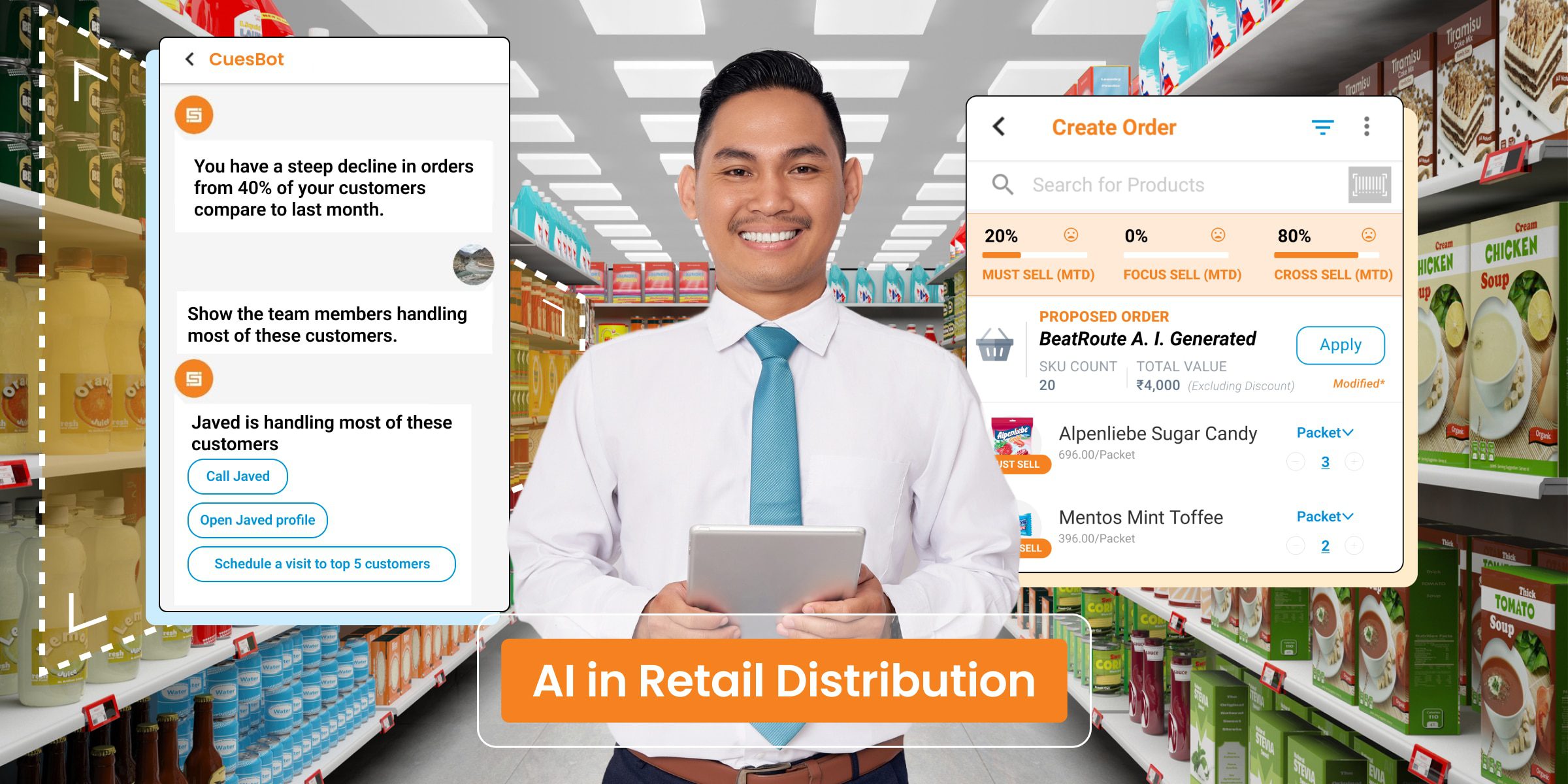
Table of Content
TL;DR This article is for sales leaders and distribution heads evaluating AI for retail execution. Generic AI lacks the industry context to drive field actions. Goal-Driven AI from BeatRoute translates sales goals into rep-level prompts, delivering 12.6% average sales uplift in year one.
Generic AI fails in retail distribution because it cannot translate company sales goals into the specific, daily actions a rep or channel partner must take in the field. It offers surface-level analysis trained on public data, so it misses the industry context that drives execution: beat plans, share of shelf, visit frequency, secondary schemes, and distributor claims.
A specialized, Goal-Driven AI system solves this by starting from the outcome your brand needs and working backward to rep-level prompts. BeatRoute is the only SFA-DMS built to execute your sales goals, and its Goal-Driven AI ensures every rep and channel partner stays aligned with the outcomes your goals define.
This article explains why generic AI falls short for retail distribution, what a purpose-built alternative looks like, and how brands use it to fix execution gaps across ordering, visit planning, shelf audits, and demand forecasting.
Why generic AI falls short in retail distribution
Consider a retail store that has not ordered from you for longer than usual based on its historical pattern and sales potential. Something has gone wrong, but your visit schedule does not send a rep there for another week.
A generic AI does not flag this as a problem. It was not trained on how retail coverage works, so it treats the gap as noise. Your reps keep working from intuition and the field keeps leaking revenue.
The FMCG industry runs on fixed beat plans. The building materials industry sets visit frequencies but leaves the actual call pattern to rep discretion. BeatRoute recognizes this difference and gives industry-appropriate recommendations. Its Scheduling AI Agent prioritizes high-impact stores based on payment status, sales decline, and territory goals, so reps reach the right outlets before revenue slips further.
Generic AI vs specialized retail AI
The table below contrasts off-the-shelf AI with a system built for retail sales and distribution.
| AI Generik | Specialized retail AI (BeatRoute) |
|---|---|
| Offers surface-level answers without deep understanding of distribution challenges, so it needs heavy customization to be useful. | Built for retail distribution from day one: territory design, order capture, inventory visibility, and rep productivity. |
| Lacks the vocabulary of retail: face count, share of shelf, planogram compliance, competitor SKUs. | Audits shelves from photos, scores share of shelf, flags planogram non-compliance, and benchmarks competitor presence. |
| One-size-fits-all approach that ignores vertical nuance. | Tuned to FMCG, AlcoBev, building materials, pharma, agri-inputs, and other retail verticals. |
| Calculates the shortest path from point A to point B. | Prioritizes stores using sales performance, visit frequency, outstanding payments, and order patterns. |
| Requires ongoing setup, prompts, and retraining to perform any real task. | Ships ready to use for retail teams and connects to SFA, DMS, and the Retailer & Influencer App. |
| Presents data but not the next action. | Recommends the next order, the next visit, and the next intervention. |
| Gets more expensive as you try to bend it to your industry. | Cost-effective because it is pre-configured for retail sales and distribution. |
Where specialized AI drives real execution
AI is one tool in your route-to-market strategy, not the whole strategy. To drive impact, your AI must be configured for your brand, your industry, and your goals, and it must produce next actions rather than dashboards. A sales team still handles the relationships, conversations, and negotiations that move volume. BeatRoute’s AI handles the decision support that makes every field hour count.
- Ordering. A successful rep visit pushes products that fit a store’s purchase trend and sales capacity. Memory and intuition cannot carry store-specific combinations across dozens of outlets a day. The Order AI Agent recommends order baskets using past purchases plus what similar retailers in the same area are buying, contributing 4 to 6% sales uplift on its own.
- Analytics and manager queries. Sales managers need immediate answers on store issues, decline patterns, and coverage gaps without waiting for a dashboard build. BeatRoute Copilot answers natural-language queries from reps and managers in multiple languages and sends proactive nudges when an account slips.
- Visit planning. In building materials, consumer durables, and many manager workflows, visit plans are not fixed. The Scheduling AI Agent prioritizes high-impact visits using pending payments, sales decline, territory goals, and customer context, lifting productive visits from 45% to 78% in reported deployments.
- Demand forecasting. Historical sales data, seasonality, and territory trends combine to predict what to stock and when. BeatRoute factors in distributor cycles and promotion periods, not just aggregate retail patterns.
- In-store auditing. The VM Audit AI Agent scores shelf photos for share of shelf, planogram compliance, and face count across your brand and your competitors. You get reliable audit data at a lower cost and without pretraining.
How does BeatRoute execute retail distribution goals?
Traditional SFAs give you just data. BeatRoute uses Goal-Driven AI to ensure your sales strategy gets executed by your sales team and channel partners. Every goal you set at HQ, from revenue targets and range selling to coverage and collections, gets translated into rep-level prompts, daily priorities, and channel partner workflows.
The platform pairs a complete SFA-DMS with specialized AI Agents. Otomatisasi Tenaga Penjualan handles territory, orders, and tasks on a mobile-first app. The Sistem Manajemen Distributor runs secondary billing, primary ordering, and claims with Tally and Busy Plugins plus other accounting integrations. Matriks BeatRoute connects all of this to your ERP and analytics stack through 300+ enterprise connections.
Brands like Perfetti India have used this approach to achieve 15% market expansion, and Valvoline has driven 3X customer connect across its dealer network. The average BeatRoute customer sees 12.6% sales uplift in the first year.
What Goal-Driven execution means for your retail distribution strategy
Generic AI gives you data. It does not give you execution. Retail distribution runs on thousands of small, industry-specific decisions every day, and those decisions need a system that understands beat plans, share of shelf, claims cycles, and channel partner behavior. A purpose-built platform translates your goals into the right next action for every rep and every partner.
The brands that execute their distribution strategies are the ones that equip their field teams with AI built for their industry, not generic tools repurposed from other domains. BeatRoute’s Goal-Driven AI is that purpose-built system, and it is already delivering measurable results across 200+ enterprise brands in 20+ countries.
Pesan demo gratis to see how Goal-Driven AI executes your retail distribution strategy.
Pertanyaan yang sering diajukan
Why does generic AI fail in retail distribution?
Generic AI is trained on general-purpose data and has no awareness of retail distribution rules such as beat plans, share of shelf, secondary schemes, or claims cycles. It can describe data but cannot prescribe the next action a rep or channel partner should take. BeatRoute’s Goal-Driven AI is built on these rules from day one.
What is specialized retail AI and how is it different?
Specialized retail AI is pre-configured for sales and distribution workflows. It recommends order baskets, prioritizes store visits, scores shelf photos for planogram compliance, and forecasts demand using your own sales history. Unlike generic AI, it ships ready to use and connects directly to your SFA, DMS, and channel partner apps.
How does Goal-Driven AI improve field execution?
Goal-Driven AI translates company-level sales goals into rep-level actions. It ensures every rep and channel partner stays aligned with outcomes from revenue and coverage to collections and range selling. BeatRoute customers see 12.6% average sales uplift in the first year because execution happens in the field, not just on dashboards.
Which AI Agents does BeatRoute use for retail distribution?
BeatRoute uses the Scheduling AI Agent for daily visit prioritization, the Order AI Agent for replenishment and new SKU recommendations, the VM Audit AI Agent for shelf and planogram compliance scoring, the Customer Insights AI Agent for outlet-specific interventions, and BeatRoute Copilot for natural-language analytics and proactive nudges.
Does BeatRoute work across FMCG, building materials, and pharma?
Yes. BeatRoute is used by brands across FMCG, AlcoBev, building materials, consumer durables, pharma, agri-inputs, and auto aftermarket, including Perfetti India, Valvoline, and Dangote Cement. Each industry has its own beat pattern, channel structure, and compliance needs, and the platform configures for each without custom development.