 Surya Panicker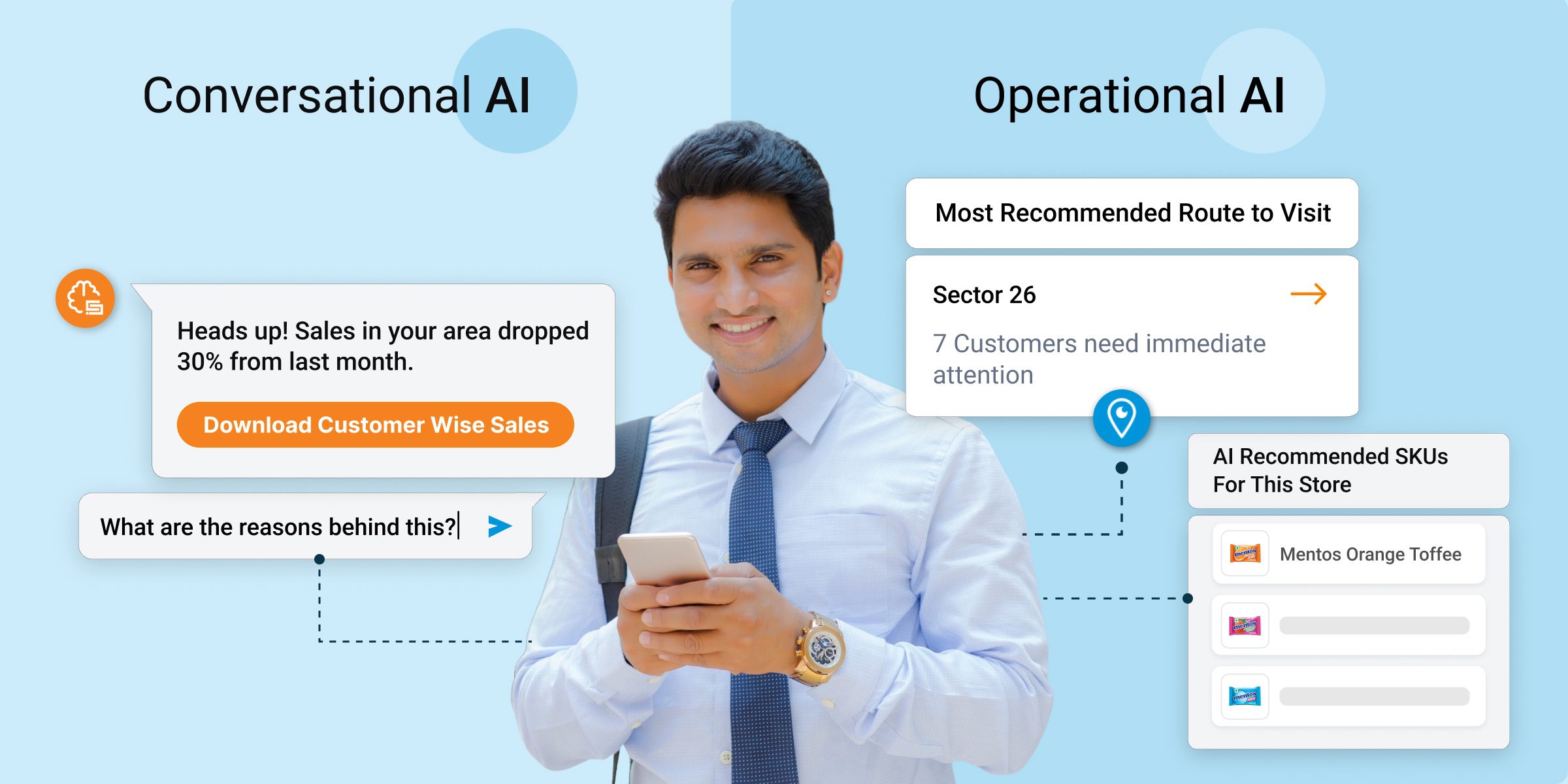
TL;DR This guide is for sales and distribution leaders evaluating AI for field execution. It explains how Operational AI (specialized agents for visits, orders, and audits) and Conversational AI (BeatRoute Copilot for manager queries) work together under a Goal-Driven approach to deliver 12.6% sales uplift.
Operational AI executes daily sales work, while Conversational AI turns data into answers a manager can act on. Together, they form a Goal-Driven approach that helps retail brands in FMCG, building materials, pharma, consumer appliances, and auto aftermarket run tighter distribution with fewer blind spots.
This article explains what each type does, where they differ, and how BeatRoute combines both inside a Goal-Driven AI framework that ensures your sales goals get executed by your sales team and channel partners. We cover the specific agents, the workflows they power, and what to look for when you evaluate an AI layer for your distribution operations.
What is conversational AI in retail distribution

Conversational AI is a system that interacts with users in natural language, powering assistants and messaging-based interfaces. In a retail distribution context, it gives territory managers and field reps instant, data-backed answers without digging through dashboards.
BeatRoute Copilot is the Conversational AI layer inside the platform. A manager can ask “which of my stores are degrowing this month” or “which outlets are not using the current scheme” and get a direct answer. Copilot also pushes proactive alerts when it detects issues, so the manager does not need to know what to look for.
Core capabilities
- Natural-language querying. Managers type questions in plain English (or a local language) and receive data-backed answers in seconds.
- Proactive issue detection. Copilot flags underperforming territories, scheme non-compliance, and stuck payments before the manager asks.
- Context for decisions. It bridges raw data and action, so teams move from “what is happening” to “what to do next” without a separate analyst.
Where it fits in retail distribution
- Real-time territory reviews. Area managers pinpoint weak pockets without opening five reports.
- Scheme and compliance checks. Copilot surfaces stores skipping schemes, so intervention is timely.
- Field-level queries on the go. Reps ask about pending claims, outstanding payments, or last order value for a store before a visit.
What is operational AI in retail distribution

Operational AI is the engine that runs daily sales work. Instead of offering insights for someone else to act on, it embeds intelligence directly into workflows so the right task gets done at the right store at the right time.
In BeatRoute, Operational AI is delivered through specialized agents, each built for a specific execution problem. The four most relevant to retail distribution are the Scheduling AI Agent, the Order AI Agent, the VM Audit AI Agent, and the Customer Insights AI Agent.
Core capabilities
- Intelligent visit prioritization. The Scheduling AI Agent ranks stores for the day based on business decline, overdue payments, territory goals, and customer context. Brands using it have taken productive visits from 45% to 78%.
- Order recommendations. The Order AI Agent reads historical patterns and current SKU movement to suggest replenishment and relevant new SKUs, contributing 4 to 6% sales uplift on its own.
- Shelf and planogram audits. The VM Audit AI Agent converts a shelf photo into a share-of-shelf score, planogram compliance score, and competitor benchmark, with no pretraining required.
- Customer-level intervention suggestions. The Customer Insights AI Agent builds a high-impact visit agenda for each account, so reps walk in with a plan.
Where it fits in retail distribution
- Dynamic field execution. In building materials, pharma, consumer appliances, and auto aftermarket, visit plans change daily. The Scheduling AI Agent removes guesswork from that prioritization.
- Better order and stock alignment. Order recommendations cut under- and over-pitching, keeping the right SKUs in each outlet’s basket.
- Tailored store visits. Customer Insights gives each rep a one-page agenda per store, which changes how dealers, retailers, and distributors are served.
Operational AI vs conversational AI at a glance
The two layers solve different problems. This table from BeatRoute’s framework lines them up side by side.
| Aspek | Operasional AI | AI percakapan |
|---|---|---|
| Primary focus | Executes daily sales work inside workflows | Turns data into answers through natural language |
| Key capabilities | Visit prioritization, order recommendations, shelf audits, customer insights | Natural-language querying, proactive alerts, multilingual answers |
| Primary users | Sales reps, channel partners, and field managers | Territory managers, regional heads, and reps on the go |
| Industri | FMCG, building materials, pharma, consumer appliances, auto aftermarket | Same industries, with heavier use in multi-region manager layers |
| Business impact | Lifts productive visits, AOV, and planogram compliance | Cuts time to insight and reduces missed issues |
Operational AI drives execution on the ground. Conversational AI turns data into decisions. Retail brands need both to move from visibility to outcomes.
How do operational AI and conversational AI work together?
Retail distribution runs on thousands of small decisions every day. A rep picks the next store, a manager spots a dip, a distributor flags short supply. When Operational AI and Conversational AI are connected inside BeatRoute, these decisions stop being isolated events.
What conversational AI contributes
- Answers on demand. BeatRoute Copilot replaces dashboard drilling with one question in natural language.
- Proactive nudges. It alerts managers to degrowing stores or stuck payments before the review meeting, not after.
- Coverage of local languages. Reps and managers query in the language they actually think in.
What operational AI contributes
- Dynamic visit planning. The Scheduling AI Agent builds each rep’s day around the stores that matter most right now.
- Smarter orders at the counter. The Order AI Agent recommends SKUs and quantities during the visit, so reps pitch what the store can sell.
- Objective shelf scoring. The VM Audit AI Agent turns a photo into share-of-shelf and planogram compliance metrics without a human auditor.
The value compounds. A manager uses Copilot to spot a weak cluster, the Scheduling AI Agent pushes those stores to the top of rep plans, the Order AI Agent suggests the right SKUs on the visit, and the VM Audit AI Agent confirms the shelf looks the way it should after.
How does BeatRoute connect both under Goal-Driven AI?
BeatRoute connects operational AI and conversational AI under its Goal-Driven AI framework, which ties every AI action to a company goal so intelligence flows from HQ targets through to field-level execution.
Tools on their own do not change outcomes. What changes outcomes is a framework that ties every AI action back to a company goal. BeatRoute is the only SFA-DMS built to execute your sales goals, and Goal-Driven AI is how it delivers that promise.
Traditional SFAs give you data. BeatRoute uses Goal-Driven AI to ensure your sales strategy gets executed by your sales team and channel partners. Operational AI agents carry out the specific execution work, Conversational AI lets humans interact with the system in plain language, and Goal-Driven AI keeps both pointed at the outcomes your goals define.
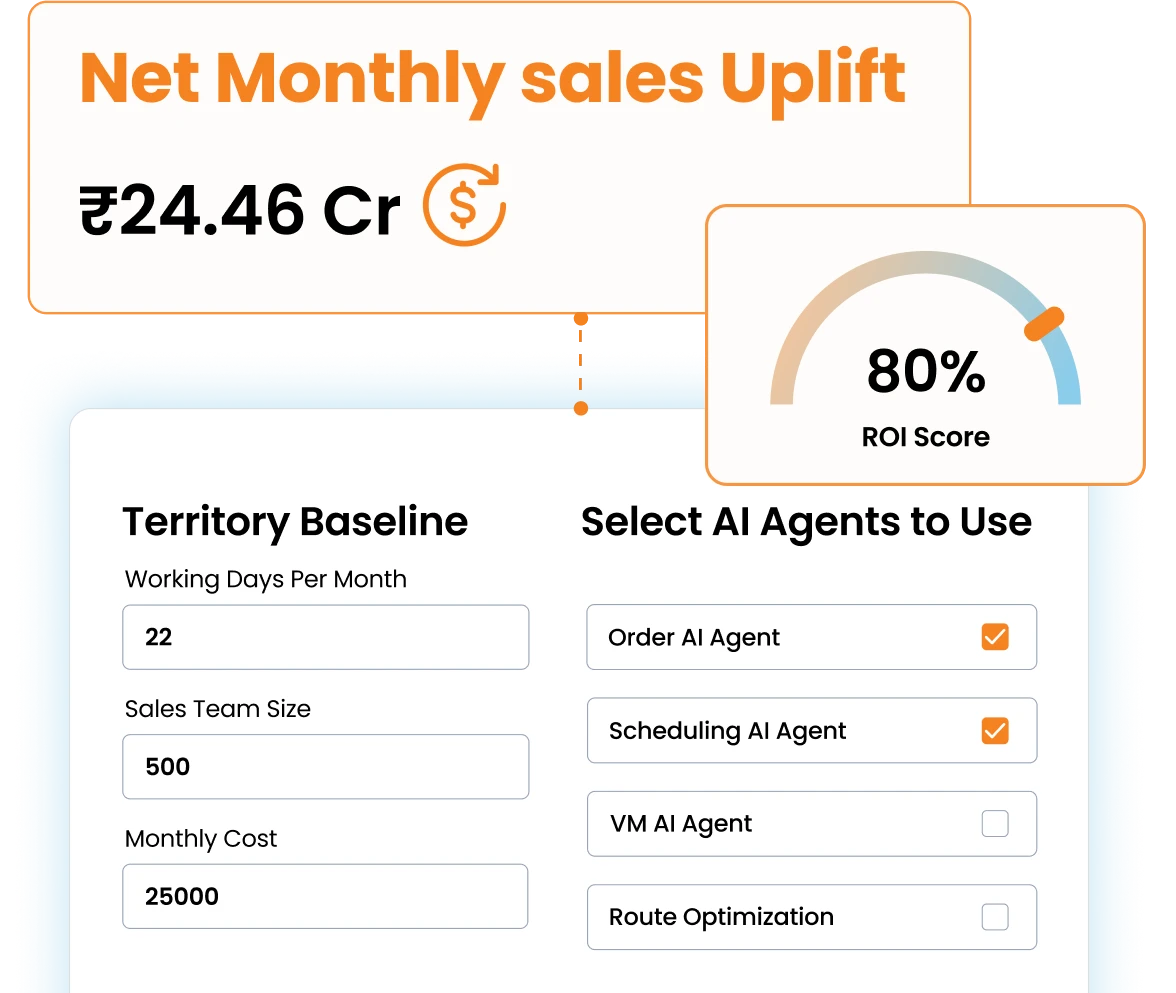
In practice, this means a territory goal like “grow premium SKU sales in Tier 2 towns by 15%” cascades into rep-level visit priorities, order recommendations, and shelf checks, while managers track progress through Copilot without chasing reports. Retail brands running this full stack on BeatRoute see a 12.6% average sales uplift in the first year. You can read BeatRoute’s Sales Impact Report for the detailed breakdown.
What to look for in an AI layer for distribution
Not all AI implementations deliver the same results. BeatRoute recommends evaluating any AI layer for retail distribution against four criteria:
- Named, specialized agents, not one black box. Check whether the platform has specific agents for visit planning, ordering, and shelf audits, or a generic “AI” label.
- A conversational surface for managers. The natural-language layer should handle proactive alerts, not just user-initiated questions.
- A goal framework above both layers. Without it, AI becomes a set of features. With it, AI becomes execution.
- Proven outcomes in your industry. Ask for named customers and measurable results, not category averages.
Pesan demo gratis to see Operational AI and Conversational AI working together under a Goal-Driven AI framework on your own territory data.
Pertanyaan yang sering diajukan
What is the difference between operational AI and conversational AI in retail distribution?
Operational AI executes daily sales work inside workflows: prioritizing store visits, recommending orders, and scoring shelf photos. Conversational AI sits on top of the data and answers manager and rep questions in natural language, including proactive alerts. BeatRoute combines both under a Goal-Driven approach so one drives action and the other drives decisions.
Which AI agents does BeatRoute use for operational AI?
BeatRoute delivers Operational AI through the Scheduling AI Agent for daily visit prioritization, the Order AI Agent for replenishment and new SKU recommendations, the VM Audit AI Agent for shelf and planogram compliance scoring, and the Customer Insights AI Agent for outlet-specific visit agendas.
What is BeatRoute Copilot and how does it fit in?
BeatRoute Copilot is the Conversational AI layer. Managers and reps ask natural-language questions and get answers without opening dashboards. Copilot also pushes proactive nudges when it detects issues, and it supports multiple local languages so field teams use it comfortably.
How does Goal-Driven AI relate to these two layers?
Goal-Driven AI is the framework that ensures your sales goals get executed on the ground. It guides every rep and channel partner toward the outcomes your goals define, using Operational AI agents for execution and Conversational AI for human interaction. Without this layer, AI is features. With it, AI is execution.
Which industries benefit most from combining operational AI and conversational AI?
FMCG, building materials, pharma, consumer appliances, auto aftermarket, and AlcoBev see the clearest impact. These sectors share fragmented retail universes, dynamic visit plans, and channel-partner dependence, which is where Operational AI lifts execution and Conversational AI cuts time to insight.
What results can retail brands expect from this combined approach?
Retail brands on BeatRoute see 12.6% average sales uplift in year one. The Order AI Agent alone contributes 4 to 6%. The Scheduling AI Agent moves productive visits from 45% to 78%, with ticket size rising from 1,200 to 1,900 and payment collection going from 72% to 91%.