Auto ancillary companies have been trying to use FMCG sales tools for years. The tools track visits. Generate reports. Show a dashboard.
Influencers are not the buyer. The channel is multi-brand. The scheme logic is complex in ways that FMCG never has to deal with. FMCG-first SFA platforms were not built for any of this and autThe field results don’t move.
Mengapa ini penting: Auto aftermarket distribution looks like FMCG distribution from the outside: salespeople, distributors, retailers, targets. Underneath, it is completely different. The product is technical. The io ancillary companies are paying for that mismatch every quarter.
The channel is built differently
In FMCG, the sales rep visits a retailer. The retailer buys stock. The retailer sells to the consumer. Three steps. Clean. In the auto aftermarket, the path looks like this: the brand reaches a distributor. The distributor supplies to retailers and workshops. The workshop mechanic recommends a product to the vehicle owner. The vehicle owner buys.
The problem: The person who actually decides which product gets used is the mechanic. He is not your customer. He is not on your payroll. He is not the person your sales rep is calling on most days. He is an influencer in a channel that most SFA platforms were never designed to track. FMCG-first tools manage the retailer relationship.
They have no workflow for the mechanic. No way to track engagement, loyalty points, scheme eligibility, or visit history for a workshop. No way to separate a retail-channel visit from an influencer-channel visit in the same visit plan. For a lubricant or brake-parts company, that gap is not a missing feature. It is a broken sales model running on the wrong software.
Multi-brand distribution breaks standard DMS logic
Every major FMCG distributor is usually aligned to one brand or one parent company. The secondary sales logic, scheme application, and stock norms are built for that relationship. Auto aftermarket distributors almost always carry multiple competing brands.
Why this matters: When a distributor carries your brand alongside three competitors, the standard DMS assumption that all distributor sales flow up to your brand’s reports breaks down. Secondary visibility becomes partial at best, unreliable at worst. Auto ancillary companies describe this consistently. The distributor has hundreds of branches. The retailer base runs into the tens of thousands.
The sales team is small relative to the territory it covers. And the secondary data coming out of a standard FMCG-origin DMS tells them very little about what is actually moving off the shelf and why. A platform built for auto aftermarket connects SFA and DMS into a single data layer. What the sales rep does on the field and what leaves the distributor’s warehouse exist in the same system. That connection is what makes secondary visibility real, not approximate.
The mechanic engagement problem has no answer in a standard SFA
Mechanic loyalty programs are one of the most common investments in auto aftermarket. Almost every major brand has one or is building one. Most of them are failing quietly.
The bottom line: The reason is not the scheme. The reason is the system. Coupon scanning at the workshop level, managed by the sales rep visiting on behalf of the mechanic, is a manual process running on the honor system. Points are entered after the fact. Redemption data is disconnected from the visit record.
The brand has no reliable picture of which mechanics are active, which are lapsing, and which are recommending a competitor’s product to every second customer. Auto ancillary companies that have tried to solve mechanic engagement through loyalty apps built outside their core SFA find the same problem: the app becomes a separate silo.
Enrollment data sits in one place. Visit data sits in another. Scheme performance sits in a third. A platform built for this channel manages mechanic engagement within the core sales workflow, not as a bolt-on. The sales rep’s visit to a workshop, the mechanic’s enrollment status, the scheme they qualify for, and the points they have accumulated are visible in the same system the rep is already using to plan their day and log their activity.
Visit planning in auto ancillary is not a retail beat plan
In FMCG, a beat plan is a list of retail outlets a rep visits in a fixed sequence. The logic is geographic and frequency-based: visit this outlet every week, hit this cluster on Tuesday. The plan is designed in advance, approved by management, and the rep follows it. In auto aftermarket, the rep’s day works differently. Sales reps plan their own visits, deciding each day or week who to call on based on priorities, relationships, and business signals. This is adhoc visit planning, and it is the norm in the industry, not an exception to be managed around.
The reality: The same rep might visit a large distributor’s branch in the morning, call on a group of independent workshops in an industrial area after lunch, follow up with a modern trade outlet in the afternoon, and then handle a new customer onboarding before end of day. Different customer types. Different conversation goals. Different data to capture at each stop.
FMCG-first SFA tools treat all of these the same way. One visit form. One call report format. One set of activity metrics. Auto ancillary companies need their sales rep to capture different information depending on who they are visiting and need that information to feed separate performance metrics by channel type, not a single combined call completion rate. A visit plan that does not distinguish between a distributor branch, a workshop, and a retail outlet is producing a single number that means nothing.
Scheme management in auto is more complex than FMCG volume logic
FMCG trade schemes are typically volume-driven. Buy a certain number of cases, get a discount or free goods. The logic is straightforward and the scheme software that FMCG-first platforms carry reflects that logic. Auto ancillary scheme structures are more complex.
Mengapa ini penting: In auto aftermarket, schemes often have to account for product-specific eligibility, channel-specific conditions, and customer-segment-specific rules, all at the same time. A scheme for one SKU category may not apply to another, even within the same brand. The quantity purchased matters, but so does who is buying, through which channel, and against which product line. FMCG-first scheme modules don’t carry this logic.
The result is that auto ancillary companies either simplify their schemes to fit the software, losing commercial effectiveness, or manage the complex scheme logic in spreadsheets outside the system. Neither outcome is acceptable when scheme execution is one of the primary levers for distributor and mechanic engagement.
The SFA evaluation problem: auto ancillary buyers are comparing against the wrong benchmark
When auto ancillary companies evaluate SFA platforms, they typically compare features against other SFA platforms. Visit logging. Journey planning. Target tracking. Order management. Report dashboards. On those dimensions, most platforms look similar.
The question they don’t ask: Is this platform built to handle mechanic engagement natively? Can the DMS and SFA share a live data layer? Can visit plans distinguish between customer types? Does the scheme engine carry the product-specific and channel-specific complexity that auto aftermarket actually requires? Can the system calculate distributor performance by brand in a multi-brand environment?
When those questions get asked, most FMCG-first platforms give the same answer: that those are customizations, that they can be built, that it will take time, that it will require a separate project. What auto ancillary companies need is a platform where those capabilities are not customizations. They are the default.
What a platform built for the auto aftermarket looks like
BeatRoute is a Goal-Driven AI platform built for companies that sell through complex distribution networks, including auto ancillary companies across multiple markets. The difference shows up in how the platform is designed, not just what it includes.
Visit planning in BeatRoute is built for the adhoc nature of auto aftermarket field sales, where reps plan their own routes based on priorities, not a fixed sequence handed to them each week.
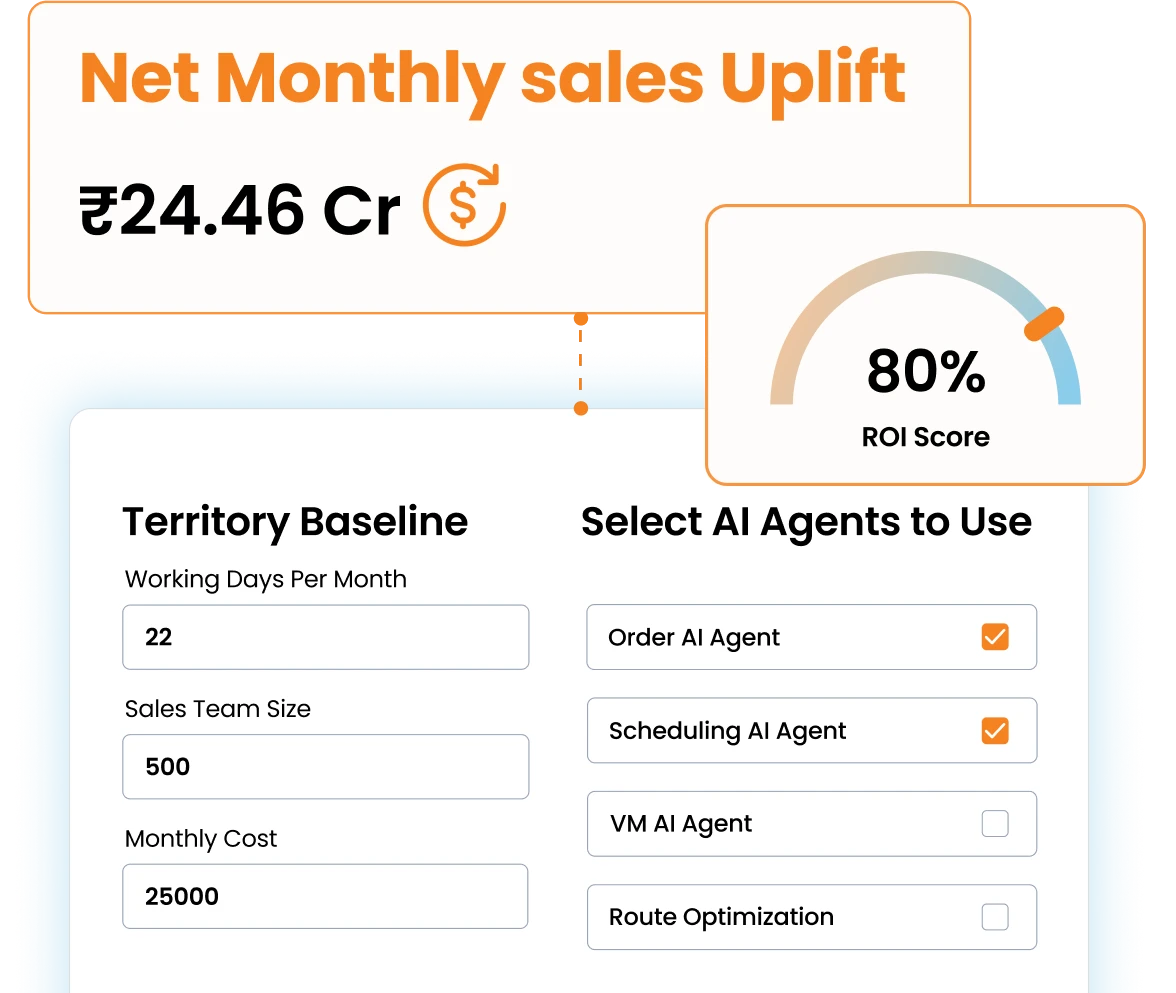
The Scheduling AI Agent supports this by generating data-backed, prioritized visit plans for each rep, surfacing which accounts to visit and why, based on sales signals, unresolved tasks, payment risks, and coverage gaps. Within each recommended route, the agent highlights priority customers with specific reasons and suggested actions, so reps walk in prepared rather than improvising.
BeatRoute can distinguish between customer types within the same rep’s journey: distributor branches, workshops, retailers, and new customer additions each carry different visit forms, different activity capture requirements, and different performance metrics. The rep uses one app. The system keeps the data separated and comparable.
Mechanic engagement is managed within the same platform as the core SFA workflow, not as a separate app or a loyalty bolt-on. Enrollment, visit history, scheme eligibility, and points balance are visible to the rep during the workshop visit, not reconstructed from a separate database after the fact. DMS and SFA data exist in the same layer. What the rep logs in the field and what moves through the distributor network are connected, not reconciled manually at month end. Secondary sales visibility becomes a live operational signal, not a monthly exercise.
Scheme configuration in BeatRoute handles the complexity that auto ancillary schemes actually require.
The Trade Promotion Management module supports product-specific, channel-specific, and customer-segment-specific scheme logic, without forcing the scheme design to fit a simplified template. AI agents surface the decisions that manual dashboards bury.
BeatRoute’s Order AI Agent builds personalized order baskets for each distributor or retailer, drawing on their purchase history, what similar accounts are ordering, Must Sell and Focus Sell compliance targets, and SKU gaps, so the rep walks into the meeting with a ready order recommendation rather than starting from scratch.
The Customer Insights AI Agent recommends the right engagement action during every visit. BeatRoute Copilot gives managers conversational access to territory performance, flagging exceptions, surfacing trends, and answering questions without requiring a dashboard or an analyst.
The shift that is already happening
Auto ancillary companies are not short of data. They have call reports, distributor claims, scheme disbursement records, and monthly sales numbers.
What they are short of is intelligence. The ability to see what is about to go wrong before it does. The ability to know which mechanic is about to defect to a competitor. The ability to see secondary sell-out by SKU across a distributor network that carries three other brands alongside theirs.
Traditional SFA platforms, whether FMCG-origin or generic, answer the question: what did the sales team do?
A Goal-Driven AI platform answers the question: what should the sales team do next to achieve their goals and why? That is the shift that brands like Hero MotoCorp and Valvoline have made with BeatRoute. And for auto ancillary companies still running field sales on a platform built for someone else’s distribution model, it is long overdue.
An FMCG-first sales force automation platform was not built for the auto ancillary industry. The channel is different. The mechanic matters. The scheme logic is more complex. BeatRoute is built for exactly this. Pesan demo gratis and see how auto ancillary companies are hitting their goals faster with a platform that understands their distribution model.
 EN
EN  ID
ID
 ES
ES