6 Actionable Takeaways to Drive Digital Transformation in the AI Era ft. Dhruv Suri
 Surya Panicker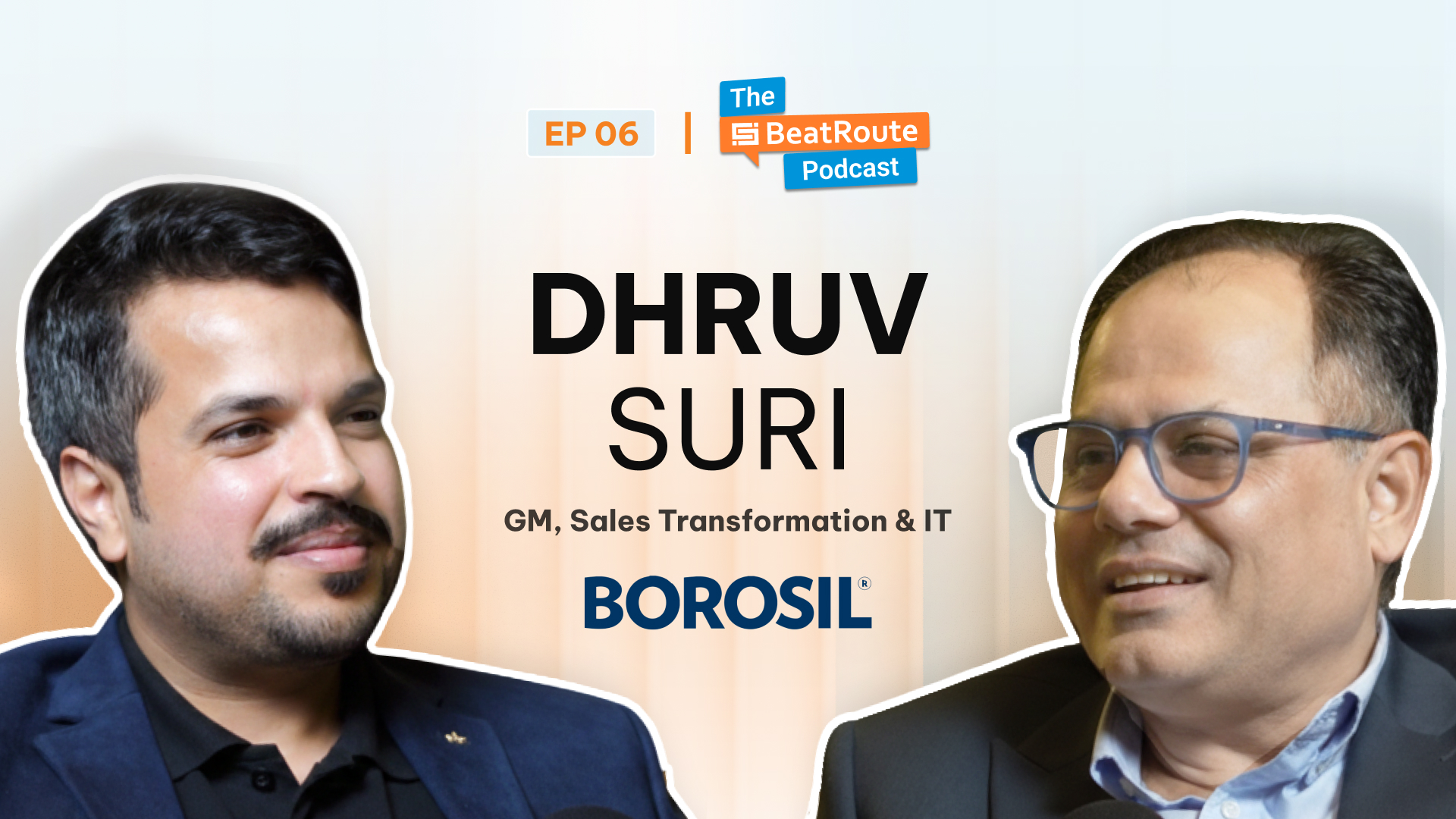
Table of Content
Featuring: Dhruv Suri, GM, Sales Transformation & IT at Borosil Limited
Host: Nikhil Chaudhary, VP Marketing at BeatRoute
Digital transformation in retail distribution is often reduced to dashboards, automation projects, and new software rollouts. But real transformation begins when sales and IT move in sync toward measurable business outcomes using technology.
In this episode, Nikhil Chaudhary speaks with Dhruv Suri, GM, Sales Transformation and IT at Borosil Limited. His journey spans frontline sales roles at Tata and SIFI, followed by enterprise technology leadership at Samsung. That dual exposure gives him a rare perspective. He understands what it takes to close numbers on the ground and what it takes to build systems that enable those numbers at scale.
In this conversation, Dhruv shares six practical insights for driving digital transformation in the AI era. Covering AI adoption, data discipline, and cross-functional ownership, he explains why transformation should be treated as a business priority, not just an IT initiative.
Let’s dive straight into the conversation.
#1 There Is No “Digital Transformation Leader”
As Dhruv explains, digital transformation does not need to sit outside IT, nor does it belong to a standalone function. It can be led within IT, embedded in business strategy, or even supported by external partners. What matters is alignment. Automation, sales transformation, IT, AI, they are not separate tracks. They are parts of the same system working toward business impact.
During his stint at Samsung, Dhruv learned one defining principle: treat the sales team as the first client. That mindset shapes every rollout he leads. Internal users are treated with the same seriousness as paying customers. UAT is rigorous, feedback is acted upon, and the language of each sales vertical is respected.
When sales teams feel served rather than managed, adoption follows naturally. Trust becomes the foundation of transformation.
“Your sales team is your first client. If you treat somebody as a client or a customer, then you try to take that extra step to achieve things for him.”
#2 Start Now! The Pace of Change Won’t Wait
For Dhruv, when it comes to adopting digital transformation, urgency is not optional. “If you don’t do that, it means you’re late. You’re late in the pool, late in the party,” he says candidly.
He points out that transformation cycles have compressed significantly. What once took four years can now happen in two. With AI and machine learning advancing rapidly, meaningful shifts are no longer annual events. They unfold monthly, sometimes even weekly.
His message is clear: start now. If you wait, you are at a risk of falling behind.
“When should an organization go into transformation or into the IT sphere? The answer is ASAP. If you don’t, you’re late. AI and ML are already moving at such a speed that changes happen every month, every week.”
#3 AI Is a Tool, Not a Hype Cycle
Despite leading AI-driven initiatives, Dhruv views AI with grounded pragmatism. At Borosil, this philosophy translated into practical solutions.
Adding a practical perspective, Dhruv highlighted two key initiatives they drove at Borosil:
- AI-Powered Product Recommendation Engine – Designed to simplify selling across 9,000+ SKUs, the engine narrows choices to 18 high-relevance suggestions per outlet based on repeat trends, strong performers, geographic patterns, and profitability logic. The aim was simple: help reps sell smarter, and faster.
- Borosil IQ – Intelligent Sales Assistant – A voice/text-enabled assistant that delivers real-time national, regional, or category-level insights in seconds. What earlier took manual consolidation or BI analysis is now instant, role-based, and actionable.
Both initiatives were positioned not as AI projects, but as productivity drivers for sales.
“I look at AI and ML as tools which would help you build upon your IT practices, your digital transformation practices or your automation practices. It is not that you treat it as a hype and you go gung-ho on it.”
#4 Frame the Change in Business Language
According to Dhruv, adoption hinges on how change is framed. Sales teams respond to business impact, not technology jargon. When reps see that a tool helps them cover more outlets, increase order value, and earn more incentives, resistance drops.
Transformation leaders, in his view, must share accountability with the business. When sales wins, transformation wins.
“My thought has always been creating products. We have never told the sales team explicitly that there’s an AI product. We just told them that this feature will help you hit business goals faster.”
#5 Data Cleanliness Comes Before Anything Else
No AI strategy can succeed without strong data foundations. Dhruv is unequivocal on this point.
He recalls that Borosil’s DMS rollout took place during the peak of COVID in 2020–2021, when operations were disrupted and teams were remote. Yet instead of slowing down, the company focused on cleaning and standardizing legacy data. Master data management was treated as a priority then and continues to remain one today.
Only after getting the data right did Borosil build its cloud-based data lake. That foundation now supports internal data science work, automated reports, and faster decision-making without heavy dependence on vendors.
As Dhruv puts it simply: garbage in, garbage out. If the data going in is wrong, the output will be wrong.
“Any journey, IT, digital transformation, AI journey, they need to set their data sets, their legacy data correct.”
#6 Build Where It Matters, Buy Where It Makes Sense
Dhruv cautions against assuming AI is plug-and-play. Hallucinations and inaccuracies are real risks, especially when integrating new datasets or workflows.
For high-stakes differentiation such as custom recommendation engines or forecasting logic, he advocates strong internal ownership and rigorous testing. Strategic intelligence should remain close to the business.
At the same time, platforms like SFA and DMS can be left to standard package vendors while plugging in the proprietary intelligence into them.
“There’s no plug and play in AI. There’s nothing called as plug and play, you have to test it.”
Way Forward…
Looking ahead, Dhruv emphasized three core priorities for leaders driving digital transformation:
- Be deliberate with AI adoption and stay updated on fast-moving technology, ensuring every solution addresses real pain points on the sales floor.
- Stay close to your teams, understand their challenges, validate ideas quickly through proofs of concept, and accept “not now” when business priorities shift.
- Anchor every initiative to measurable outcomes and reinforce adoption through continuous training and follow-through.
He further advises future transformation leaders to stay grounded in the business, avoid chasing every new trend, and build credibility through consistent, tangible results. Patience is essential. One well-designed, widely adopted solution delivers far more impact than multiple rushed rollouts. When digital transformation is owned by sales rather than treated as a standalone IT project, it moves beyond being just a rollout and becomes a real competitive advantage.
Acerca de BeatRoute
BeatRoute is a goal-driven AI platform for retail brands. It is an enterprise-grade, functionally scalable platform that uses a unique goal-driven mechanism with AI at its heart to deliver measurable business impact for brands in their retail sales and distribution channels.
Worldwide, retail brands from industries such as FMCG, consumer goods, and building materials face the difficult choice of risky and high capex implementation projects on development platforms. We are solving this global problem with our ready-to-deploy SaaS solution.
BeatRoute currently serves 200+ enterprise brands in 20+ countries, with 100K+ users across India, South Asia, and Africa in 10 industry verticals.