 Surya Panicker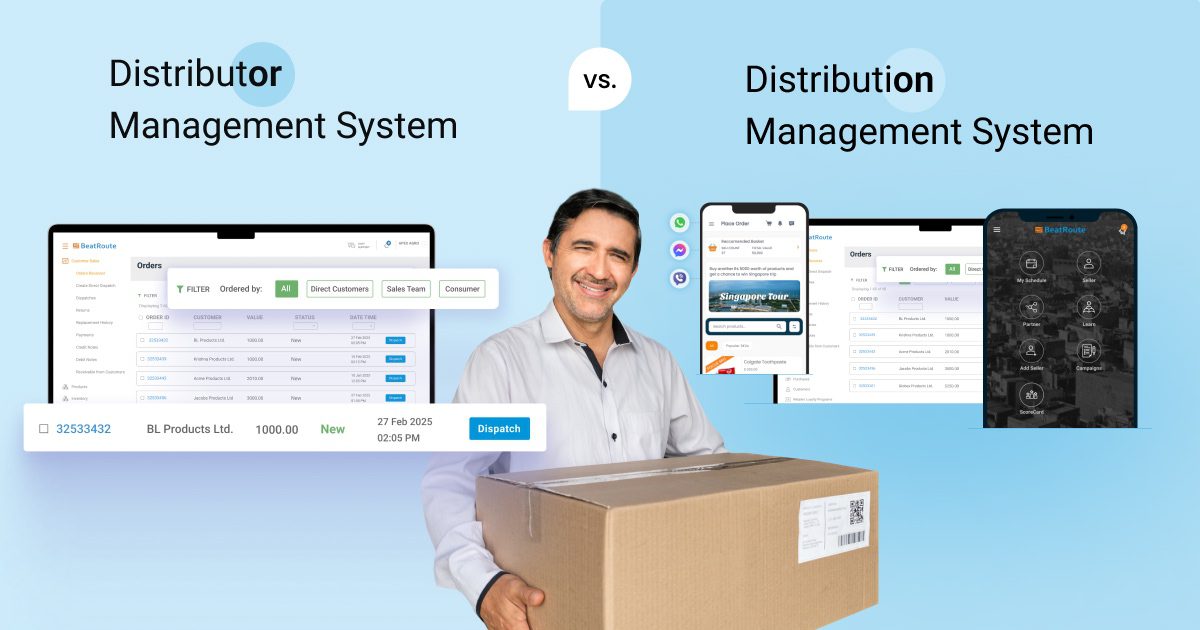
A Distributor Management System handles the primary flow between a brand and its distributors: order placement, invoicing, claims, and payments. A Distribution Management System is the broader platform that also covers the secondary flow from distributors to retailers, including billing, scheme visibility, statement of accounts, configurable dashboards, and tertiary offtake reporting. Picking the right one depends on whether you need to run distributor operations alone or manage the full brand-to-retailer channel.
Most retail brands need both layers working together. Legacy tools treat them as separate silos, which creates blind spots between what a distributor orders from the brand and what actually moves to retailers. This blog walks through each system, where they differ, and how BeatRoute unifies primary and secondary flows under one platform.
Key takeaways
- A Distributor Management System covers the primary flow: distributors place orders on the brand, the brand invoices and ships, and claims settle between the two parties.
- A Distribution Management System extends that scope to the secondary flow: distributor-to-retailer billing, scheme execution, statement of accounts, configurable dashboards, and tertiary sales reporting.
- Brands that only care about primary ordering can run a narrow Distributor Management System, but most lose visibility the moment goods leave the distributor warehouse.
- BeatRoute’s DMS covers both the Primary DMS layer (brand to distributor) and the Secondary DMS layer (distributor to retailer) with Tally and Busy Plugins plus 300+ enterprise integrations.
Apa yang dimaksud dengan Sistem Manajemen Distributor
A Sistem Manajemen Distributor manages the primary flow between a brand and its distributors. It handles distributor ordering, invoicing, credit, payment tracking, and claim settlement. The focus is everything that happens between the brand’s warehouse and the distributor’s warehouse.
Instead of chasing payments over email or reconciling distributor orders in spreadsheets, a Distributor Management System generates invoices automatically and keeps a live record of what is paid, pending, or disputed. Brands get real-time visibility into distributor performance and a cleaner books-of-record with each distributor.
Key features of a Distributor Management System
- Order processing: Automates primary ordering by distributors so fulfilment is faster and more accurate, reducing errors and stock outs.
- Sales tracking: Real-time primary sales tracking shows which distributors are pulling volume and where schemes need adjustment.
- Invoicing and credit management: Automates invoices and credit limits, improving cash flow and financial oversight.
- Claim management: Lets distributors submit and track claims for damaged goods or order discrepancies, and routes them to the brand for resolution.
- Distributor performance tracking: Measures delivery adherence, order accuracy, and target attainment across General Trade and Modern Trade channels.

Challenges in existing Distributor Management Systems
Many distributors still run ordering, stock, and claims in separate tools, which creates fragmented data across the primary flow. Inventory sits in one system, sales in another, and claims in a shared email folder. Without a connected system, accurate real-time data is hard to get and brands cannot react quickly to demand shifts.
- Lack of integration: Distributors use disconnected tools like spreadsheets, Tally, or outdated accounting software, which creates data silos and breaks the flow of information between the brand and the distributor.
- Manual processes: Small distributors in remote areas still use pen and paper for stock, and orders land over WhatsApp, email, or phone calls. This leads to delays and errors on primary orders.
- Limited visibility into secondary sales: A narrow Distributor Management System stops at the distributor warehouse. Brands cannot see what moves from distributor to retailer, which hides tertiary offtake and slows response to shelf-level trends.
- Scheme management issues: Running primary and secondary schemes manually is slow and error prone. Without a central system, ROI on promotions is hard to measure.
- Inconsistent financial tracking: Manual invoicing and credit tools produce reconciliation gaps, delayed statements of accounts, and disputes that strain distributor relationships.

Benefits of using a Distributor Management System
A Sistem Manajemen Distributor unifies primary-flow processes into one platform, removing the need for multiple disconnected tools and giving brands a clean view of distributor operations.
- Integration and automation: Connects primary ordering, invoicing, and inventory into one platform. Distributors place orders, check stock, and process invoices in one place with real-time updates.

- Real-time visibility: Gives brands live data on stock levels, primary sales, and order status, so teams can shift stock between regions or adjust plans when demand moves.
- Seamless scheme management: Consolidates primary scheme data so brands can evaluate ROI and adjust allocations. If one region runs hot on a launch, the brand can reallocate stock and spend quickly.
- Accurate financial management: Automates invoicing and credit, records every transaction, and keeps statements of accounts clean between the brand and each distributor.

- Stronger distributor relationships: Clear data on orders, claims, and payments builds trust and reduces friction between brand and distributor teams.

Apa yang dimaksud dengan Sistem Manajemen Distribusi
A Distribution Management System is the broader platform that covers both the primary flow and the secondary flow from distributors to retailers. The Distributor Management System sits inside it. If the Distributor Management System is the engine, the Distribution Management System is the full vehicle that also handles route to market, field sales, retailer billing, and tertiary offtake.
Where a Distributor Management System stops at primary ordering and invoicing, a Distribution Management System adds secondary billing by distributors to retailers, scheme visibility at the retailer level, statement of accounts, configurable dashboards, and tertiary reporting. It connects manufacturers, distributors, and retailers in one system so brands get end-to-end visibility from warehouse to shelf.
Key features of a Distribution Management System
- Supply chain integration: Connects warehouse, distributor, and retailer in one live view so teams can track product movement at every stage.
- Sales Force Automation: Gives field reps real-time data from distributors and retailers so they can adjust their day in the field.

- Stakeholder collaboration: Keeps manufacturers, distributors, and retailers aligned on orders, inventory, and schemes in one place.
- Visit planning and route optimisation: Alat yang digerakkan oleh AI plan efficient routes for field teams, cutting travel time and adding selling time.

- Sales analytics: Tracks performance across primary, secondary, and tertiary sales and flags underperforming regions and SKUs.


Challenges in existing Distribution Management Systems
Many brands still run distribution on legacy systems that were built for a narrower scope. These tools handle the primary flow well enough but lose ground once secondary and tertiary sales enter the picture. Without one connected view, decision-making slows down and teams across the network work with different versions of the truth.
Common challenges brands run into:
- Complex stakeholder coordination: Misalignment between manufacturers, distributors, and retailers causes duplicated stock, missed promotions, and slow resolution on claims.
- Supply chain visibility gaps: Legacy tools do not show the secondary flow in real time, so brands cannot track retailer-level inventory, SOA, or scheme uptake as it happens.
- Managing distribution channels: Brands often struggle to run General Trade and Modern Trade on the same backbone. Independent retailers and modern trade accounts need different handling, which legacy systems rarely support cleanly.
- Reluctance to adopt AI: Teams that stick to manual planning miss gains from AI-led visit planning, demand sensing, and scheme impact analysis.
- Lack of real-time data access: Field teams and HQ work off yesterday’s numbers, which slows response to stockouts, price moves, and competitor action.

Benefits of using a Distribution Management System
A Distribution Management System centralises data across primary, secondary, and tertiary sales and automates the handoffs in between. Brands get one source of truth for distributor orders, retailer billing, scheme execution, and offtake reporting.
- Real-time communication and data sharing: Connects sales force, distributors, and retailers on one platform, with live updates on stock, sales, and promotions.
- Order management: Tracks primary and secondary orders, stock levels, and deliveries in real time. In Building Materials, where inventories are large and project timelines are tight, this keeps product moving to sites on schedule.

- Schemes and offers: Runs primary and secondary schemes, tracks claims back, and shows brand teams which offers actually landed. In HOREKA, distributors can tailor schemes for restaurants and cafes and track claims cleanly.
- Enhanced collaboration: Improves communication between manufacturers, distributors, and retailers. In FMCG, alignment on inventory and promotions across thousands of outlets is the difference between growth and stockouts.
- AI-optimised field operations: Visit planning and route tools shrink travel time and add selling time. In FMCG, where reps cover large territories, this improves coverage and reduces cost to serve.

- Improved sales performance: Real-time insights surface gaps at the distributor, retailer, and SKU level so teams can course correct within the week, not the quarter.
- Configurable and scalable platform: Brand teams can configure KPIs, dashboards, and workflows as the business expands into new regions or product lines.


Distributor Management System vs. Distribution Management System: a quick comparison
Side by side, here is how the two systems differ in scope, audience, and outcomes:
| Sistem Manajemen Distributor | Sistem Manajemen Distribusi |
| Covers the primary flow: brand to distributor. | Covers primary plus secondary flow: brand to distributor to retailer. |
| Automates distributor ordering, invoicing, credit, and claim management. | Adds secondary billing, scheme visibility, SOA, configurable dashboards, and tertiary reporting on top. |
| Focused on distributor relationships and primary sales data. | Focused on the full network, including field sales, routes, and retailer-level performance. |
| Best suited to brands that need a clean books-of-record with each distributor. | Ideal for brands that need real-time visibility and control across the entire channel. |
| Tracks primary sales and adjusts distributor-level strategy. | Tracks primary, secondary, and tertiary sales and adjusts strategy across regions and channels. |
| Lighter integration footprint, scoped to distributor operations. | Deep integration across manufacturers, distributors, field teams, and retailers. |
| Fits smaller to mid-sized brands or brands that outsource field sales. | Fits brands with large field forces and complex, multi-region distribution. |

How BeatRoute unifies Primary DMS and Secondary DMS
BeatRoute is the only SFA-DMS built to execute your sales goals. The DMS is full-fledged across desktop and mobile and is designed so brands do not have to choose between a Distributor Management System and a Distribution Management System. Both layers run on one platform.
- Primary DMS layer: Handles distributor ordering on the brand, invoicing, credit, and claims with Tally and Busy Plugins and other accounting integrations built in.
- Secondary DMS layer: Covers distributor-to-retailer billing, primary and secondary scheme visibility, statement of accounts, a configurable dashboard, and tertiary offtake reporting.
- Connected SFA: Field reps, managers, and channel partners work off the same live data, and BeatRoute uses Goal-Driven AI to ensure your sales goals get executed by your sales team and channel partners.
- Enterprise-grade integrations: BeatRoute Matrix connects the DMS to 300+ enterprise systems so primary, secondary, and tertiary data stay in sync with ERP, finance, and analytics.
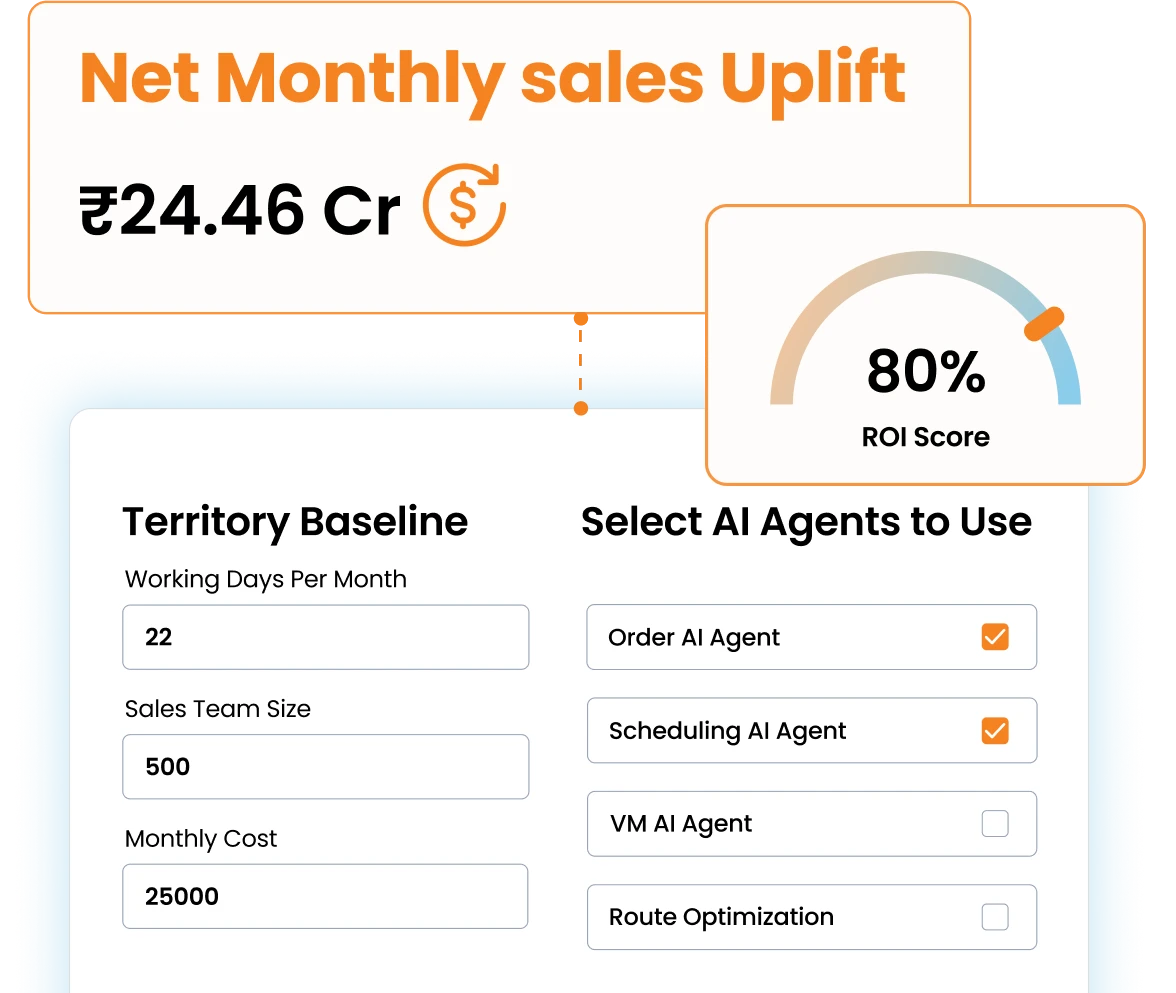
Brands on BeatRoute see a 12.6% average sales uplift in the first year, with strong gains in distributor visibility, scheme ROI, and field productivity.
Choosing the system that fits your brand
Use these pointers to decide where to start:
- Evaluate your priority: If the immediate goal is cleaning up distributor ordering, invoicing, and claims, a Distributor Management System solves that.
- Assess your network: If you need visibility down to the retailer and tertiary offtake, a Distribution Management System is the right scope.
- Plan for growth: Starting with a Distributor Management System is fine, but pick a platform that can extend into full distribution management without a rebuild.
- Technology readiness: If you are ready to use AI for field planning and scheme ROI, a full Distribution Management System unlocks that faster.
Get a Free Demo of BeatRoute’s Distribution Management to see how primary and secondary DMS layers work together on one platform.
Pertanyaan yang Sering Diajukan
What is the difference between a Distributor Management System and a Distribution Management System?
A Distributor Management System manages the primary flow between a brand and its distributors, covering ordering, invoicing, credit, and claims. A Distribution Management System is broader and also covers the secondary flow from distributors to retailers, including secondary billing, scheme visibility, statement of accounts, configurable dashboards, and tertiary offtake reporting.
Is a Distributor Management System part of a Distribution Management System?
Yes. A Distributor Management System is a subset of a Distribution Management System. The Distributor Management System handles primary-flow tasks between brand and distributor. The Distribution Management System wraps that and adds distributor-to-retailer operations, field sales, and tertiary reporting in one platform.
Which system do FMCG brands typically need?
Most FMCG brands need both. A Distributor Management System alone leaves blind spots beyond the distributor warehouse. A full Distribution Management System tracks secondary billing to retailers, scheme uptake, and tertiary offtake, which is where FMCG growth and scheme ROI are actually decided.
How does BeatRoute cover both systems?
BeatRoute is the only SFA-DMS built to execute your sales goals. Its DMS covers the Primary DMS layer for brand-to-distributor ordering with Tally and Busy Plugins, and the Secondary DMS layer for distributor-to-retailer billing, scheme visibility, SOA, configurable dashboards, and tertiary reporting, all connected to SFA and 300+ enterprise integrations.
Can a brand start with a Distributor Management System and expand later?
Yes, but the platform choice matters. Starting narrow is fine if the goal is to fix primary ordering and claims first. Picking a platform like BeatRoute that already supports both Primary DMS and Secondary DMS means the secondary flow, SFA, and tertiary reporting can be switched on without a replatform.