Route to market for FMCG in Africa: opportunities and technology
 Soham Chakraborty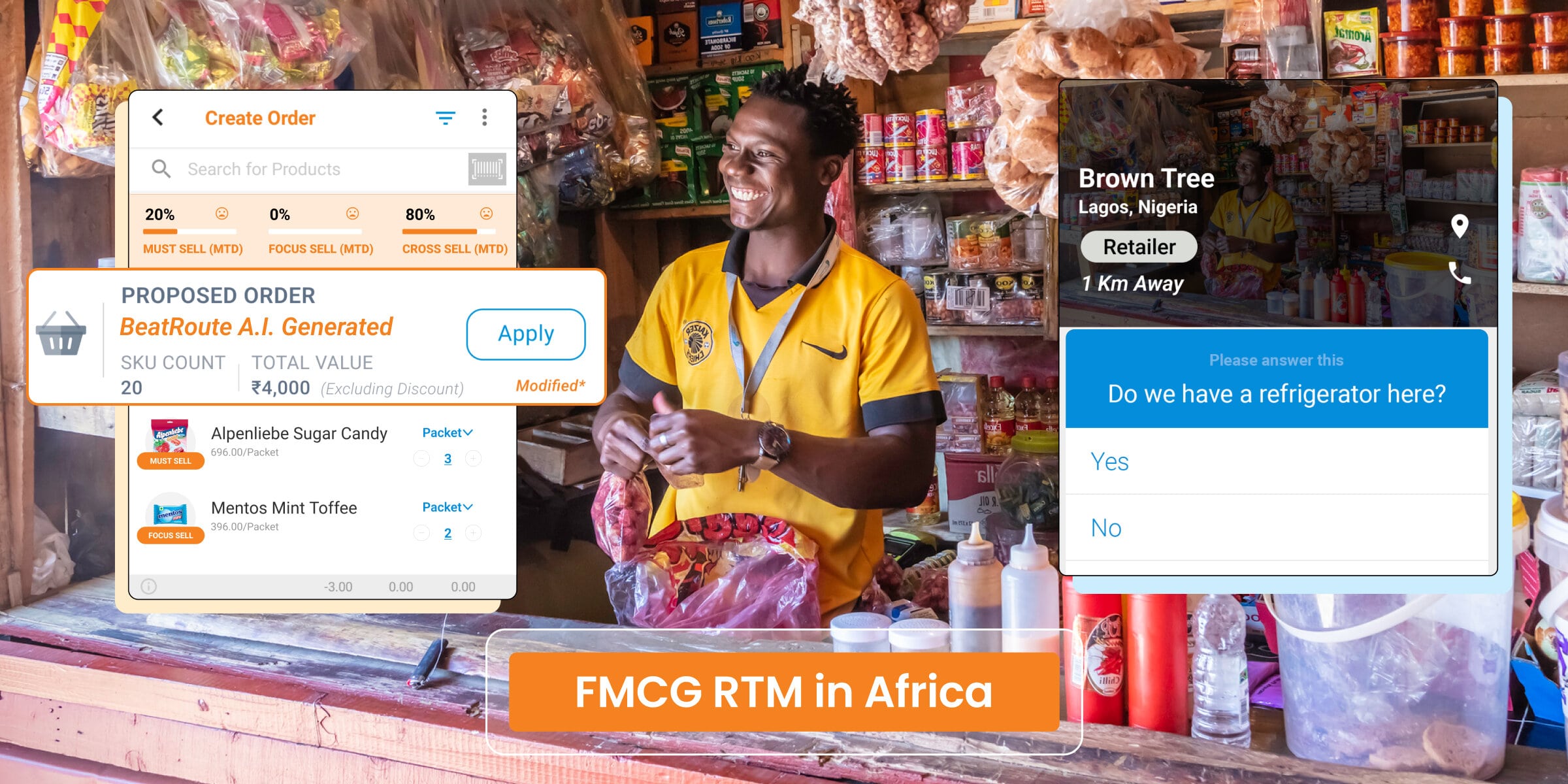
Table of Content
TL;DR FMCG sales and distribution leaders in Nigeria, South Africa, and Egypt need route-to-market technology that handles fragmented retail, poor infrastructure, and limited digital adoption. BeatRoute connects field reps, distributors, and retailers on one Goal-Driven platform, driving measurable sales productivity gains across African markets.
Africa’s FMCG market is growing fast, but fragmented retail, poor roads, and limited digital adoption make route-to-market execution hard. This guide covers how FMCG brands in Nigeria, South Africa, and Egypt can use SFA, DMS, and retailer apps to grow sales per outlet, improve field productivity, and reduce the cost of serving retailers. BeatRoute connects every stakeholder on one Goal-Driven platform, with AAVA Brands (Nigeria) recording 30% higher sales productivity after adoption.
The FMCG sector in Africa
Africa’s FMCG sector spans food, beverages, personal care, and home care. Retail spending has crossed $1.4 trillion, with Nigeria leading at $350 billion. Population growth, rising disposable income, and urbanization keep expanding the opportunity for brands willing to invest in execution.
Traditional retail dominates the continent. Unlicensed or unregistered retailers operate from kiosks and street-side stalls, making localized distribution strategies essential. African consumers prefer to buy close to home and stick to a small group of retailers where they get loyalty benefits. They also buy with value for money in mind, which shapes the SKU mix in primary and secondary sales.
Urbanization has also lifted ecommerce, projected to generate about $67.8 billion by 2027. Formal trade is growing as retail chains expand, but traditional retail still carries the bulk of FMCG volume. BeatRoute helps brands serve both channels from a single Otomatisasi Tenaga Penjualan (SFA) dan Sistem Manajemen Distributor (DMS) platform.
As incomes rise, demand will broaden, and more premium FMCG products will enter African markets. Brands will need human-digital synergy in retail placement, merchandising, ordering, visit hygiene, stock keeping, and complaint resolution to keep up.
African countries with promising FMCG markets
Nigeria
Traditional retailing accounts for about 90% of all retailers in Nigeria. The country is shifting toward modern trade as shopping centres and supermarket chains grow, giving FMCG brands a solid foothold. As disposable incomes rise and urbanization accelerates, brands sell more processed food and beverages through retail.
Nigeria’s geography and thin infrastructure force brands to set up local distribution centres. Local hubs shorten distributor-to-retailer delivery, cut transportation costs, and give brands more control over inventory. BeatRoute connects local distribution centres, retail outlets, and field teams to improve stock keeping, timely ordering, product awareness, and complaint management across the route to market.
Afrika Selatan
South Africa has a highly developed retail infrastructure with deep modern trade penetration. Essential items remain in high demand across food and personal care categories. Traditional retail stores such as spaza shops still serve much of the population, particularly in rural areas.
Experts project traditional retailers will continue to dominate 65 to 75% of sales through 2030. Brands must build strong B2B relationships, and aligning with successful retailers creates stability and expansion. South Africa serves as a gateway for FMCG companies expanding across the continent, making it a strategic starting point for BeatRoute deployment.
Mesir
Egypt’s FMCG market posted 45.3% growth in sales volume in 2023. Consumers focus on essentials and in-home consumption. Smaller pack sizes sell more as disposable income tightens, and local products win over global brands on cost and accessibility.
Traditional channels like grocery stores and corner outlets drive most sales. Modern retail stores allow stronger placement and cleaner stock control. The core gap is the inability of many traditional stores to adopt digital tools for stock and self-ordering. BeatRoute bridges that gap with offline-capable mobile tools and WhatsApp ordering for retailers.
| Rural market in Africa | Urban market in Africa |
|---|---|
| Low disposable income with preference for essential products. | Higher incomes and a growing middle class create preference for premium products. |
| Infrastruktur yang sangat terbatas berarti ketergantungan pada ritel tradisional dan toko-toko kecil. | More modern trade stores such as supermarket chains. |
| Word-of-mouth marketing is more effective. | Consumers see more global and national brands through TV, social media, and the internet. |
| Low technology adoption among route-to-market stakeholders. | Higher smartphone adoption among retailers and distributors. |
How technology fixes FMCG distribution challenges in Africa
FMCG brands in Africa are investing in technology to improve customer service and capture the data that route-to-market operations depend on. The continent has over 500 million unique mobile subscribers. With user-friendly tools that offer real value, retailers and distributors adopt mobile technology that helps them hit sales goals.
When a sales rep visits stores for orders or onboarding, a digital solution always beats physical data capture. Paper is prone to oversight and errors. With a reliable aplikasi penjualan lapangan, reps collect sales potential, store size, consumer demographics, and in-store space during onboarding. Managers then analyze this data and make fact-based decisions about store approvals.
Modern digital solutions also help brands prioritize stores most likely to deliver repeat business. By surfacing stores with better long-term sales potential, BeatRoute pushes reps to focus where revenue lives. Enhanced reporting lets managers track sales performance across regions and build strategies on real data.
What a sales app does for FMCG in Africa
A aplikasi penjualan lapangan supports field activities and digitizes sales operations. It improves productivity by letting field managers oversee store visits and take corrective action when needed. Core capabilities include efficient order taking with auto-scheme application, effective store audits via photo and video capture, a complaints redressal system for accurate tracking, and capture of store details for manager assessment before onboarding.
What a DMS does for FMCG in Africa
A Distributor Management System (DMS) optimizes distribution and improves primary and secondary sales performance. BeatRoute’s DMS supports Tally and Busy Plugins plus other accounting integrations. Distributors place orders with the brand, view secondary orders flowing in from retailers or sales apps, and mark dispatch. Resource management covers deliveries, returns, and payment collection.
What a Retailer & Influencer App does for FMCG in Africa
The Retailer & Influencer App enables retailers to meet their own goals, which in turn fulfills the brand’s goals. Retailers self-order when a sales rep is not available, check transactions, view statements of account, see complaints and their resolution stage, and learn about product launches. BeatRoute Copilot nudges retailers about low stock, new schemes, or the next milestone.
AAVA Brands Nigeria: a BeatRoute case study
AAVA Brands (Nigeria) recorded 30% higher sales productivity after rolling out BeatRoute. The brand struggled with a low ratio of productive retail stores, underperforming sales reps, sub-par average order sizes, and limited distribution channel throughput.
They used BeatRoute’s Field Sales App to align reps and managers on shared goals. Gamification, scorecard KPIs, and rewards motivated their teams to deliver. They also used BeatRoute’s DMS to improve visibility across their order-to-cash and order-to-dispatch cycles. Unifying sales, marketing, visual merchandising, and distributor operations on one platform created strong synergy across their route-to-market strategy. Read the full AAVA Brands case study.
What BeatRoute brings to African FMCG brands
BeatRoute is the only SFA-DMS built to execute your sales goals. Traditional SFAs give you just data. BeatRoute uses Goal-Driven AI to ensure your sales strategy gets executed by your sales team and channel partners across the FMCG route to market in Africa. Everyone works toward shared goals, reinforced by a robust rewards system, while AI-driven workflows lift sales performance further.
BeatRoute enables your sales teams to take orders more successfully with Order AI Agent recommendations and auto-scheme application, delivering 4 to 6% sales uplift from ordering alone. Your distributors get full visibility into primary sales, secondary sales, rewards, and their own stock. Retailers self-order when needed, learn about product launches, lodge and track complaints, and check statements of accounts.
The Scheduling AI Agent helps reps prioritize daily visits based on sales volume achievement, order patterns, payment status, and trade campaign execution. Productive visits have improved from 45% to 78% in reported deployments. The VM Audit AI Agent scores shelf photos for share of shelf, planogram compliance, and competitor benchmarks. BeatRoute Copilot answers natural-language queries from reps and managers in multiple languages.
BeatRoute customers see a 12.6% average sales uplift in the first year. The platform serves 200+ customers across 20+ countries with BeatRoute Matrix providing 300+ enterprise integrations.
Get a free demo of BeatRoute’s FMCG Sales Platform to see how it fits your African route to market.
Where African FMCG distribution goes next
Africa’s FMCG opportunity will keep growing as populations rise and urbanization accelerates. Brands that invest in digital route-to-market execution now will capture more market share as the shift from traditional to modern trade continues. The winners will be those who bring sales teams, distributors, and retailers onto a shared platform with clear goals and AI-powered decision support.
BeatRoute’s Goal-Driven AI guides every rep and channel partner toward the outcomes your goals define, across traditional and modern trade. The next wave of growth belongs to brands that move from tracking activities to executing outcomes.
Pertanyaan yang sering diajukan
What is FMCG route to market in Africa?
FMCG route to market in Africa is the combined system of sales teams, distributors, and retailers that moves everyday products from brand to consumer across traditional trade, modern trade, and rural coverage. It depends on local distribution hubs, field execution, and digital tools that keep stock moving in markets like Nigeria, South Africa, and Egypt.
Why is traditional retail so important for FMCG brands in Africa?
Traditional retail carries the bulk of FMCG volume across Africa, with Nigeria alone running at about 90% traditional retailers. Kiosks, spaza shops, and corner stores sit closest to consumers and drive repeat daily purchases. Brands that win in traditional trade win the category.
How does BeatRoute help FMCG brands execute their route to market in Africa?
BeatRoute brings sales teams, distributors, and retailers onto one platform. Goal-Driven AI ensures your FMCG sales strategy gets executed, while the Order AI Agent lifts average order values by 4 to 6% and the VM Audit AI Agent keeps shelves compliant. AAVA Brands (Nigeria) recorded 30% higher sales productivity after adoption.
What distribution challenges do FMCG brands face in Africa?
African FMCG brands face fragmented retail networks, poor road infrastructure, limited digital adoption in rural areas, and a heavy reliance on local distributors. These factors cause delays, stock confusion, and uneven coverage. BeatRoute’s offline-capable mobile tools and WhatsApp ordering reduce these friction points.
How does technology reduce the cost of serving retailers in Africa?
Digital tools replace paper-based capture with accurate store data, AI-driven order recommendations, photo-based audits, and full visibility across primary and secondary sales. BeatRoute’s Route Optimization helps HQ planners design lowest-cost serving networks, while the Scheduling AI Agent ensures reps visit the right stores at the right time.