 Soham Chakraborty
TL;DR This article is for field sales managers and brand execution leads who need retail audits that produce same-day corrective actions, not PDF reports nobody reads. It covers what retail audits are, the different types, common mistakes, best practices, and a 10-step checklist your field team can follow on every store visit. BeatRoute’s VM Audit AI Agent scores every shelf photo automatically and routes flagged issues back into the rep’s beat plan.
What a retail audit is and why it matters
A audit ritel is how a brand checks whether each outlet is stocking, pricing, and displaying its products the way the plan intended. More importantly, it checks whether those standards are actually moving the needle at the shelf. Done well, a retail audit converts store visits into a steady feed of signals your field team can act on the same day.
The problem with most retail audits is that they generate data, not decisions. Forms get filled, photos get uploaded, and the gap between “what we saw” and “what we fixed” stays wide. BeatRoute is the only SFA-DMS built to execute your sales goals, so audits do not just record reality. They trigger the next action: a re-merchandising visit, a stock replenishment, or a scorecard update for the rep.
Research shows that 86% of consumers are willing to pay more for a better customer experience. Retail audits are the mechanism that ensures the in-store experience matches what the brand promised.
Types of retail audits
A retail audit can cover multiple categories in a single visit or spread them across separate visits. Each type targets a different aspect of in-store execution. Here is what each one covers and why it matters.
| Audit type | What it checks | Why it matters |
|---|---|---|
| Merchandising audit | Product placement, shelf space, lighting, signage, pricing visibility, visual appeal | Products placed correctly at eye level with visible pricing convert more shoppers |
| Competitor audit | Competitor product placement, signage, promotions, shelf share | Understanding competitor tactics informs better in-store counter-strategies |
| Inventory audit | Stock on record vs. actual stock, low-stock and overstock flags | Prevents stockouts that kill sales and overstocking that ties up working capital |
| Marketing audit | Brand visibility, marketing material presence, campaign reach | Confirms that marketing spend is translating into actual in-store presence |
| Promotion audit | Discount execution, campaign implementation, consumer reception | Validates that promos run as planned and identifies which ones drive lift |
| Quality audit | Seal integrity, packaging condition, expiry dates | Protects brand image and prevents customer complaints from damaged goods |
| Brand image audit | Store aesthetics, lighting, ambiance, brand presentation | Ensures the overall store environment reinforces the brand rather than undermining it |
| Consumer satisfaction audit | Staff helpfulness, promoter performance, consumer feedback | Captures the end-consumer experience that drives repeat purchases |
A smart merchandising visual tool backed by AI makes the whole process faster and more consistent. BeatRoute’s VM Audit AI Agent handles scoring across merchandising, competitor, and quality dimensions from a single set of shelf photos.
Advantages of running regular retail audits
Retail audits produce four measurable benefits when run consistently.
Stronger channel partner cooperation. Audits formalize the expectations between brand and retailer: signage placement, product positioning, hygiene standards, and in-store space. When both sides see the same scorecard, the partnership becomes more transparent and accountable.
More precise data for better decisions. A primary function of retail audits is gathering structured data from the field, archiving it, and using it to find what works and fix what does not. BeatRoute stores every audit result against the outlet profile, building a historical record that improves decision accuracy over time.
Cost savings and sales growth. Catching issues early (expired stock, missing displays, wrong pricing) costs far less than damage control after the fact. Brands using BeatRoute’s perangkat lunak audit ritel resolve shelf issues on the same visit cycle they are detected, preventing revenue leakage before it compounds.
Better retailer experience. When audits lead to actionable feedback (not just criticism), retailers see the brand as a partner invested in their success. Proper audits ensure products, promotions, inventory, and merchandising are genuinely effective, which helps the retailer sell more and generate better revenue on their end.
Common mistakes to avoid during retail audits
Even well-intentioned audit programs fail when they repeat these five mistakes.
Mistake 1: No clear objectives. Auditors without defined criteria produce inconsistent data. Set specific, measurable objectives for each audit type and provide auditors with standardized checklists they can reference on every visit.
Mistake 2: Untrained auditors. Reps who do not understand the audit process, the product standards, or the technology they need to use produce unreliable results. Train them on the audit workflow, your product portfolio, and the tools (like BeatRoute’s mobile app) before sending them into the field.
Mistake 3: Inadequate sample size. Auditing only a few stores, or skipping certain outlet classes, creates a skewed picture of brand performance. Include different store classes and locations to get a complete view. BeatRoute makes this easier by embedding audit tasks into every beat plan, so audits run across the full outlet universe rather than a cherry-picked sample.
Mistake 4: Relying on manual data collection. Paper forms and manual tallies introduce transcription errors and inconsistent scoring. The VM Audit AI Agent inside BeatRoute scores every photo for planogram compliance, share of shelf, and promo presence automatically. The same scoring rubric applies to every store, every time.
Mistake 5: Treating audits as evaluative instead of collaborative. Retailers disengage when audits feel like inspections. Share findings constructively and frame corrections as mutual improvements. BeatRoute’s outlet-level scorecards give retailers visibility into their own performance, turning the audit into a partnership tool rather than a policing exercise.
Best practices for effective retail audits
Plan your data collection method in advance. Determine what data you need (inventory counts, compliance scores, photo evidence, customer feedback) and define the methodology before the auditor reaches the store. BeatRoute’s configurable audit templates let you standardize data collection across the entire field team.
Use retail audit software built for field teams. Your auditors move store to store checking promotions, merchandising, inventory, and customer satisfaction. A tool like BeatRoute gives comprehensive audit capabilities, versatile input options, and KPI tracking with complete transparency from the auditor to their manager to brand HQ. Capturing, analyzing, and acting on audit data through a mobile app (not paper) is what turns audits from a reporting exercise into a feedback loop.
Look for a tool that supports photo capture as part of the audit report. If an auditor sees a misplaced product, a damaged item, or any other deviation, a photograph is clear proof for HQ. BeatRoute’s VM Audit AI Agent reads those photos automatically, detecting planogram deviations, missing SKUs, and share-of-shelf drift, and routes the flagged outlets back into the rep’s beat plan for a fix visit.
Digitize and standardize forms. Digital forms eliminate the risk of lost paper and inconsistent handwriting. Create standardized, scannable checklists that cover every audit dimension and leave room for additional notes. BeatRoute’s form builder lets brands configure audit templates by outlet class, region, or audit type.
Communicate audit timing with retailers. Agree on date, time, and duration with the retailer in advance. Unannounced audits during peak footfall periods disrupt the retailer’s business and produce unreliable data. Coordinated scheduling builds trust and produces cleaner results.
10-step retail audit checklist for field teams
Use this checklist on every store visit to ensure nothing gets missed. Each step produces a data point that feeds back into your execution system.
1. Product placement and planogram compliance
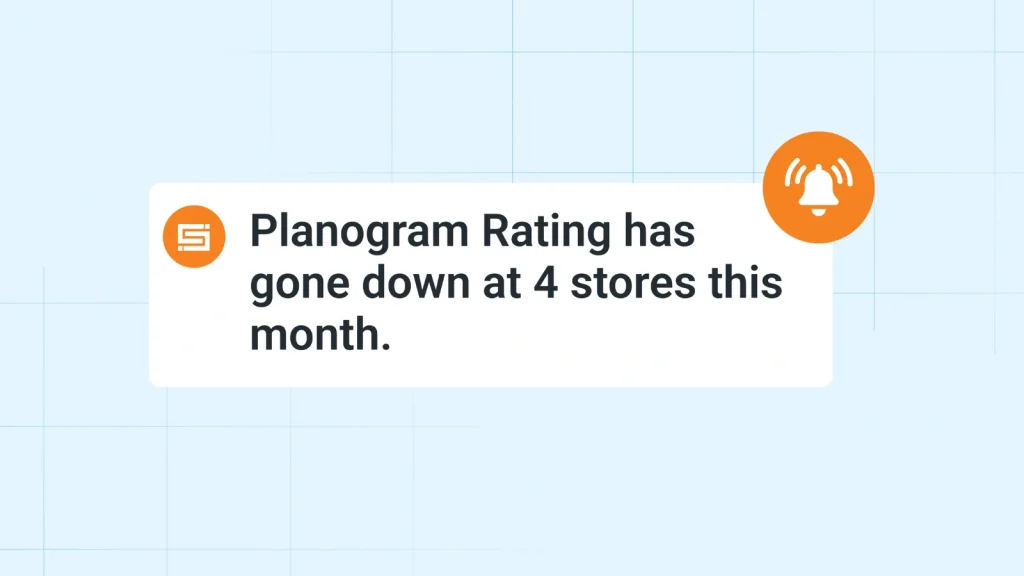
- Check if products are placed according to the brand’s layout plan
- Verify shelves are tidy, products are at eye level, and lighting is adequate
2. Pricing and signage
- Confirm shelf prices match current promotions
- Check that signs are visible, accurate, and in good condition
3. Inventory accuracy
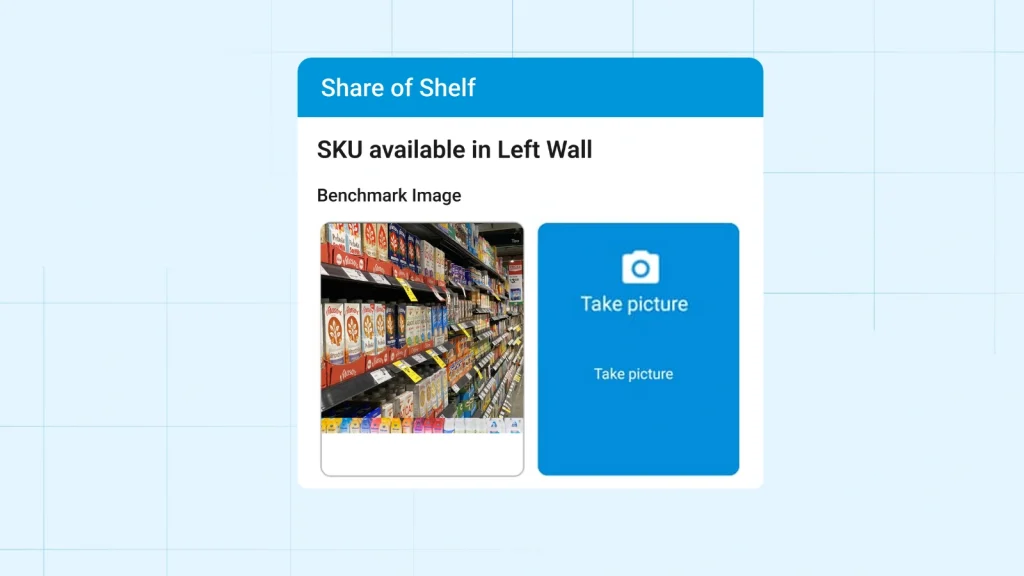
- Compare stock recorded in the system with actual stock on the shelf and in the back room
- Flag items that are running low or overstocked
4. Competitor positioning
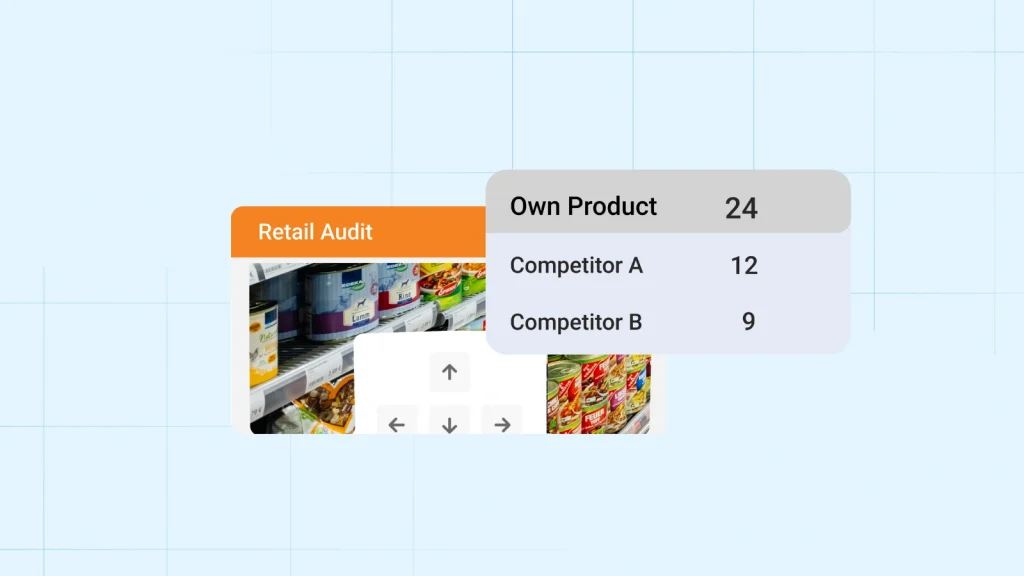
- Observe how competitors have placed their products and run promotions
- Capture photos for later review and strategy planning
5. Promotions and campaign execution
- Verify all current promotions are displayed as planned
- Check that promotional materials are complete and undamaged
6. Quality control
- Look for damaged packaging, expired products, or broken seals
- Remove any products that do not meet quality standards
7. Store and brand presentation
- Check cleanliness, lighting, and overall appearance of the store
- Verify that the store reflects the brand’s image standards
8. Consumer experience
- Observe how store staff interact with customers
- Collect customer feedback when possible
9. Photographic evidence
- Take clear photos showing both correct and incorrect setups
- Attach photos to the audit report as proof for HQ and as input for the VM Audit AI Agent
10. Immediate action log
- Record any urgent issues found during the audit
- Share them with the right team immediately so corrective action starts the same day
BeatRoute embeds this entire checklist into the rep’s mobile workflow. Each step is a form field or photo capture that feeds directly into the outlet scorecard. The VM Audit AI Agent scores the photos, flags deviations, and pushes corrective tasks back into the beat plan automatically.
How does BeatRoute turn retail audits into same-day action?
BeatRoute’s VM Audit AI Agent reads store photos, detects planogram deviations and missing SKUs, and returns a compliance score in seconds, turning every audit finding into a same-day corrective action.
There is no shortage of alat bantu audit ritel on the market. Finding one that closes the loop between observation and action is another challenge. BeatRoute’s AI-powered visual merchandising software changes the equation for eksekusi di dalam toko.
The VM Audit AI Agent reads store photos, detects planogram deviations, missing SKUs, and promotional gaps, and returns a compliance score in seconds. Issues are flagged in real time and fed back into the rep’s next visit, so merchandising standards hold up across every outlet. Over 200 enterprise brands across 20+ countries trust BeatRoute to run their retail audits, with a 12.6% average sales uplift in the first year.
With BeatRoute, your field team gets:
- Robust data gathering with geo-tagged images and KPI tracking
- Real-time communication of audit findings across the organization
- High scalability from 50 outlets to 50,000 outlets
- Collaboration powered by automation rather than manual follow-up
Minta demo gratis to see how BeatRoute’s retail audit workflow turns every store visit into a measurable improvement.
Pertanyaan yang sering diajukan
What is a retail audit?
A retail audit is a structured check on how each outlet executes on the brand plan: placement, pricing, promotions, inventory, and overall store presentation. The output is a list of gaps that the field team closes on the next visit. It is the feedback loop that keeps in-store execution honest, cycle after cycle.
How often should a retail audit be run?
Frequency depends on outlet tier and category velocity. High-throughput outlets and promotion-heavy SKUs usually warrant weekly or bi-weekly audits. Long-tail outlets can run on a monthly or quarterly cycle. The better question is whether each audit produces a same-day action. If it does not, higher frequency alone will not help.
What does an AI retail audit actually do?
It replaces manual tallies with image recognition. The VM Audit AI Agent reads every store photo, scores it against the planogram, detects missing SKUs and share-of-shelf drift, and pushes flagged outlets back into the rep’s beat plan for a fix visit, all before the auditor leaves the store.
What is the difference between a retail audit and in-store execution?
In-store execution is the work: placing stock, setting the planogram, running promotions. A retail audit is how you verify that work actually happened the way it was planned. Audits without execution changes are reporting. Execution without audits is guesswork. You need both.
What KPIs should a retail audit track?
The core set includes planogram compliance, share of shelf, on-shelf availability, price compliance, promotion presence, and damage or expiry incidents. Layer on an outlet-level action-close rate (the percentage of flagged issues fixed before the next visit) to measure whether the audit program is actually improving execution.
Do we still need field auditors if AI scores the photos?
Yes, with a different job. Field reps still capture photos, talk to retailers, and close the actions the AI flags. What changes is that they stop filling forms and transcribing data. The VM Audit AI Agent handles scoring. The rep focuses on the fix.