


Short answer A channel loyalty program is a reward program for the trade partners who sell or recommend your product. They include distributors, dealers and retailers, and tradespeople such as mechanics and painters. It works when every point traces back to a sale you can check, and when partners can join, earn points and get paid from their phone.
What is a channel loyalty program?
A channel loyalty program, also called a channel rewards program or channel partner loyalty program, gives each partner one earning account that runs across seasons. That gives them a reason to keep choosing you after any single scheme or incentive ends. The aim is share of wallet: more of what the partner buys, stocks or recommends in your category comes to you. It is one part of your wider trade channel marketing.
Each partner makes a different choice every day, so each needs its own rules:
- Retailers decide what to stock and reorder. Reward ordering every cycle, more lines per order and must-sell products, with rewards they can redeem quickly. In larger stores, enrol the counter staff who recommend brands as well.
- Distributors and dealers decide which brand their salespeople push. Reward their sales to retailers and new outlets as well as their own purchases. See how a dealer loyalty program works.
- Influencers such as painters, mechanics and masons pick the product on the job but rarely buy from you. An influencer loyalty program rewards that choice, usually through a QR code on the pack.
Start with the partner who has the most say over what sells, and ask before you pick a reward: would this behaviour have happened anyway?
Types of channel loyalty programs
| Type | How partners earn | Suits | Watch out for |
|---|---|---|---|
| Points per unit | Points for each case, litre or pack bought or scanned | Retailers and influencers | Paying steady buyers for what they already buy |
| Tiered | Higher levels, such as silver, gold and platinum, earn more per unit | Distributors, dealers, large retailers | Partners near the next level may overstock |
| Rebate or target scheme | Cashback or credit for hitting a target in a quarter or season | Launches and seasonal pushes | Sales pulled forward, then a dip |
| Scan to earn | The influencer scans a code on the pack after using it | Painters, mechanics, masons, electricians | Codes scanned in bulk with no real job |
| Activity rewards | Points for a display, a training or a referred outlet | Launches and visibility drives | Each action needs proof, such as a rep’s photo |
| Experiential | Trips or events for the top performers in a period | Large dealers and top influencers | Only the top few take part |
Everyday points and period purchase schemes can share one budget, with the schemes on the lines you most want to push. For reward redemption, partners can choose bank transfers, wallet payouts, invoice credit, gift cards or catalog items. Small retailers and influencers often prefer cash or wallet payouts, because the value is plain to see. For tiers and reward formats in depth, read our guide to B2B reward programs, and for workshops, our mechanics loyalty program guide.
Pay rewards from secondary sales, not from claims
What matters most is where each point comes from. A reward the partner has to claim is a scheme claim under another name and needs the same checks. A reward worked out from sales data you already trust needs far fewer. Our rule:
- Retailers earn from the distributor’s bill to the retailer, your secondary sales. It covers bulk orders where scanning every pack is not practical.
- Distributors earn on stock that sold through to retailers, which their own billing shows.
- Influencers earn from a unique code or serial number on a pack you shipped, with limits on bulk scans, because no invoice carries their name.
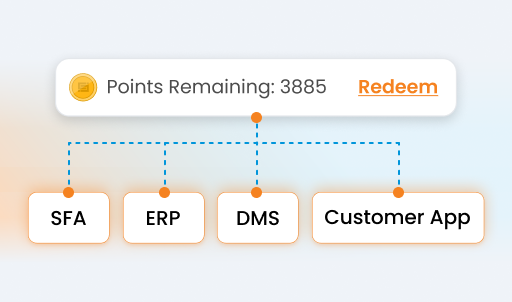
When points and distributor billing sit in one system, the loyalty payout and the scheme settlement come from the same numbers, and a duplicate invoice shows up before it is paid.
If a point cannot be traced to a line on a bill or to a unique code you issued, it is a claim, not a sale.
The same logic sets the budget. Fund the program from the trade scheme budget you already spend, moving money out of flat discounts that every partner gets whatever they do. Keep a reward while its cost per extra unit stays below the margin on that unit, and drop it when it does not.
How to design a channel partner loyalty program
- Set one goal. A program with five goals rarely moves any of them.
- Clean the partner list. Keep one record per outlet, linked to its distributor, with a phone number that works on WhatsApp. Duplicate outlets split a partner’s points and break the link to billing.
- Choose who takes part, what earns and the proof for each, using the rule above, with limits per partner and per period.
- Enrol partners on visits. Have reps sign them up during their usual store calls, over WhatsApp in the partner’s language, since many will not install another app.
- Train reps on what partners could earn, rather than how the tiers work. On episode 9 of the BeatRoute Podcast, channel loyalty specialist Manas Bisht said that under 60 percent of enrolled channel partners actively use their programs, against 80 to 90 percent in a healthy one. Let reps log the objections they hear in the first weeks.
- Credit points when the bill posts, not at month end. Slow payouts break trust faster than small rewards do.
- Message partners when points land and when they near the next level.
How to measure a channel loyalty program
Measure whether partner behaviour changed and whether that paid for the rewards:
- Active rate: the share of enrolled partners who earned in the last cycle.
- Redemption rate and time to pay.
- Behaviour change: order frequency, lines per order or scans, against a control region.
- Share of wallet: your share of the partner’s buying in the category.
- Cost per extra unit: reward and running cost divided by volume above the baseline.
- Dormant partners who stopped earning.
Pilot first: one region or partner tier for a full buying cycle, with a similar region as the control. If the pilot moves and the control does not, go to the next region. For why programs stall, read why dealer loyalty programs fail.
How to choose channel loyalty software
| Kind of solution | What it does | Suits |
|---|---|---|
| Standalone loyalty platform | Its own partner app, rules and catalog, apart from your sales systems | Brands with no field sales or distributor system |
| Loyalty inside sales software | Rewards run in the field sales and distributor system, so points match billing | Brands that run reps and distributors and want one set of numbers |
| Program run by an agency | An agency designs and runs it, including partner support and reward delivery | Teams with no one to run it day to day |
| Reward or voucher tool | Sends gift cards or runs one contest, without earning rules | A short push |
In a demo, ask to see a duplicate invoice being caught and a dormant partner being flagged. Those two screens tell you more than a feature list.
BeatRoute runs loyalty management inside its field sales and distributor management software. Points reconcile against primary and secondary sales. Partners join on WhatsApp or a light web app and redeem for cashback, gift cards or catalog rewards. Fraud checks run on QR scans, invoices and referrals, and BeatRoute Copilot flags dormant partners. BeatRoute suits brands that already run field teams and distributors and want loyalty in the same system as orders and visits; if you only need gift cards for a one-off contest, a simple voucher tool will do. More than 200 enterprise brands in 20+ countries run on BeatRoute. To see how a pilot region would run, book a demo.
Frequently asked questions
How is a channel loyalty program different from a channel incentive program?
A channel incentive program usually pays for one push, such as a quarterly target, and ends with it. A loyalty program keeps an account for each partner across seasons. An incentive can run inside the loyalty program and pay into the same balance.
Should we run a channel loyalty program in-house or through an agency?
Run it in-house if your team can handle partner calls and reward delivery, and use an agency if not. Either way, keep the rules and sales data on your side, so you can change agencies without losing the history.
Should reward points expire?
Usually, after a set period and with reminders before they lapse. Expiry gives partners a reason to redeem and keeps what you owe predictable. Points that vanish without warning cost more trust than they save.
Who should own a channel loyalty program?
Trade marketing usually sets the rules and the budget. Sales owns enrolment and follow-up, because reps are the ones who visit partners. Finance signs off settlement. Give one person the partner list, so nobody is enrolled twice.
How much does BeatRoute cost?
BeatRoute is subscription software, priced per user and module on annual contracts, with no free trial.