

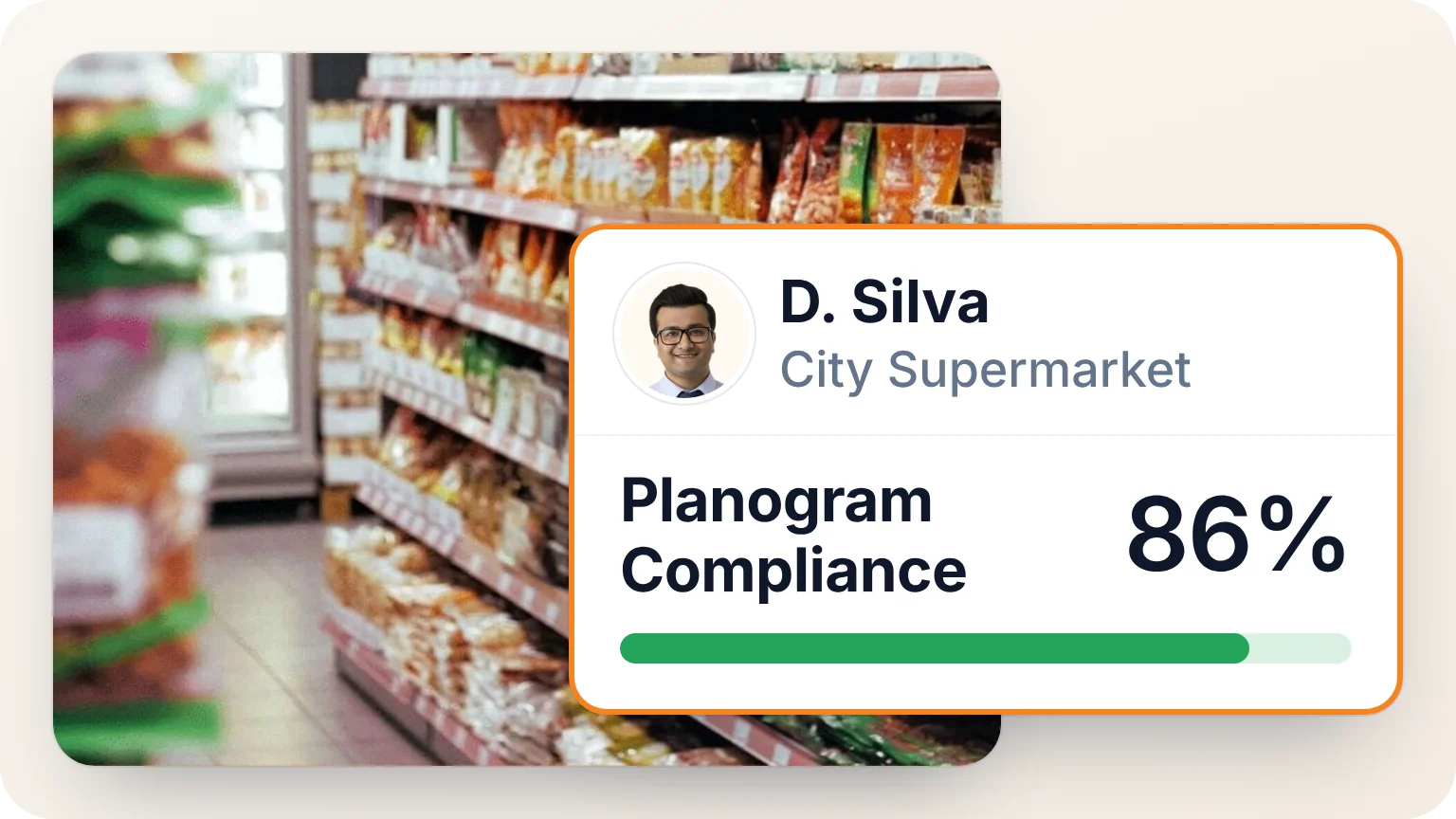
In short FMCG merchandising is the work of keeping a brand’s products in stock, in the right place, fresh, priced and promoted in every store that sells them. Visual merchandising (VM) in FMCG is the display part: how a brand’s packs, displays and point-of-sale materials look in the store, so the shopper sees the product and picks it up.
Fast-moving consumer goods sell on habit and impulse. A shopper who cannot find your pack picks the one next to it, so the shelf shapes the choice. A brand has to get that shelf right in thousands of stores it does not own.
Principles of FMCG visual merchandising
A rep can check most of these in a shelf photo:
- Eye level sells. Key SKUs go on the shelf at the shopper’s eye line, where shoppers look first.
- Block the brand. Packs of one brand stand together (brand blocking), so the shopper sees one strong block.
- One focal point. A single eye-catching display per aisle or counter beats five small ones fighting for attention.
- Follow the shopper’s path. Store layout decides where people walk, so displays go at the entrance, aisle ends and till.
- Keep it clean. Faded signage, torn shelf strips and dusty packs tell the shopper the product is old.
Types of FMCG displays and POSM
| Display or POSM | Where it sits | What it is for | Where it is used most |
|---|---|---|---|
| Shelf talkers and wobblers | On the shelf edge | Call out a price, offer or new pack | Both channels |
| Branded shelf or rack | In the aisle or behind the counter | Give the brand its own space, agreed with the owner | General trade |
| End cap (gondola end) | At the end of an aisle | Hold a promotion, launch or seasonal range | Modern trade |
| Floor stand or dump bin | In open floor space | A secondary display for a promotion, away from the main shelf | Modern trade |
| Chiller or cooler | Near the entrance or counter | Keep drinks and dairy cold, with the brand on the door | Both channels |
| Counter display | At the till | Sell small impulse packs while the shopper pays | Both channels |
See our guide to point-of-sale material (POSM) for how brands track each kind.
Visual merchandising examples in modern and general trade
The same brand does VM differently in modern trade and general trade. Two typical cases:
A launch end cap in a supermarket (modern trade). Shoppers serve themselves, so the shelf does the selling. The brand agrees an end cap and shelf talkers with the chain for the launch period. On each visit the merchandiser photographs the end cap and the main shelf. The common miss is a full end cap while the new pack is out of stock on the main shelf, so the rep raises the order before leaving.
A branded cooler in a small shop (general trade). The shopkeeper decides what goes where. The brand’s visibility is mostly a rack, cooler or sign it has placed in the shop. The rep checks on each order visit that the cooler still holds the brand’s packs, hero SKU on top, and not someone else’s. When it keeps filling with other brands, the sales manager takes it up with the owner.
What does FMCG merchandising cover?
In food, drinks, personal care and household goods, retail merchandising comes down to six jobs, and visual merchandising is one of them:
- Product availability: the must-stock SKUs for that store are on the shelf.
- Product placement: packs sit where the planogram says, with the agreed facings.
- Rotation: older stock moves to the front (first in, first out, or FIFO), and for chilled goods the pack that expires first goes first (FEFO).
- Visibility: displays and point-of-sale materials (POSM) are up and in the right spot. This is the VM job.
- Promotion and price: the paid offer is live and the shelf tag matches the till.
- Reporting: what the visit found and fixed reaches the people who plan.
The six jobs work together: a display in front of an empty shelf sells nothing.
Merchandising standards and planograms in FMCG
Merchandising standards in FMCG are the written rules for how a brand should look in each type of store: which SKUs must be stocked, how many facings, which shelf position, what share of shelf, which POSM and how prices are shown. A standard turns “make it look good” into something a rep can check and a manager can score.
The planogram is the picture of that standard: a shelf map of where each SKU goes and how many facings it gets. Brands keep one layout per store format.
Store staff move stock and other brands take space. In many stores the brand pays for its shelf space or display, so a shelf that drifts from the planogram is space the brand paid for and did not get. See our post on planogram compliance.
How brands check merchandising compliance at scale
No brand can send a manager to every shelf, so most use photo audits. The VM or trade marketing team writes the standards, sends out POSM and reads the results. Sales reps, merchandisers (from the brand, the distributor or an agency) and promoters take shelf photos in a mobile app on every visit, each stamped with the time, place and store.
Image recognition can score each photo against the brand’s benchmark for planogram compliance, share of shelf and competitor presence while the rep is still in the store.
The score is only half the job. Decide in advance who owns each kind of gap:
- The rep fixes it in the visit: stock the store has in the back, packs out of place, a missing shelf talker.
- The manager takes it: a shelf price that differs from the till, another brand’s stand in your paid space, a store that keeps losing its display.
Each gap becomes a ticket for a named person, and the next visit checks it. Retail audit software keeps the form, photos and follow-up in one visit.
KPIs for FMCG merchandising
| KPI | What it tells you |
|---|---|
| On-shelf availability (or out-of-stock rate) | How often must-stock SKUs are on the shelf |
| Planogram compliance and facings | How closely the shelf and facings match the planogram |
| Share of shelf | The brand’s share of the shelf space in its category |
| POSM and display compliance | Whether agreed displays are up and in good shape |
| Promotion and price compliance | Whether the offer is live and the price right |
| Audit coverage | Share of target stores audited in the period |
| Time to fix | How long a ticket stays open after the gap is found |
Track these by store, region and channel, because a national average hides the stores falling behind. Read compliance next to sales for the same stores: a display that scores well but does not lift off-take is the one to redesign, not the rep to chase.
How BeatRoute helps with FMCG visual merchandising
BeatRoute’s visual merchandising software runs the whole loop on the same platform as sales force automation and distributor management. The VM team sets planograms, POSM and share-of-shelf targets by outlet type or region, and reps capture the shelf in the app, even offline.

The VM Audit AI Agent, now in field runs with customers, scores each shelf photo against the benchmark the brand uploads. It needs no pretraining for new SKUs or planograms. BeatRoute puts the agent’s shelf-audit cost at 80% lower than manual audits and 40% lower than traditional machine-learning audits. Dashboards show compliance next to sales and off-take. BeatRoute suits brands whose reps, merchandisers or promoters check stores the brand does not own; a retailer auditing its own stores for safety and operations needs a store operations tool instead.
AAVA Brands, an FMCG company in Nigeria, runs its field sales and distributors on BeatRoute SFA and DMS. It set out to fix slow response to poor must-sell compliance, the availability job above. With sharper tracking of distribution and coverage in SFA and DMS, AAVA grew store-level sellouts 25–30%. Read the AAVA Brands case study.
Book a demo to see shelf audits run on the same platform as your field sales.
Frequently asked questions
What does VM mean in retail?
VM is short for visual merchandising; in retail, that is the full form of VM. VM material is the display kit itself: racks, shelf strips, wobblers and signs. The VM team is the brand team that designs that kit and sets the visual standards that reps and merchandisers follow.
How is FMCG visual merchandising different from fashion retail?
A fashion retailer owns its stores, so its VM is about windows, mannequins and lighting. An FMCG brand sells through stores it does not own. Its VM is about winning shelf and display space from the store owner, then checking on every visit that it still looks as agreed.
How often should FMCG displays change?
Promotional displays such as end caps and shelf talkers come down when the promotion ends. Racks and coolers stay, and their artwork changes for a launch or a season. Whatever the cadence, the standard for each store type should change on the same day, so reps are not scored against last season’s planogram.
What does an FMCG merchandiser do?
An FMCG merchandiser visits stores to restock and rotate shelves, set facings to the planogram, put up POSM and check prices and promotions. They record what they found and fixed with photos in a mobile app.