

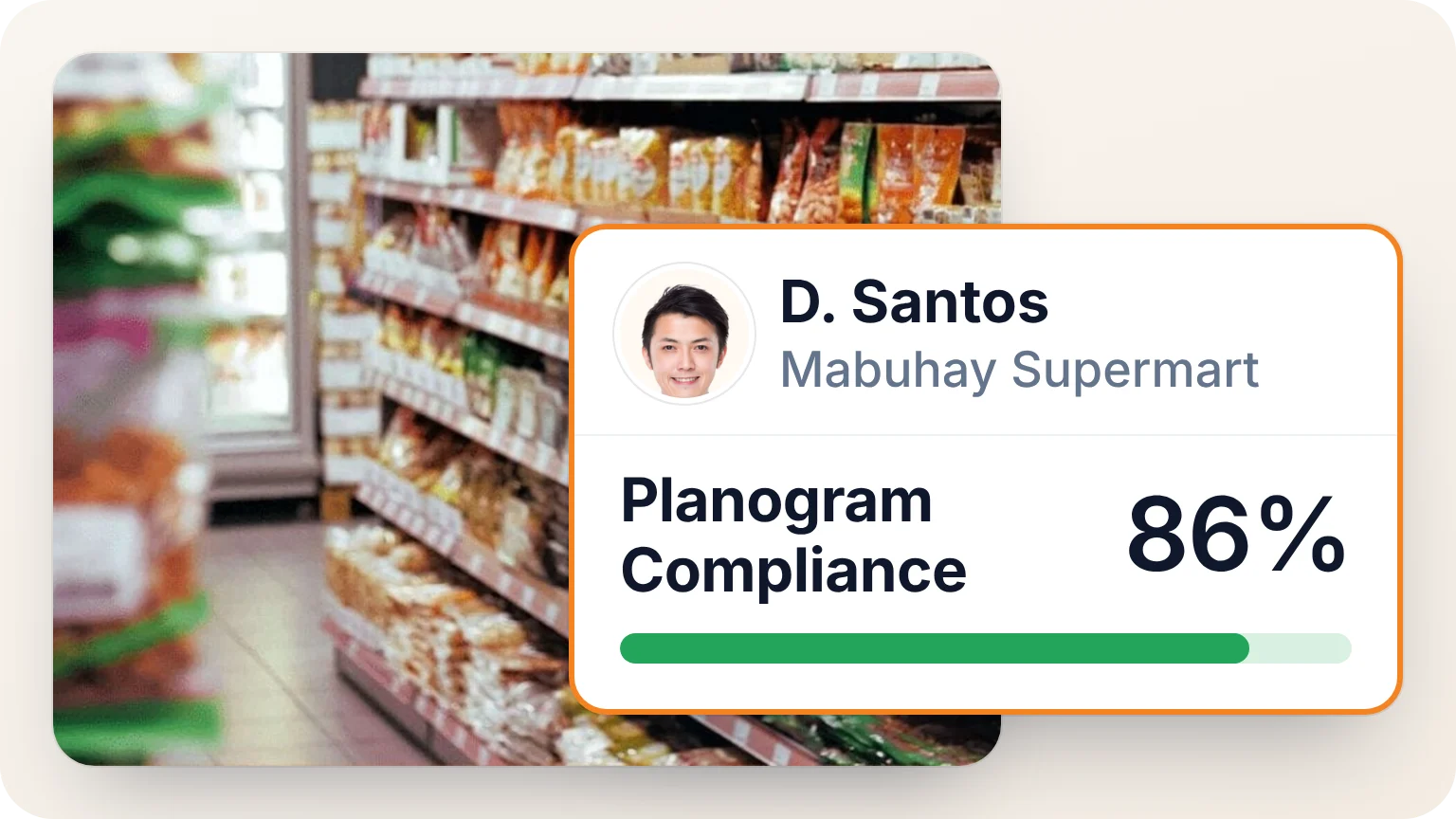
In short FMCG merchandising means your products are on the shelf, in the right spot, fresh, correctly priced and promoted in each store that carries them. Visual merchandising (VM) covers the display side. A Philippine brand writes one standard for each outlet type, from the sari-sari store to the supermarket, and checks it with shelf photos at every visit.
Shoppers buy FMCG by habit and on impulse. If they cannot spot your pack, they take the one beside it. So the shelf decides a large share of sales. In the Philippines that shelf can be a supermarket aisle in Metro Manila or a sari-sari store counter in Mindanao. A brand with thousands of outlets has to get both right.
What does FMCG merchandising cover?
For food, drinks, personal care and household brands, the work in the store comes down to six jobs:
- Availability. Every must-stock SKU for that outlet is on the shelf, with no gaps. The range depends on the outlet. A sari-sari store carries the core packs, and a supermarket carries the full line.
- Product placement. Packs go where the planogram puts them, with the agreed facings and shelf height. Key SKUs sit at eye level. Packs of one brand are kept together (brand blocking) so the shopper sees a single strong block.
- Rotation and freshness. Older stock is pulled to the front so it sells first (first in, first out, or FIFO). Expired or damaged packs are taken off.
- Visibility. Displays and point-of-sale materials (POSM) are up, in good shape and in the agreed spot.
- Promotion and price. The promo the brand paid for is running. The shelf tag shows the same price the cashier charges.
- Reporting. What the visit found and fixed gets back to the people who plan what happens next.
Visibility is the VM job. When FMCG teams talk about VM, the VM team or VM materials, they mean displays, POSM and the way the brand looks in store. But the six jobs work only together. A fine display above an empty shelf sells nothing.
Types of FMCG displays and POSM
| Display or POSM | Where it sits | What it is for |
|---|---|---|
| Shelf talkers and wobblers | On the shelf edge | Call out a price, an offer or a new pack at the moment of choice |
| Branded shelf or rack | In the aisle or behind the counter | Give the brand its own space, often agreed with the store owner |
| End cap (gondola end) | At the end of an aisle | Hold a promotion, a launch or a seasonal range where traffic is high |
| Floor stand or dump bin | In open floor space | Add stock and shelf presence for a promotion away from the main shelf |
| Visi-cooler or chiller | Near the entrance or counter | Keep drinks and dairy cold and carry the brand on the door |
| Counter display | At the cashier | Sell small impulse packs while the shopper pays |
| Tarpaulin, window and outdoor signage | Outside the store | Tell people passing by that the brand is sold here |
Many displays change with the season. In the Ber months, for example, end caps and floor stands often get Christmas artwork, and the same fixture is dressed again for a launch. To see each kind of material and how brands track it, read our guide to point-of-sale material (POSM).
Merchandising standards and planograms in FMCG

A merchandising standard is the brand’s written rule for how it should look in one type of outlet. It sets a target for each of the six jobs. That covers the must-stock SKUs, the facings, the shelf, the share of shelf, the POSM and how price is shown. With it, “make it look good” becomes something a rep can check and a manager can score.
The planogram draws that standard as a shelf map. It shows where each SKU goes and how many facings it gets. Most brands keep one layout per store format, because a hypermarket, a convenience store and a sari-sari store have very different shelves. Standards shift with campaigns too. For a few weeks of promo, the standard may add an end cap and a shelf talker.
A standard helps only when stores follow it, and shelves drift. Staff shift stock, shoppers return packs to the wrong place and other brands creep into your space. Many brands pay for shelf space or display, so a drifting shelf is space paid for and not received. Our post on planogram compliance covers how brands keep shelves on plan.
Modern trade and general trade merchandising

Modern trade (MT) covers supermarkets, hypermarkets, groceries, drugstore chains and convenience stores. Shoppers pick up packs themselves, so the shelf does the selling. The brand agrees planograms and paid displays with the chain, and promodisers visit or are posted in the bigger stores. Watch planogram compliance, share of shelf and promotion compliance first.
General trade (GT) covers sari-sari stores, wet market stalls, kiosks and small wholesalers. The storekeeper serves the shopper and space is tight. Visibility comes from a branded rack, a visi-cooler, a tarpaulin and whatever facings the owner agrees to. The sales rep usually does the merchandising during the order visit, and having the core range in stock matters most. Our guide to modern trade vs general trade explains how the two channels work.
Who does FMCG merchandising?
- Sales reps check the shelf, fix what they can and take photos on order visits, mostly in general trade.
- Promodisers and merchandisers make scheduled visits to restock, rotate stock, set facings and put up POSM. They may be employed by the brand, the distributor or an agency.
- In-store promoters are posted in busy supermarkets to keep the display tidy and help shoppers.
- The VM or trade marketing team writes the standards, designs the displays, ships the POSM and reads the results.
- Sales managers take on gaps the field cannot close, such as a store that keeps losing its display space.
Together they run one loop:
- The VM team sets the standard for each outlet type and campaign.
- The rep or promodiser visits, fixes what they can and photographs the shelf.
- Each photo is scored against the standard.
- Every gap becomes a ticket with a named owner, and the next visit re-checks it.
How brands check merchandising compliance at scale

No manager can walk every shelf of a brand with thousands of outlets, so photo audits do the checking. At each visit the rep or promodiser shoots the shelf and fills in a short audit form in a mobile app. The app stamps each photo with time, place and store, so the manager knows it was taken where and when it should have been.
Then the photos need scoring. By hand, that means staff going through thousands of images that arrive by Viber or in Excel sheets. It is slow and costly, and the answer can land after the promo is over. Image recognition does the scoring instead. It compares each photo with the brand’s benchmark and returns planogram compliance, share of shelf and competitor presence before the rep leaves the store.
A score is half the job. Each gap also needs an owner. Gaps include an out-of-stock SKU, a missing shelf talker, a shelf price that differs from the cashier or a rival stand in your space. Retail audit software puts the audit form, the photos and the follow-up into one visit.
KPIs for FMCG merchandising

FMCG brands track these measures most for in-store execution:
| KPI | What it tells you |
|---|---|
| On-shelf availability (or out-of-stock rate) | How often the must-stock SKUs are on the shelf when the shopper looks |
| Planogram compliance | How closely the shelf matches the planogram for that store format |
| Share of shelf | The brand’s share of the shelf space in its category |
| Facings | How many product fronts face the shopper, against the target |
| POSM and display compliance | Whether the agreed displays and materials are up and in good shape |
| Promotion and price compliance | Whether the promotion is live and the shelf price is right |
| Audit coverage | The share of target stores audited in the period |
| Time to fix | How long a ticket stays open after the gap is found |
Report them by store, region and channel, because a national average hides the stores that are slipping. Put compliance beside sales for the same stores and you can see which displays and standards pay back.
How BeatRoute helps with FMCG merchandising
BeatRoute’s visual merchandising software runs the full loop on one platform with sales force automation and distributor management. The VM team sets campaigns with planograms, POSM and share-of-shelf targets by outlet type or region. Reps and promodisers capture the shelf in the app, even offline, which helps in provincial areas with weak signal.
The VM Audit AI Agent scores each photo against the benchmark the brand uploads, while the rep is still in the outlet. New SKUs and planograms need no pretraining. BeatRoute puts the agent’s shelf-audit cost at 80% lower than manual audits and 40% lower than traditional machine-learning audits. Stockouts and display issues become tickets during the visit, and the supervisor is alerted when a store drops below the standard. Dashboards show compliance by store, rep and channel beside sales and off-take.
AAVA Brands is an FMCG company in Nigeria with food, personal care and household brands, sold through the same general trade and modern trade mix. It runs field sales and distributors on BeatRoute SFA and DMS. It wanted a faster response to weak must-sell compliance, and with sharper tracking of distribution and coverage it grew store-level sellouts 25–30%. Read the AAVA Brands case study.
Book a demo to see visual merchandising and shelf audits run on the same platform as your field sales.
Frequently asked questions
What is FMCG merchandising?
FMCG merchandising makes sure a consumer goods brand’s products are in stock, placed to plan, fresh, correctly priced and promoted in each outlet that sells them, from sari-sari stores to supermarkets. It includes availability, planograms and facings, stock rotation, displays and POSM, promotions and the reports that show what was done.
What does VM mean in retail?
VM means visual merchandising. In FMCG it is the displays, point-of-sale materials and shelf presentation that make a brand easy to spot in store. The VM or trade marketing team usually designs the displays and sets the visual standards that sales reps and promodisers follow.
What are merchandising standards in FMCG?
Merchandising standards are a brand’s written rules for each outlet type: the must-stock SKUs, the facings, the shelf position, the share of shelf, the POSM and how prices are shown. The planogram is the standard drawn as a shelf map.
What does a promodiser do?
A promodiser visits stores to restock shelves, rotate stock so older packs sell first, set facings to the planogram, put up displays and POSM, check prices and promotions and go through the must-stock list. They log what they found and fixed, usually with photos in a mobile app.
What are the 7 R’s of merchandising?
The 7 R’s sum up the goal of merchandising: the right product, in the right quantity, in the right place, at the right time, at the right price, in the right condition, for the right customer.
How do brands audit merchandising compliance across many stores?
Most brands use photo audits at every visit. The rep or promodiser photographs the shelf and fills in a short audit form in a mobile app, and each photo carries the time, location and store. The photos are scored against the standard for that outlet type: planogram compliance, share of shelf, facings, out-of-stock SKUs, POSM and display condition, promotion and price compliance, and competitor activity. Manual scoring is slow, so many brands now use image recognition. BeatRoute’s VM Audit AI Agent scores each photo against the brand’s benchmark during the visit, with no pretraining for new SKUs or planograms. Every gap becomes a ticket for a named person. Managers then track compliance by store, region and channel next to sales and see which merchandising work moved stock.