


Perfect store execution means each store matches the standard your brand set for its store type: the must-stock range on the shelf, in the agreed place, at the right price, with the promotion and displays up. In-store execution is the work your reps and merchandisers do on each visit to get there.
To improve in-store execution, write a short standard for each type of store, check it on every visit with photos, fix gaps before the rep leaves and track the result as a perfect store score.
Shelves drift between visits: a rival takes the eye-level shelf, a delivery runs short, a display fills with another brand. Good store execution catches each gap on the next visit, before the sales report does. For how it differs from trade marketing, read what retail execution is.
What a perfect store standard checks
Most perfect store standards cover six elements, or pillars, each a check a rep can do in a minute or two.
| Element | What good looks like | How it usually goes wrong |
|---|---|---|
| Must-stock range | Every product on the store type's must-stock list is listed. | A new launch never reaches the store. |
| On-shelf availability | Each must-stock product is on the shelf, not only in the back room. | Stock sits in the back while the shelf is empty, or one pack is left at the front. |
| Shelf share and placement | The agreed share of shelf, at eye level, in line with the planogram. | A rival brand takes the eye-level shelf after the rep leaves. |
| Price | The shelf price matches the agreed or promotion price. | The promotion starts and the tag still shows the old price. |
| Promotion | The live offer is running and shoppers can see it. | The offer is in the system but nobody in the store knows. |
| POSM and displays | Agreed displays, coolers and point-of-sale material are in place, clean and working. | A display built on day one holds another brand by week two. |
Keep the in-store execution checklist short: a rep with forty checks in a ten-minute visit rushes all forty. Check only what loses sales when it fails.
Step 1: Write one standard for each store type
A supermarket and a corner shop cannot share one perfect store. Hold both to one standard and the small store always fails, so the score means nothing. Group your outlets into two to five classes and write a standard for each, with a reference photo of a store that meets it.
- Large self-service stores can carry a full planogram, a brand block and secondary displays.
- Convenience stores need the core range, eye-level placement and one display.
- Counter-service shops, where the shopkeeper hands over the goods, need the core range, a display behind the counter and the right price. Planogram checks rarely apply.
Step 2: Turn the standard into a perfect store score
Weight each element by how much money you lose when it fails. Range and availability usually weigh the most, because a missing product loses the sale. An illustration for a convenience store:
| Element | Weight | Points | What the rep found |
|---|---|---|---|
| Must-stock range | 30 | 26 | 7 of the 8 must-stock products listed |
| On-shelf availability | 25 | 25 | All listed products on the shelf |
| Shelf share and placement | 20 | 5 | Agreed facings held, but moved from eye level to the bottom shelf |
| Price | 10 | 10 | Prices correct |
| Promotion | 10 | 10 | Offer running |
| POSM and displays | 5 | 5 | Display in place |
| Store score | 81 |
A score of 81 looks fine on a dashboard. The breakdown shows the store lost most of its points because the brand moved off eye level. Show the rep the score by element, so they raise it with the owner before they leave.
Set your own weights by comparing sell-out in stores that pass and fail each element. Two rules keep the score honest: score only what the rep or the store can change, and keep the weights stable for at least a quarter, so a change in the score means a change in the store.
Step 3: Check perfect store compliance with photos
Reps fill a short audit and take shelf photos on every routine visit. Ask for the whole bay, taken straight on with price tags readable, plus one photo of each display. When the tick and the photo disagree, the photo wins.
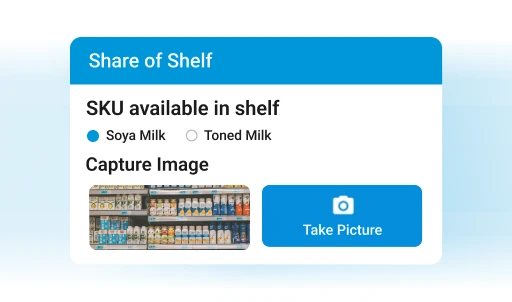
Time the visit a day or two after the distributor delivers, so the rep sees whether the order reached the shelf. Visit top sellers and low scorers most often.
Step 4: Fix the gap before the rep leaves
Fix the shelf while the rep stands in front of it, with the stock in the back room and the owner there to ask.
- Ask for the facings back and put up the display or signage.
- Order the missing product in the same visit; the Order AI Agent suggests what to add.
- Flag only what the rep cannot fix, with an owner and a date.
Shelf space is a favor as much as a contract: a rep who helps the owner sell more gets the eye-level shelf back more easily.
Step 5: Train and coach field teams
In-store execution training works best in short sessions, close to the shelf:
- Show a shelf that meets the standard and one that does not; ask the rep to find the gaps.
- Ride along monthly; coach each rep on their weakest element.
- Before a launch or promotion, brief reps and the store staff and promoters who keep the shelf right between visits.
How to measure in-store execution
Track these in-store execution KPIs at store level, then roll them up by rep, store type and region:
- Perfect store score: the weighted total and each element on its own.
- Gap close rate: the share of flagged gaps fixed by the next visit, which shows whether the program changes anything.
- Audit coverage: the share of stores audited, so a high score is not just the easy stores.
- Supply gaps: products missing because the distributor ran out, kept out of the score.
Each quarter, compare sell-out for high and low scorers in the same store type; no difference means the standard measures the wrong things. Full marks on every visit usually means the standard is too easy or the audit is filled from memory.
Retail execution strategies that improve in-store execution
A retail execution strategy is decided at head office, but its in-store implementation happens one shelf at a time. Two habits improve retail execution once the score exists:
- Bring the distributor in first. Must-stock gaps often start in its warehouse, and a rep cannot fix a gap the distributor cannot fill. Share store scores with distributors.
- Spot-check a sample of audits. A supervisor revisits a few stores a month, plus any store whose score jumps or drops sharply, which keeps photos honest.
Where in-store execution software helps
Paper checklists work for a pilot, but at scale supervisors stop looking at every photo and ticks drift upward. That is when in-store execution software earns its place: it shows each rep the standard for the store they are in and grades the shelf photo during the visit. Image recognition reads every store the same way, but blurred photos need a retake, closed coolers are hard to see and new packs must be added before launch. Keep a person in the loop for disputed scores.
AI reads the shelf. It does not get a distributor to deliver. A flag raised by AI still needs a named owner and a due date.
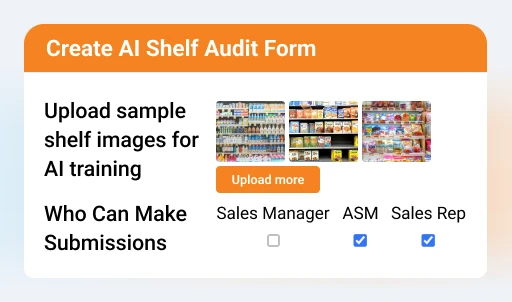
BeatRoute runs the audit, the order and visit planning in one field app. Its VM Audit AI Agent, part of BeatRoute's visual merchandising software, reads shelf photos for share of shelf, placement and POSM, at 80% lower shelf-audit cost than manual audits. The Scheduling AI Agent ranks each rep's visits by need; with it, productive visits rose from 45% to 78%.
On the BeatRoute platform, AAVA Brands, an FMCG company in Nigeria, grew store-level sellouts by 25 to 30%. Read the AAVA Brands case study, or request a demo to see a perfect store audit run on your own store types.
Frequently asked questions
What is perfect store execution?
It is a brand's standard for each store type, turned into a score that every visit is checked against. Because each store is scored against its own type, a low score means the store is off plan, not that it is small.
Who should run in-store execution: sales reps or merchandisers?
It depends on whether the visit also takes the order. A rep who sells can fix a stock gap with an order on the spot; where merchandisers handle the shelf, their audit should still reach the sales rep and the distributor.
Can a perfect store standard change during a promotion?
Keep the core standard and its weights fixed, and score the promotion as a dated add-on, such as a three-week end-of-aisle stand, so the store score stays comparable.
Does perfect store execution cover a retailer’s own in-store operations?
Not usually. It is a brand checking its own products in stores it sells through. BeatRoute suits brands whose reps, merchandisers or promoters check stores the brand does not own; a retailer auditing its own stores for safety and operations needs a store operations tool instead.