

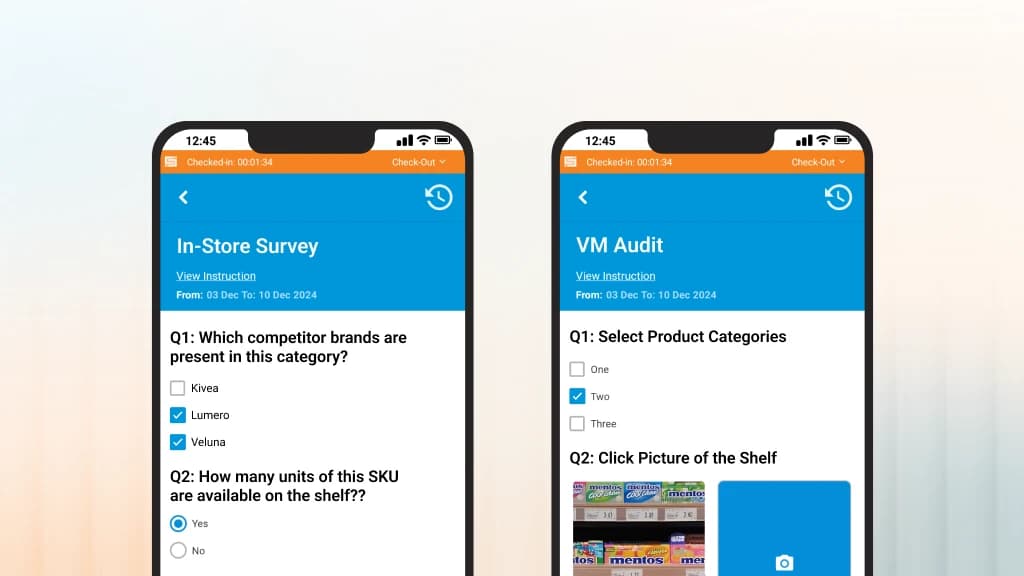
In short Retail execution is making sure the product, price, display and promotion a brand planned are what shoppers find in each store. It runs as a four-step loop: a rep visits the store, checks the shelf against the plan, fixes or flags what is wrong, and head office sees the result and acts on it. Most brands do the first two steps well and lose the last two.
It is also called in-store execution. It is how the plan made at head office becomes the shelf a shopper sees, in every store a consumer goods brand sells through.
Poor execution costs more than it looks. Out-of-stocks during a promotion send shoppers to the next brand on the shelf. Trade spend goes on promotional displays that never get built. A new launch gets judged weak when the product simply never reached the store. So the question to ask after every store visit is whether the gap got closed.
Retail execution vs retail strategy and trade marketing
Trade marketing plans and funds the promotion. A retail execution strategy decides which stores, which products and what the shelf should look like. Retail execution is whether that plan gets executed in each store. Visual merchandising is one part of it: how the product looks on the shelf.
A simple case shows the difference. A snack brand plans a summer bundle for its top stores, with a display stand and a price card in each. That plan is the strategy. Retail execution is how many of those stores have the stand built, the bundle in stock and the right price on the card in the first week, and how fast the rest get fixed.
What retail execution covers
Six pieces of work make up retail execution. Each one needs a clear check that field reps can do in a few minutes on a store visit.
| Component | What it means | What the rep checks |
|---|---|---|
| Distribution and availability | The right products are listed in the store and sit on the shelf, not only in the back room. | Is every must-stock product on the shelf? If something is missing, is there stock in the store or at the distributor? |
| Product placement and planogram | Products sit where the brand agreed, with the agreed number of facings. | Does the shelf match the planogram or the agreed layout? How much shelf space does the brand have against the plan? |
| Pricing | Shoppers see the right price on the right label. | Does the shelf price match the agreed price? Is the promo price showing during the promotion, and gone after it? |
| Promotions and POSM | In-store promotions and point-of-sale material (POSM) go live on time. | Is the promotional display built, the price card up and the promoted product stocked? Has old material been taken down? |
| Store visits and audits | Reps visit each store as often as planned and record what they find. | Was the visit made on the planned day? Are there photos with time and place? Was the audit filled in fully? |
| Briefing and training store staff and retailers | Store staff and owners know what the brand is running and why it matters to them. | Do staff know about the new product or offer? Has the retailer got the scheme details? Is it time to refresh staff training? |
For a step-by-step checklist for each type of execution, from planograms to displays, see our in-store execution playbook.
Why retail execution breaks down
Four failures come up again and again, and three of them happen after the visit, in steps three and four of the loop. Good teams design around each one.
The stock never reached the store
A rep finds the promoted product missing and marks it out of stock. But the problem started earlier: the distributor ran out, or never ordered the promo pack. Unless the rep can see the distributor's stock, the flag goes nowhere useful, and the next visit finds the same empty shelf.
Reps visit the easy stores
Reps who are judged on visit counts go to the stores that are close, friendly and quick. The large store with the tough manager, or the outlet at the edge of the territory, gets skipped. Visit numbers look fine while the stores that matter most drift away from the plan.
The fix needs someone else, and nobody owns it
A broken display stand needs the materials team. A wrong shelf price needs the chain's store manager or buyer. A missing listing needs the key account manager. When the flag lands in a shared report instead of with a named person, it waits.
Head office sees it too late
Many teams still collect photos in chat groups and roll them into a spreadsheet at month end. By the time the head of trade marketing reads it, the promotion is over. The data is right, but nobody can act on it any more.
A worked example: one missing product, from distributor to shelf
Here is what closing the loop looks like on a typical visit. A drinks brand launches a new flavour with a price-off offer in its neighbourhood grocery stores.
- A rep visits a store on the launch list. The new flavour is not on the shelf, yet the price card for it is already up.
- The rep asks the owner, who says the distributor's salesman never offered it. On their phone, the rep checks the distributor's stock: the launch stock arrived at the distributor but has not been sold into this area yet.
- The rep takes a small order for the new flavour on the spot and flags the gap. The flag goes to the area manager, with the store and the distributor named.
- The area manager calls the distributor the same day. The distributor adds this store, and the stores near it, to the next delivery run.
- On the next visit, the rep photographs the shelf. The flavour is in place with the right price card, and the flag is closed.
Without the loop, the same visit ends at step one. The rep notes "out of stock", head office sees a low availability number weeks later, and the launch looks weak. The real problem was one distributor's delivery plan, and it took one flag and one owner to fix.
Retail execution in chains and in small independent stores
The job changes with the store. Chains run on central agreements and the store's own staff. Small independent stores run on the owner's choices and the rep's visit. Plan a separate checklist for each.
| Question | Chains and large stores | Small independent stores |
|---|---|---|
| Who decides what goes on the shelf | The head office buyer, through the agreed planogram | The store owner, visit by visit |
| Who sets up displays and prices | Mostly store staff, sometimes merchandisers | Often the brand's rep or the distributor's salesman |
| What the rep mostly does | Audits against the agreement and escalates gaps | Fixes the shelf, takes the order and sells in the promotion |
| Main risk | Agreed space or promotion not delivered in some stores | Product not stocked, or stock runs out between visits |
| Who fixes a gap | Store manager, buyer or key account manager | The rep and the distributor |
| How often to visit | Set by sales value and the promotion calendar | More often for busy stores, less often for small, steady ones |
In chains, the rep's lever is proof: dated photos that show where the brand did not get the space it paid for. In independent stores, the lever is the relationship with the owner, built by fixing the shelf and taking the order in the same visit.
How retail execution differs by industry
The loop is the same everywhere, but what the rep checks first depends on the category.
- FMCG, food and drinks: many products and frequent visits, so the checks focus on availability, planograms, share of shelf and promotions.
- Cosmetics and personal care: range displays, testers and well-briefed counter staff carry the sale.
- Lubricants and auto parts: mechanic shops and parts dealers have little shelf to manage, so counter advice, display units and retailer schemes matter more.
- Paints and building materials: dealers and hardware stores, where shade cards, tinting machines and dealer schemes drive what gets sold.
- Pharma and over-the-counter products: much of the range sits behind the counter, so availability, expiry dates and the pharmacist's recall count more than facings.
How to measure retail execution
You can measure retail execution with a few KPIs captured on every visit. Add one more that tells you whether problems got fixed. That last one, the action-close rate, is the number most teams lack.
| KPI | What it tells you | How to capture it |
|---|---|---|
| On-shelf availability | The share of must-stock products on the shelf when the rep visits | The rep ticks each product on a store-specific list and adds a shelf photo |
| Planogram compliance | How closely the shelf matches the agreed layout | A shelf photo, scored against the planogram by a person or by image recognition |
| Share of shelf | Your space on the shelf compared with the whole category | Facings counted from the shelf photo |
| Price compliance | Whether shoppers see the agreed price | The rep records the shelf price of key products and flags any gap |
| Promotion and POSM compliance | Whether the promotion is live in each store on the list | A photo of the display and price card, checked against the promotion list |
| Visit compliance | Whether planned visits happen on the planned day | A geo-tagged check-in, matched to the visit plan |
| Action-close rate | The share of flagged issues fixed before the next visit | Each flag gets an owner and a due date, and the next visit confirms the fix |
Read the KPIs together. High visit compliance with flat availability means reps are visiting but nothing is changing. A falling action-close rate is the early warning: it shows the loop breaking before the availability number drops.
Best practices for retail execution
Give each store its own short checklist. A rep with a long, generic form skims it. Keep the list to what matters in this store this month: its must-stock products, its layout and its live promotions. A visual merchandising app can push the right planogram to the right store, so the rep never checks against the wrong one.
Ask for photo proof with time and place. A ticked box says the display is up. A photo with a date and location shows it. Score photos the same way in every region, so a compliance score means the same thing wherever it comes from.
Give every flag an owner and a due date. "Out of stock" is a note. "Distributor to deliver by Friday, area manager to confirm" is an action. Route each type of problem to the person who can fix it: stock gaps to the distributor, missing displays to the materials team, wrong chain prices to the key account manager.
Set visit frequency by store value and risk. Visit busy stores and stores with a live promotion more often, and steady small stores less often. Visit planning software can build routes from these rules, so the hard stores stop getting skipped.
Brief store staff and reward retailers. Staff who know about an offer will point shoppers to it. Retailer schemes, such as payments for display space or points for keeping the agreed shelf, give the owner a reason to hold the layout between visits.
Review the action-close rate every week. A short weekly look at open flags, area by area, keeps fixes moving. It also shows which managers need help before a promotion is lost.
Retail execution software: what it does and when you need it
Retail execution software puts a store-specific task list on each rep's phone and records the audit and photos. It sends each problem to the person who should fix it, and it shows managers what is happening in every store. Most tools also plan visits, and many take orders.
The tools fall into a few kinds:
- Field sales apps with audits built in: one app for visits, orders and store audits. They suit brands whose reps both sell and merchandise. The ones linked to distributor stock and orders also show the rep why a product is missing.
- Standalone audit and image recognition tools: focused on shelf photos and scoring. They suit teams that already have a sales app and want better shelf data.
- Outsourced merchandising services: an agency supplies merchandisers along with its own app. This is a service, and it suits brands that do not want their own field team in some areas.
Photos and a spreadsheet will do when you have a couple of reps, a few dozen stores and a short product list. A manager can look at every photo and chase every gap by phone. That stops working once nobody can read all the photos, flags need to reach distributors or store managers, or head office needs a promotion's status while it is still running.
BeatRoute belongs to the first kind. Its retail audit software and sales force automation run the visit, the audit, the order and the follow-up in one app. The app is linked to distributor stock through the distributor management system. The VM Audit AI Agent scores shelf photos, and the Scheduling AI Agent plans which stores each rep should visit. On visit planning, productive visits rose from 45% to 78% with the Scheduling AI Agent.
On the BeatRoute platform, Valvoline Cummins lifted customer connect from 25-30% of its assigned customers to 70%+, using sales force automation, smart routing and geo-tagged store visits. Read the Valvoline Cummins case study.
AAVA Brands tracked must-sell products against retail execution KPIs on BeatRoute and grew store-level sellouts by 25-30%. Read the AAVA Brands case study.
How to test a tool before you commit
Run a pilot in one territory that has both chain and independent stores. Record on-shelf availability and the action-close rate before you start, run the tool for a few weeks, then compare. Judge it by how many flags got an owner and got closed. Ask every vendor three things: can a rep see distributor stock during the visit, who receives a flag and how, and how is a shelf photo scored?
For a closer look at features, read our guide to retail execution software, or book a demo to see the loop run on your own store list.
Frequently asked questions
What does retail execution mean?
Retail execution means making sure the products, prices, displays and promotions a brand planned are what shoppers find in each store. It is also called in-store execution. It covers stock, shelf placement, pricing, promotions, store visits and briefing store staff.
What does a retail execution specialist do?
A retail execution specialist, sometimes called a merchandiser or retail execution rep, visits a set of stores on a planned route. On each visit they check stock, shelf layout, prices and promotions against the plan, fix what they can, take photos and flag the rest to the right person. They also brief store staff on new products and offers, and report what they found.
What is retail execution software?
Retail execution software is a mobile and web tool for field teams that visit stores. It gives each rep store-specific tasks and records shelf audits and photos. It sends each issue to an owner and shows managers the status of every store. Many tools also plan visits and take orders.
How is retail execution different from visual merchandising?
Visual merchandising is the display part of retail execution: how products look on the shelf and in displays. Retail execution is wider. It also covers stock, pricing, promotions, staff briefing and the follow-up that gets a problem fixed.
What KPIs should we track for retail execution?
Start with on-shelf availability, planogram compliance, share of shelf, price compliance, promotion compliance and visit compliance. Then add an action-close rate: the share of flagged issues fixed before the next visit. It shows whether the loop actually works.
How does AI change retail execution?
AI takes over the slow parts. Image recognition scores shelf photos so managers do not have to read each one, and visit planning picks which stores need a visit next. Supervisors can then spend their time fixing the gaps the tools flag.
Is retail execution still relevant as more shopping moves online?
Yes. As long as shoppers buy from store shelves, someone has to make sure the shelf matches the plan. Online listings need the same habits: the right product listed, in stock and at the agreed price.