

Sales and distribution software, often sold as distribution management software, records how goods are ordered, stocked, billed and sold on their way from the maker, through distributors, to the shops. It comes in two kinds, and what tells them apart is whose records it keeps.
One kind is run by a distributor or wholesaler to manage its own distribution business: purchase orders, warehouse stock, invoices, shipments and accounts. The other is run by a brand across all the distributors that sell its products: what each one orders, holds, sells on to shops and claims back.
Vendors of both call their products distribution software, distribution network software or a distribution management system, so the label will not tell you which one you need. Most distribution software systems track inventory and take sales orders, so the feature list will not tell you either. Start with one question: whose business will the software run?
Two kinds of distribution software, by who runs it
Distributor ERP and billing software: run by the distributor
This is ERP software for a wholesale distribution business. The distributor buys it and uses it to run its own company:
- purchase orders to every brand it buys from
- inventory control in its warehouse, by batch and expiry date
- sales orders, invoices and shipments to the shops it supplies
- payments, credit and the accounts
It suits a distributor or wholesaler that carries many brands and needs one set of books for all of them. It shows the distributor everything about its own business. It shows a brand nothing, unless the distributor sends a report.
Brand-side distributor management system: run by the brand
A distributor management system (DMS) is bought by the brand and used across every distributor that sells its products. Distributors log in to it, or connect their own software to it. It handles:
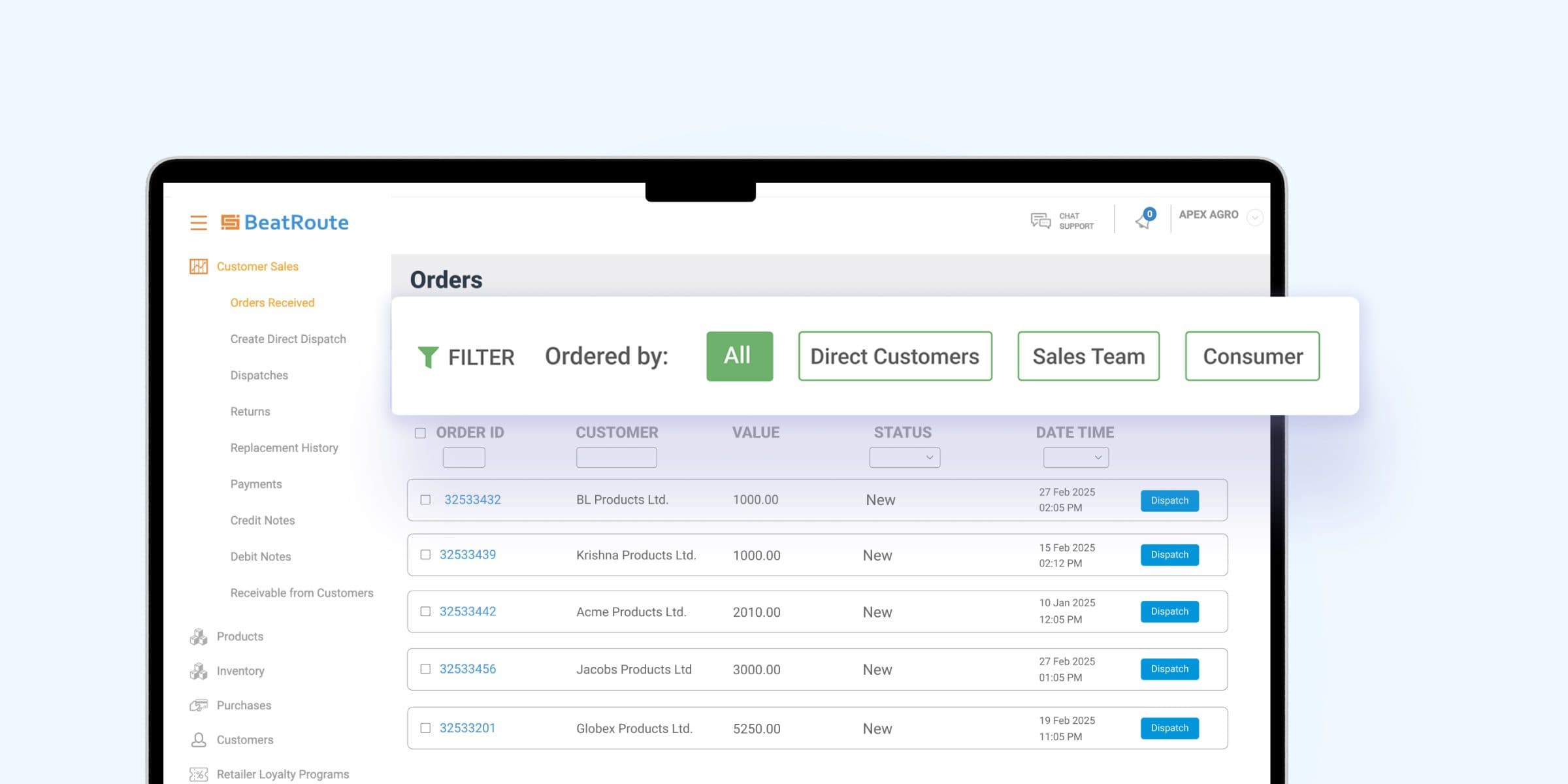
- Primary orders. Each distributor orders from the brand on a phone, a desktop or WhatsApp, with live schemes and credit limits on screen. See what a distributor order management system changes.
- Secondary sales. What each distributor bills to each shop, with the brand's price and scheme already on the invoice.
- Distributor stock. The stock levels of each product at every distributor, so the brand can plan replenishment instead of guessing.
- Schemes and claims. The scheme goes on the distributor's invoice to the shop, and the distributor's claim for that money is tracked from invoice to credit note.
It suits a brand that sells through many distributors and needs one view of all of them. Many brands run sales force automation (SFA) beside it, so the orders reps take in shops reach the right distributor without a phone call, and a retailer app so shops can reorder and see schemes themselves. For a brand, that pairing is the sales and distribution software: the DMS keeps the distributor's records and the sales app keeps the shop's. A retail distribution management system that stops at the distributor shows what was billed to each shop, but not what reached the shelf.
For a row-by-row comparison of the two kinds, see why accounting software alone cannot run FMCG distribution. If the names are the confusing part, read our explainer on distributor management vs distribution management systems, or our guide to how a distribution management system works.
How to tell which kind you need
Answer four questions about your own business:
- Where does the stock sit before it reaches the shops? If it sits in your own warehouse and you bill the shops yourself, with no distributor in between, you need billing or ERP software, not a DMS. If it sits with distributors you sell to, you need a brand-side DMS.
- Do your distributors' reports arrive on time? If a few distributors send a clean stock and sales report each month, you may not need a system yet. When reports come in late, in different formats, and you chase each distributor for numbers, you do.
- Do you need to see what distributors sell on to shops? If your schemes, targets or product launches depend on secondary sales, a brand-side system gives you them as each invoice is raised.
- Do your reps take orders that a distributor delivers? Then the order a rep takes and the invoice the distributor raises have to be the same record.
When a brand's DMS meets a distributor's own software
In a working network the two kinds sit side by side: the distributor keeps its ERP or billing software for its own books, and the brand's DMS sits on top for the brand's products. Price lists and schemes flow down from the brand. Secondary sales, stock and claims flow back up.
What decides whether this works is the distributor that carries many brands. It will not change its accounting software for one of them, and it will not type every invoice twice. In BeatRoute rollouts, that distributor keeps its software and a plugin syncs its sales, claims and credit notes to the brand, with no double entry. A distributor that mainly carries one brand can run the full DMS as its billing system. One with no back office at all uses a light mobile app that works offline.

So if you own a distribution business and a brand asks you to use its DMS, ask how it connects to the software you already run. If you are the brand, ask anyone selling you distribution management system software to show it syncing with a real multi-brand distributor's own books.
What BeatRoute runs for brands
BeatRoute is retail distribution software run by the brand: SFA, a distributor management system and a retailer app on one platform. It is used by 200+ enterprise brands in 20+ countries, across 10 industry verticals including building materials, agri-inputs and pharmaceuticals. BeatRoute suits brands that sell through many distributors and want to see their stock, sales and dues in one place; a distributor buying software for its own warehouse will be better served by a lighter billing tool.
On the field side, Perfetti Van Melle India increased outlet reach by 15% and cut delivery cost 10% with BeatRoute route optimization. Read the Perfetti India case study.
To see how each of your distributors would connect, book a demo and bring a list of your distributors with the software each one runs today.
Frequently asked questions
Is there free sales and distribution software?
For a distributor keeping its own books, a small business may get by with a basic billing tool. A system a brand runs across many distributors is paid software, because it has to be set up for your schemes, price lists and distributors. BeatRoute is subscription software, priced per user and module on annual contracts, with no free trial.
Does a distributor management system replace our ERP?
No. Your ERP keeps finance, production and the invoices you raise to distributors. Distributor management system software takes price lists and schemes from it and sends back secondary sales, distributor stock and claims.
Does BeatRoute use AI in distribution management?
Yes. The Order AI Agent suggests what each outlet or distributor should reorder, based on what it has bought before, what similar outlets on the same route buy and the schemes running that month.