

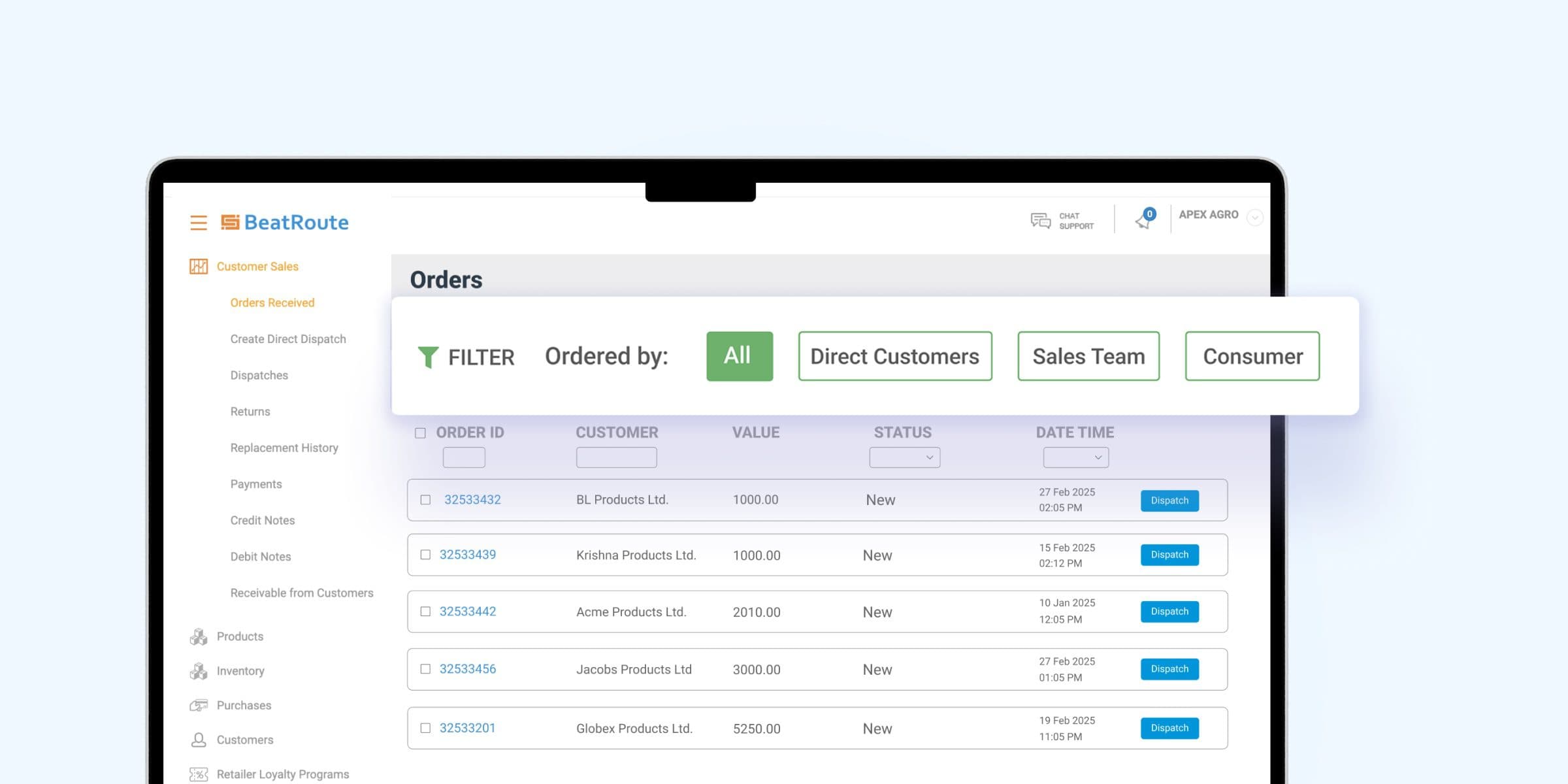
TL;DR This guide is for Philippine sales and distribution leaders evaluating distribution management software. It explains what a full-stack platform actually does and how it differs from distributor management software. It also makes the case for one connected view across the primary, secondary and retail layers. That view is what serves sari-sari stores and modern trade alike, across Luzon, Visayas and Mindanao. BeatRoute runs this on any Android, even low-end devices, online and offline.
Distribution management software is no longer just a backend record-keeper. For Philippine retail brands, this is the system deciding whether stock actually reaches the shelf. The chain runs across three regional networks, thousands of general trade outlets, and a distributor base spread over 7,641 islands. When sales, inventory and retailer touchpoints sit in separate tools, the gaps take familiar shapes. Stockouts. Ghost visits. Reports arriving too late to act on.
This guide explains what distribution management software really is and how it differs from distributor management software. It also shows why a full-stack platform beats a pile of stitched-together apps for executing across the primary, secondary and retail layers.
What is distribution management software?
Distribution management software is a platform that digitizes and connects a brand's entire route-to-market, from the distributor warehouse to the sari-sari shelf. Inventory, order cycles, schemes and territory sales become visible and controllable in real time. Brand, distributor and field team then read from the same numbers instead of chasing updates on Viber and hand-consolidated Excel trackers.
A good platform connects every stakeholder, that is sales reps, distributors, dealers, and retailers, on one operating system. That means coordinated execution and cleaner data for decisions. BeatRoute, the SFA and distributor management (DMS) platform, reaches past basic logistics into field sales, retailer engagement, and outlet-level recommendations in a single stack. It runs on any Android, even low-end devices, online and offline, which matters when your reps carry entry-level phones into provincial dead zones.
Distribution management vs. distributor management software
The two terms get used interchangeably, but they cover different scopes. Getting the distinction right saves you from buying a narrow tool when your operation needs the full picture.
| Aspect | Distributor management software | Distribution management software |
|---|---|---|
| Scope | The brand-distributor relationship only | The whole route to market: primary, secondary and retail |
| Focus | Order capture, claim processing, scheme visibility | Field execution, territory governance, retailer engagement, data feedback loops |
| Best for | Brands focused mainly on primary sales | Brands managing upstream and downstream together |
Most Philippine retail brands need both. Your distributors run van sales to sari-sari stores and supply Puregold cash-and-carry, while your own team works modern trade and key accounts. BeatRoute combines distributor operations and field execution in one stack, so you do not run two disconnected systems for the same channel. For a deeper walk through the concept itself, see our companion explainer on distribution management systems.
Why BeatRoute leads as full-stack distribution management software
BeatRoute is one platform that connects field sales teams, distributors, and retailers through a single intelligent system. It works across devices, regions, and channel types. From primary order placement to in-store execution, every workflow aligns to Goal-Driven AI. The sales strategy set at head office actually gets executed by your team and your channel partners on the ground.
Sales Team App (SFA)
- Field sales collaboration: the Scheduling AI Agent plans the visits, with geo-tags, scorecards and missed-target nudges built in. Intelligent prioritization takes productive visits from 45% to 78%, and reps make the calls that matter and still get home before dark.
- Beat planning and AI scheduling: Customizable beat plans with AI-powered scheduling and territory balancing, tuned to real routes so traffic eats fewer selling hours.
- Retailer engagement: one flow at the outlet covers everything. The rep takes the order and validates the delivery. They set the planogram, capture shelf visibility, activates the promo and logs satisfaction.
- Dashboards and alerts: Real-time monitoring of sales KPIs by territory or channel, with custom dashboards for area and regional managers.
- Visual compliance audits: The VM Audit AI Agent turns shelf photos into planogram compliance scores, share-of-shelf measurements, and competitor benchmarks, without pretraining.
DMS (distributor-facing)
- Primary order execution: Mobile, desktop, and Viber ordering with live scheme and credit visibility. The Order AI Agent recommends replenishment and new SKUs, delivering a 4 to 6% sales uplift from smarter order composition alone.
- Secondary order and billing: accounting plugins keep sales, claims and credit notes synced, and secondary visibility current. A self-serve distributor interface keeps collaboration simple even for a solo distributor in the provinces.
- Scheme and claims management: Auto-apply rules and end-to-end claim tracking from invoice to credit note, so a distributor never argues later about which promo applied.
- Smart inventory insights: Real-time stock visibility, outlet-level demand cues, and stock-norm governance keep inventory healthy and replenishment proactive across island networks.
- Trade promotion planning: Role-based control for planning, budgeting, and monitoring promotions across regions.
Retailer and Influencer App
- Self-serve ordering: outlets order, track delivery, view schemes and log feedback on Viber and Messenger. Those are the channels where Philippine trade already runs, so a sari-sari owner does not wait for the next rep visit to reorder.
- Auto-replenishment and nudges: The Order AI Agent makes repeat orders easier with reminders based on consumption patterns.
- Scheme redemption and reward visibility: Users see available schemes, track progress, and redeem points inside the app.
- Returns and claims: Dealers file returns, watch their claims move, and get approvals digitally.
- Training content: Brands push campaigns, product videos, and short training to keep retail partners informed.
- Dealer collaboration: dealer networks get their own workflows for orders, schemes and store-level fulfillment.
This is why global scale and local proof matter together. BeatRoute is a global platform tuned to how distribution runs here, with a working presence on the ground. That is why major Philippine brands like Monde Nissin and Unilab count on it, backed by a Manila office and PH-timezone support.
Flexible deployment across partner types
Your distribution ecosystem is not uniform, and neither is the software. BeatRoute adapts across regions, devices, and partner types, with deployment options built for the real mix of a Philippine channel.
Adaptive for any partner
- Full DMS for large stockists: the structured, high-volume regional partners get the advanced feature set.
- Light mobile version for solo distributors: A simple interface with all core workflows, usable offline in patchy-signal towns.
- Accounting plugins for multi-brand partners: Easy plug-in with no dual entry, so a distributor carrying several brands does not mag-encode the same order twice.
Built for scale
- Configurable KPIs, schemes, and workflows: Tailor everything to regional or business-unit needs.
- Plug-and-play modules for any channel structure: General trade, modern trade, wholesale, or a hybrid of all three.
- Fast, low-code deployment: Go live without heavy engineering dependencies. 300+ integrations via BeatRoute Matrix connect to your existing ERP and accounting systems, so there is no rip-and-replace.
Measurable impact with modern KPIs
BeatRoute gives real-time visibility into every layer of distribution performance. Configurable KPIs and AI insights let a brand benchmark execution market against market, and improve it. Here are KPIs Philippine teams track and configure by territory and channel:
- Fill rate (FR): Improve it with auto nudges and real-time stock visibility. Fewer stockouts at retail means higher offtake without adding rep visits.
- Claims turnaround time (CTAT): A digitized workflow shortens approval cycles. Distributors stay satisfied and keep investing in your brand.
- Outlet coverage rate (OCR): beat compliance and outlet expansion in one number. Serving more outlets per route pulls the cost of serving down.
- Order frequency: The Order AI Agent suggests reorders from past patterns, so stock gaps between beat visits close.
- Sales velocity per SKU: See product performance per territory and move stock toward the fast outlets while the month is still open.
- Retail satisfaction score (RSS): Track and improve retailer sentiment. Higher satisfaction correlates with larger baskets and lower churn.
When every one of these levers runs on one platform instead of scattered tools, BeatRoute customers achieve an average 12.6% sales uplift in the first year.
Is your business ready for modern distribution management software?
Eight questions gauge whether you are ready for a platform like BeatRoute:
- Do you need real-time visibility across the primary, secondary, and retail layers of distribution?
- Are your distributors mixed in size and tech maturity, some on accounting software, others on mobile or offline tools?
- Do KPIs like fill rate, CTAT, order frequency and retailer satisfaction go untracked today?
- Are field teams working without AI-planned visits, stock nudges or live scheme visibility?
- Are your promotions and claims still manual or delayed?
- Do you operate across multiple formats and geographies, from Metro Manila modern trade to provincial general trade?
- Do you need a system that holds up in low-connectivity provinces on mobile-first, low-end devices?
- Would one system carrying shared goals for field force, distributors and retailers change things?
If you said yes to most of these, it is time to move up to a modern distribution management platform that scales with your business across the islands.
One connected platform holds the sales team, the distributors and the retailers. It spans 20+ countries, 200+ enterprise brands and 2M+ retailers, serving verticals from FMCG to pharma. It also works alongside your existing ERP and Excel, with no big training program before value shows up.
Book a PH-tailored demo and see how BeatRoute can modernize your distribution management for coverage, governance, and execution at scale.
Frequently asked questions
What does distribution management software do for Philippine retail brands?
Distribution management software coordinates how products move from your brand through distributors and on to retail outlets. Primary and secondary sales, distributor inventory, schemes, claims, orders and field activity all live in one system. For a Philippine brand serving general and modern trade across three island networks, the payoff arrives in three forms. Live execution visibility. Faster claim cycles. Consistent trade programs in every region instead of month-end guesswork.
What is the difference between distribution management software and distributor management software?
Scope. Distributor management software works one distributor at a time: their inventory, their claims, their secondary sales. Distribution management software takes the whole route to market: retailer engagement, field execution, channel analytics, network-wide. BeatRoute carries both in one stack, and distributor operations and field team read the same live data.
Can BeatRoute handle both large and small distributors in the same network?
Yes, both ends at once: the large distributor running complex warehousing across a multi-brand portfolio, and the solo operator working out of one provincial location. The platform is configurable per tier, and its offline-first mobile apps extend coverage to low-connectivity towns without forcing small partners onto heavy infrastructure.
Does distribution management software work offline in the provinces?
Yes. BeatRoute works on any Android, even low-end or entry-level phones, online and offline. A rep or distributor in a provincial dead zone can place orders, check schemes and credit, and validate deliveries without signal. The app syncs automatically once connection returns. Because most Philippine channel teams run on Android, it is built for the phones they already carry.
Is distribution management software the same as a CRM?
No. An office CRM manages sales pipelines and contacts from a desk. Distribution management software runs field sales and distribution, so it handles beat plans, visit proof, distributor stock, scheme execution, and retailer ordering. BeatRoute is an SFA and DMS platform, not a CRM, which is why it fits how Philippine field sales and channels actually work.
How does distribution management software improve visibility across Luzon, Visayas, and Mindanao?
BeatRoute streams primary dispatches, distributor inventory, secondary sales, and retailer orders into one view. Brands see where stock is sitting, moving, or stuck at SKU, distributor, and outlet level across all three regional networks. Supply, trade marketing, and field teams then decide faster on replenishment, promotions, and coverage, without waiting for hand-consolidated reports from each island.