

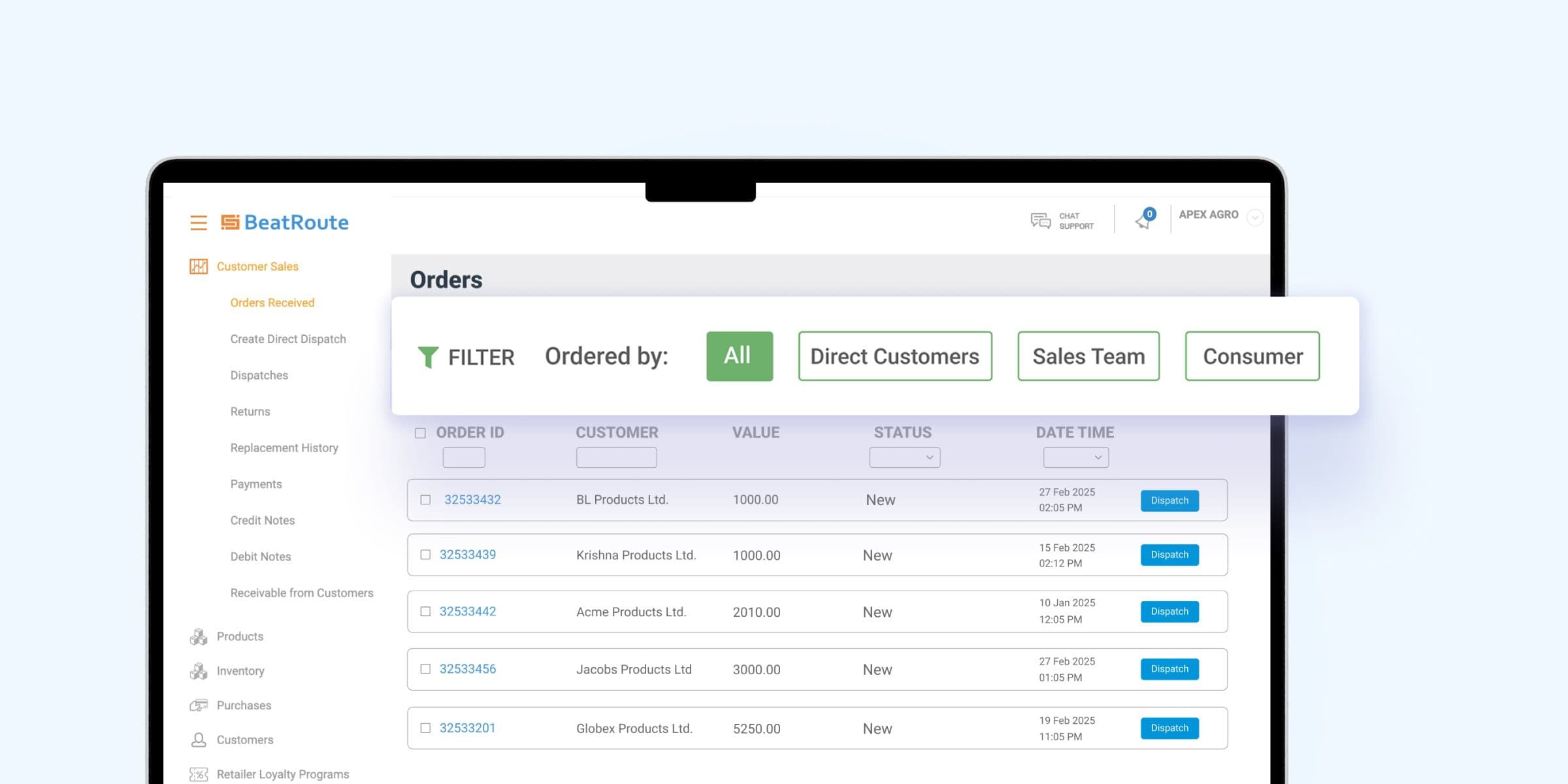
TL;DR Distribution management software coordinates how goods move from your factory through distributors to the shelf. For African brands the payoff is not logistics. It is secondary-sales visibility across open markets in Lagos, dukas in Nairobi, and spaza shops in Soweto. That is why brands like AAVA Brands and BUA Foods run on BeatRoute.
A brand can ship a full truck and still not know what reached the shelf. After dispatch, five to seven middlemen handle the stock, and the brand goes blind. Distribution management software closes that gap. This guide defines it, separates it from distributor management software, and shows what it changes in African trade.
What is distribution management software?
Distribution management software coordinates a brand's whole route to market, from primary dispatch to the retail shelf. It connects sales reps, distributors, and retailers on one system. It tracks primary sell-in, secondary sales, distributor stock, schemes, claims, and field activity in a single view.
Two acronyms travel with it. SFA means sales-force automation, the app that runs a field rep's day. DMS means distributor management, the layer that reconciles distributor stock, billing, and claims. The acronym DMS was coined in India, so many Africa-native teams simply say distribution management.
BeatRoute joins both in one stack, the SFA and distributor management platform for field sales and distribution. It is not a CRM. A CRM chases a few large accounts. This software runs thousands of small ones.
Distribution management vs distributor management software
The two terms are not the same, and the difference decides what you buy. Distributor management software is narrower. It runs operations at each distributor: order capture, claims, schemes, and secondary billing. Distribution management software is wider. It covers the full route to market.
| Aspect | Distributor management software | Distribution management software |
|---|---|---|
| Scope | Brand to distributor | Full route to market: primary, secondary, retail |
| Focus | Order capture, claims, scheme visibility | Field execution, territory governance, retailer engagement, analytics |
| Best for | Brands focused on primary sell-in | Brands managing sell-in and sell-out together |
Most African brands need both. BeatRoute combines them in one stack. So you do not stitch two tools together at the seam where claims and coverage meet.
Why does African trade need distribution management software?
Africa does not have a demand problem. It has a visibility problem. Five to seven middlemen sit between your factory and the shelf. You see primary sell-in, then the stock disappears into the channel.
Your product might move through open markets in Lagos, dukas in Nairobi or spaza shops in Soweto. After the truck leaves, the story is the same. You cannot see what actually sold, which outlets were skipped, or whether the promotion reached the shelf.
This matters because the informal shop is the market. In Nigeria roughly 90% of retail runs through small traditional outlets, not supermarkets. Distribution management software is how you finally see inside that channel.
How do you see what your distributors actually sold last week?
Secondary-sales visibility is the single biggest gap the software closes. Primary sell-in tells you what left your depot. It says nothing about what the distributor sold on to retailers. That secondary layer is where the money and the blindness both live.
Coverage without concentration knowledge is waste. In Lagos a detergent stocked in 100,000 outlets can do half its sales in just 10,000 of them. The software shows which outlets carry your growth.
Stock also crosses every territory line you draw. Sub-wholesalers restock daily at open-air markets like Onitsha and Idumota, so dumping is structural, not a distributor's moral failing. Distribution management software makes that flow visible, so you manage it with facts.
What does the distributor principal need from it?
Your distributor is a business owner you court, not command, and their staff can veto any tool. In much of African trade the distributor is a long-established family trading house. Brands earn that loyalty. They do not dictate to it.
Their worries come in a clear order. Manual claims take eight to twelve weeks to settle. Dumping floods their territory. Every currency move squeezes their margin.
Good distribution management software answers each one. Claims move faster. Territories are protected with visible sales data. Retailers order more easily. Frame it as growth rather than control, and the rising local champions adopt it willingly.
Why does offline-first decide whether the field uses it?
An app that dies without signal sends your whole team straight back to paper. This is the most common reason field rollouts fail across African markets. Signal drops between outlets, and a heavy app becomes dead weight.
Mobile data runs about 2.4% of monthly income per gigabyte in Sub-Saharan Africa, above the UN affordability line. So the software must work with zero signal and sync when the rep is back online.
Battery weighs just as much. The app should survive a full route on a low-end Android phone, load shedding included, without a charger. Test that in a real market before you sign.
Where is your data hosted?
Data residency is the question that lets one IT gatekeeper veto your whole rollout. African data laws now have teeth. South Africa's POPIA blocks cross-border transfer without a signed agreement. Kenya's Data Protection Act requires a local copy of the data.
Nigeria's regulator has levied billions of naira in fines and put over 1,300 firms on notice. Egypt's transfer-license rule bites from October 2026.
So ask any vendor where your data lives before you commit. A distribution management platform that cannot answer clearly is a risk the gatekeeper will not sign off.
What should African brands check before they buy?
Look past the feature list to the things that decide adoption in year two. Most tools demo well, then stall in the field. Use this checklist to pressure-test any distribution management software against African trade.
- Secondary-sales visibility. Can you see what distributors sold to retailers, at SKU and outlet level, not just what left the depot?
- Offline-first capture. If it needs signal to take an order, reps abandon it. Pilot it on the phones your team actually carries.
- Distributor-side value. Faster claims, protected territories, and easier retailer ordering win the staff who can veto the rollout.
- Works with your SAP and your Excel. It should read your existing systems from day one, with no rip-and-replace.
- Data residency answers. Confirm where data is hosted and how the vendor meets POPIA, Kenya's DPA, and Nigeria's NDPR.
- An execution layer, not just dashboards. Ask how it turns field data into the rep's next action.
Run a structured pilot in one region first. A demo proves the screens work. A pilot proves the trade will use it.
How does BeatRoute approach distribution management for African trade?
BeatRoute is a global platform tailored for African trade, with proof it works here, which is why brands like AAVA Brands and BUA Foods run on it. It equips the distributor and retailer networks you already have. It never replaces or bypasses them.
That distinction matters. The marketplace wave raised over 400 million dollars to own trucks and warehouses, then collapsed on thin margins. BeatRoute makes the networks that already exist visible and efficient instead.
AAVA Brands in Nigeria saw an 18 to 20% lift in field productivity and a 25 to 30% rise in store sellouts. The pattern predates the software. Coca-Cola's micro-distribution centres, each serving 250 to 600 outlets across 19 countries, long proved structured distribution scales here.
The engine is goal-driven AI, not activity tracking. It tells each rep what to do next against a real target. Every visit is time-stamped and geo-verified, so incentive payouts are never disputed. Here is how that shows up in the product.
| BeatRoute capability | What it does | Measured outcome |
|---|---|---|
| Scheduling AI Agent | Ranks each day's stops by business signal | Productive visits rose from 45% to 78% |
| Order AI Agent | Suggests the right basket and new SKUs per outlet | 4 to 6% sales uplift |
| VM Audit AI Agent | Scores each shelf photo against the planogram | Flags missing SKUs and competitor gaps |
| DMS module | Reconciles distributor stock, billing, and claims | Secondary sales visible against primary dispatch |
Native distributor management keeps primary dispatch and secondary sales reconciled in one view. BeatRoute Matrix connects to SAP, Oracle, and other systems through 300+ integrations, and low-code setup goes live in weeks. It runs across verticals including building materials, agri-inputs, and pharmaceuticals.
Brands running every lever on one platform report a 12.6% average sales uplift in the first year. BeatRoute serves 200+ enterprise brands across 20+ countries and 2M+ retailers. Get an instant demo to see it against your own routes.
Frequently asked questions
What is distribution management software?
Distribution management software coordinates how goods move from a brand through distributors to retail outlets. It tracks primary sell-in, secondary sales, distributor stock, schemes, claims, and field visits in one system. The result is visibility across a fragmented channel instead of scattered spreadsheets.
What is the difference between distribution management and distributor management software?
Distributor management software runs operations at each distributor, such as orders, claims, and secondary billing. Distribution management software is broader and covers the full route to market, including field execution and retailer engagement. BeatRoute combines both in one stack.
What do SFA and DMS mean?
SFA stands for sales-force automation, the app that runs a field rep's day. DMS stands for distributor management, the layer that reconciles distributor stock, billing, and claims. Together they connect secondary sales in the field to primary dispatch from the depot.
Is BeatRoute a CRM?
No. A CRM is built for a few large accounts and long deal cycles. BeatRoute is an SFA and distributor management platform built for high-frequency visits to thousands of small outlets, with offline capture and metrics like strike rate and coverage.
Why do African brands need distribution management software?
Because after dispatch the channel is a black box. Five to seven middlemen sit between factory and shelf, so brands see primary sell-in and then go blind. The software restores secondary-sales visibility across open markets, dukas, and spaza shops.
How does it help you see secondary sales?
It captures every order and stock movement from the distributor down to the retail outlet. Brands see what actually sold, at SKU and outlet level, not just what left the depot. That reveals which outlets drive real growth.
Does distribution management software work without internet?
A good one does. Offline-first capture lets reps take orders and log visits with zero signal, then syncs when they are back online. This matters where mobile data costs about 2.4% of monthly income per gigabyte.
How does it help distributors, not just brands?
Distributors gain faster claim settlement, protected territories against dumping, and easier ordering for their retailers. Manual claims can take eight to twelve weeks, so digitising them protects distributor margins. Because distributor staff can veto any tool, this daily value is what makes a rollout stick.
Where is my data hosted, and is that compliant?
Ask any vendor before you sign. South Africa's POPIA restricts cross-border transfer, Kenya's law requires a local data copy, and Nigeria's NDPR carries heavy fines. A platform that cannot answer clearly is a compliance risk.
How long does BeatRoute take to deploy?
BeatRoute uses low-code configuration and can go live in a few weeks. A wider rollout with DMS and ERP integration usually takes six to twelve weeks for the first region.
Does BeatRoute have African customers?
Yes. AAVA Brands and BUA Foods in Nigeria run on BeatRoute, and the platform serves 200+ enterprise brands across 20+ countries and 2M+ retailers. AAVA Brands recorded an 18 to 20% lift in field productivity and a 25 to 30% rise in store sellouts.
Can it handle both large and small distributors?
Yes. Large distributors get the full DMS for complex, multi-brand warehousing. Solo distributors get a light, offline-capable mobile version with the core workflows. The platform is configurable per tier.