

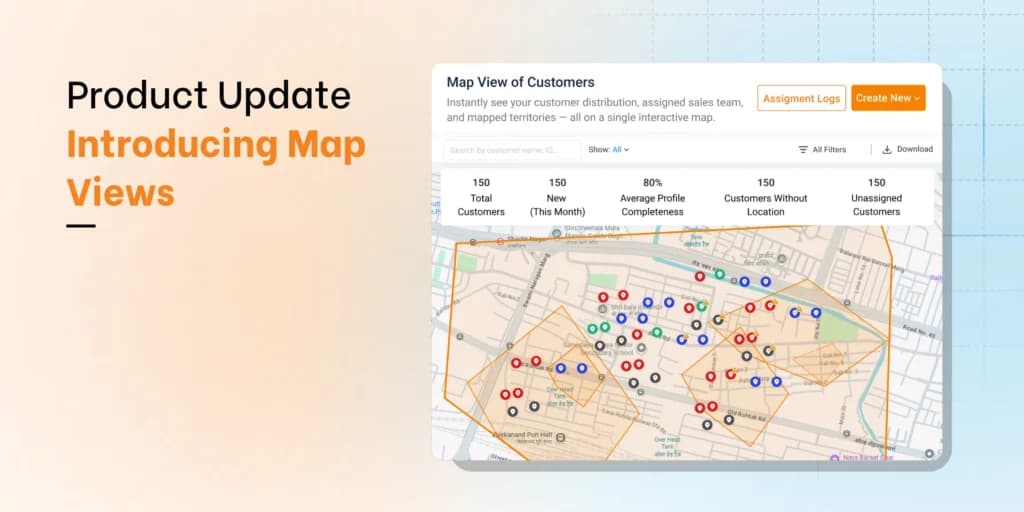
Sales territory mapping software puts your customers or outlets on a map and splits them into balanced territories, so each rep gets a fair workload and every account gets covered. Sales territory mapping itself is the work of deciding which rep, and often which distributor, owns which accounts in which area. The better tools go a step further: they turn each territory into the visit plan a rep follows every week, and they show what was sold where.
You probably need one if any of these sound familiar. You rebuild territories in a spreadsheet every quarter. Two reps argue over who owns a store. Some outlets have not seen a rep in months, while others get a visit every few days. The right kind of tool depends on how many accounts you have and whether your reps visit them on a fixed cycle.
What sales territory mapping software does
The software does four jobs that planners used to do with a spreadsheet and a printed map.
- Puts every account on the map. It places each customer from its address or a GPS pin, so you can see clusters, gaps and accounts that two reps both think are theirs.
- Balances the territories. It splits accounts so each rep has a similar amount of work, judged by sales value, visit frequency or travel time.
- Assigns owners. Each territory gets a rep and a manager. For a consumer brand it also gets the distributor that delivers to those outlets.
- Tests changes before they go live. You can try a new split, see how each rep's workload moves, and keep a record of what changed and when.
The balancing, and what reps do with the territory the next morning, are what make the map useful. BeatRoute's Map Views, for example, show your customers or your distributors on a map, with a heat map of outlet density, so a manager can spot thin coverage before drawing a single line.
Five kinds of territory mapping tool
Tools sold as sales territory mapping software do quite different jobs. Sorted by what they do, they fall into five kinds.
| Kind of tool | What it does | Best for | Where it falls short |
|---|---|---|---|
| Stand-alone mapping and territory design tools | You upload a spreadsheet of accounts, then draw regions by hand or balance them automatically. | Sales operations planners and B2B teams that redraw a few hundred accounts once or twice a year. | The territory lives apart from the visit plan and the orders, so every change is copied across by hand. |
| CRM add-ons | They map the accounts already in your CRM and write the territory back to each record. | B2B teams whose meetings, calls and deals already live in the CRM. | Built around accounts and deals, with little for distributors or repeat outlet visits. |
| Route and visit apps for outside reps | They show a rep's accounts on a phone map, plan the day's stops and log check-ins. | Small teams where each rep plans their own day and sells direct. | Light on territory design, with no distributor or order layer. |
| Field sales and distribution platforms | They plan territories, beats and routes in the same system that takes orders, records visits and manages distributors. | Consumer brands whose reps cover hundreds of small outlets on a repeating cycle. | More to set up than a mapping tool, so they make less sense for a small direct sales team. |
| GIS tools | Geographic information systems offer deep spatial analysis, population layers and custom boundaries. | Analysts with GIS skills and one-off market studies. | Slow for day-to-day sales work, and they need specialist skills. |
A beat, in the fourth row, is the fixed list of outlets a rep visits on a set day each week or fortnight.
One question settles most choices: does the territory need to drive a visit plan and an order book, or only a planning slide? If it only feeds the slide, the first two kinds will do. If reps run their day from it, look at the third and fourth.
How sales territory mapping works, step by step
- Geo-tag every account. Load your customer list and place each one on the map. Small shops often have vague or wrong addresses, so the most reliable pin is the one a rep captures while standing at the counter. Treat this as part of the project, because every later step depends on it.
- Choose your base boundaries. Build territories from areas everyone already uses, such as postal codes, districts or city wards. Reps, distributors and finance can then read the same map, and a new outlet falls into a territory the day it is added.
- Segment and weight each account. Group accounts by channel, outlet type and class, for example A, B and C outlets by sales value. Then give each one a visit frequency. A large store visited weekly carries more work than a kiosk visited once a month, even when they sit side by side.
- Add what each area could sell. Good territory planning weighs potential as well as today's sales. Population data, an outlet census or a heat map of the outlets you already serve shows the white space: areas with plenty of people but few outlets. A territory with plenty of room to grow can start with fewer active accounts, so its rep has time to open new ones.
- Draw or balance the territories. Draw boundaries by hand where you know the ground, or let the tool split accounts so each territory carries a similar load. Most teams do both: balance automatically first, then adjust where a river, a highway or a weekly market makes the computer's answer wrong. Balance on hours of work. A crowded market street can take less time to cover than a handful of outlets spread along a highway.
- Assign reps and distributors. Give each territory an owner. For a consumer brand, check that each territory matches the area its distributor really serves, or orders will land with the wrong partner.
- Turn territories into beats and routes. Split each territory into beats, then let route optimization put the stops in the best order so reps spend less time on the road.
- Rebalance on a set rhythm. Review territories each quarter, and again whenever a rep leaves, a distributor changes or a large account opens. Several small trims a year cause less upheaval than one big redraw.
What to check when you compare tools
Most demos look good on sample data. This table lists what to check, why it matters and how to test it with your own outlets.
| What to check | Why it matters | How to test it in a demo |
|---|---|---|
| Data import and geocoding | Bad pins make every territory wrong, and small outlets often have vague addresses. | Load a real outlet file from one region and count how many land in the wrong place. |
| Balancing rules | Balancing by outlet count alone gives some reps far more work than others. | Balance by sales value, visit frequency and visit time together, then change one weight and see what moves. |
| Drive time | Straight-line distance hides rivers, traffic and one-way streets. | Compare the tool's travel estimate for one real beat with what your rep actually drives. |
| Distributor boundaries | A territory that cuts across two distributors' areas causes billing and stock disputes. | Draw a territory over one distributor's area and check that outlets, orders and stock follow it. |
| Mobile view for reps | Reps need their outlets, beat and route on the phone, including where the signal drops. | Open the rep app in flight mode and complete a visit. |
| Sync with orders and visits | Without sales data on the map, you cannot tell a weak territory from a weak rep. | Ask to see last month's orders and missed visits by territory. |
| Links to your ERP or CRM | Outlet and distributor lists should come from the system that bills them, or the map drifts out of date. | Ask how a new outlet or distributor created in your ERP reaches the map, and how long it takes. |
| Rebalancing history | When results change, you need to know whether the territory changed too. | Move outlets between two territories, then check the log of who changed what and when. |
Ask the vendor to load your own outlet file instead of a demo dataset. How they handle the messy rows will tell you more than the slides do.
Consumer brands versus B2B sales teams
A consumer brand needs more from the software than a B2B sales team does.
A B2B rep usually owns a few dozen to a few hundred accounts, grouped by region or industry, and books meetings ahead. The territory decides who owns each account and who gets credit for the deal.
A rep at a consumer brand may cover hundreds of small outlets: grocers, kiosks, pharmacies and cafes. Each outlet is visited on a fixed beat, weekly or every two weeks. Each is served by a distributor who delivers the stock and collects payment. So the territory is three things at once: the rep's patch, a set of beats and a distributor's area. That changes what the software has to do.
- Cope with volume. Thousands of outlets in one region need fast import, clustering on the map and bulk moves between territories.
- Keep distributor areas on the map. Some areas have more than one distributor, each carrying different product lines, and the territory has to agree with each one's service area. BeatRoute's Workzones handle this by defining the area once and mapping each retailer once, so every authorized distributor can serve it.
- Put beats on the rep's phone. The beat, the route and each outlet's details need to work offline.
- Show orders and visits by territory. A manager should see which areas are under-served without waiting for a month-end report.
How it shifts by industry
- Food, drinks and personal care: dense outlets, short visits and weekly beats, often with more than one distributor in the same area.
- Pharma: territories built around doctors, clinics and pharmacies, with visit frequency set by how important each doctor is, and some long travel days away from base.
- Building materials and paints: fewer, larger dealers spread over wide areas, plus contractors and painters who need their own visit plan.
- Lubricants and auto parts: workshops, mechanics and parts retailers in the same territory, each visited for a different reason.
Examples from field teams
These patterns show up again and again when a brand first puts its outlets on a map.
- The city split that only looked fair. Two reps have about the same number of outlets. One works a dense market area and finishes early. The other has outlets strung along the edge of the city and never completes a beat. Moving a block of outlets to the first rep lets both finish their beats.
- Two distributors on one street. A brand sells snacks through one distributor and drinks through another, and both serve the same shops. Two separate territory maps create duplicate records for every shop. One shared map, with both distributors attached to the same area, keeps one record per shop.
- A new rep joins. Instead of redrawing the whole region, the manager carves a new territory from the edges of the two busiest neighbors and rebuilds only the beats that changed. Reps whose beats did not move keep their routine and their relationships.
The first sign a territory is wrong is a beat nobody finishes. A beat that cannot be completed teaches reps to skip outlets, and the ones they skip are usually the far ones that need attention most.
Results from BeatRoute customers
Each result below came from BeatRoute's route optimization and field sales tools, which plan visits from the same outlet map.
Perfetti Van Melle Indonesia tripled outlet coverage with BeatRoute route optimization and sales force automation. As part of the rollout, it geo-tagged its outlets so visits could be planned from the map. Read the Perfetti Van Melle Indonesia case study.
Perfetti Van Melle India increased outlet reach by 15% and cut delivery cost by 10% with BeatRoute route optimization. Read the Perfetti Van Melle India case study.
Valvoline Cummins, a lubricants brand, lifted customer connect, the share of assigned customers its reps actually reach, from 25-30% to 70%+ with BeatRoute. Read the Valvoline Cummins case study.
Pilot territory mapping software in one region
Test the tool in one region before you change the whole country.
- Pick one region with one or two distributors and a problem you can name, such as outlets nobody visits or beats nobody finishes.
- Clean the outlet list and geo-tag it before you draw anything.
- Write down where you start: visits completed, outlets ordering each month and time spent traveling.
- Draw the new territories and beats, and run them for at least two full beat cycles.
- Compare the same measures with where you started, and ask reps which outlets they still cannot reach.
Move to the next region only when reps in the pilot finish their beats without asking for changes.
Where BeatRoute fits
BeatRoute suits consumer brands that want territory management, beats, routes and distributor areas tied to the same sales data. Map Views show customers or distributors on a map, with a heat map of where coverage is thin. Workzones keep distributor areas straight. Beat planning and route optimization turn each territory into a day's work, and visit planning decides which outlets matter most this week. Because orders and visits live in the same platform, a weak territory shows up in this week's numbers.
A B2B team that only needs to draw sales regions over a CRM may be better served by a stand-alone mapping tool. If your reps run beats through distributors, request a demo and bring one region's outlet list.
Frequently asked questions
What is sales territory mapping software?
It is software that places your customers or outlets on a map and splits them into balanced territories, so each rep has a fair workload and no account is left without an owner. Field sales platforms also turn each territory into beats and routes.
How is territory mapping different from route planning?
Territory mapping decides which rep and distributor own which accounts. Route planning decides the order a rep visits those accounts on a given day. Get the territory right first, because a good route cannot fix a territory that holds too much work.
How do you balance sales territories fairly?
Weight each account by sales value and how often it needs a visit, estimate the hours of work including travel, and compare hours per rep. Outlet counts alone mislead, because dense and spread-out areas take very different amounts of time.
How often should you redraw sales territories?
Review them every quarter, and again whenever a rep leaves, a distributor changes or a big account opens. Regular small changes keep most beats stable, while a once-a-year redraw tends to move many outlets at once.
Can I map sales territories in Excel or a free map tool?
For a few reps and a few hundred accounts, yes. It breaks down once territories must drive weekly beats, match distributor areas and show orders, because every change then has to be copied by hand into several places.
What data do I need to start territory mapping?
You need an account or outlet list with addresses or GPS pins, sales history, how often each account needs a visit, your reps, and the distributor that serves each outlet. Accurate pins matter most.
How is sales territory mapping software priced?
It is usually sold as a subscription, charged per user or per module. BeatRoute is priced per user and module on annual contracts and has no free trial, so the best way to test it is a pilot in one region.
Does territory mapping software work offline for reps?
The planning side usually runs in a browser. Reps need their beat, route and outlet details on the phone even with no signal, so test the rep app offline in any demo. BeatRoute's field app works offline and syncs when the signal returns.