

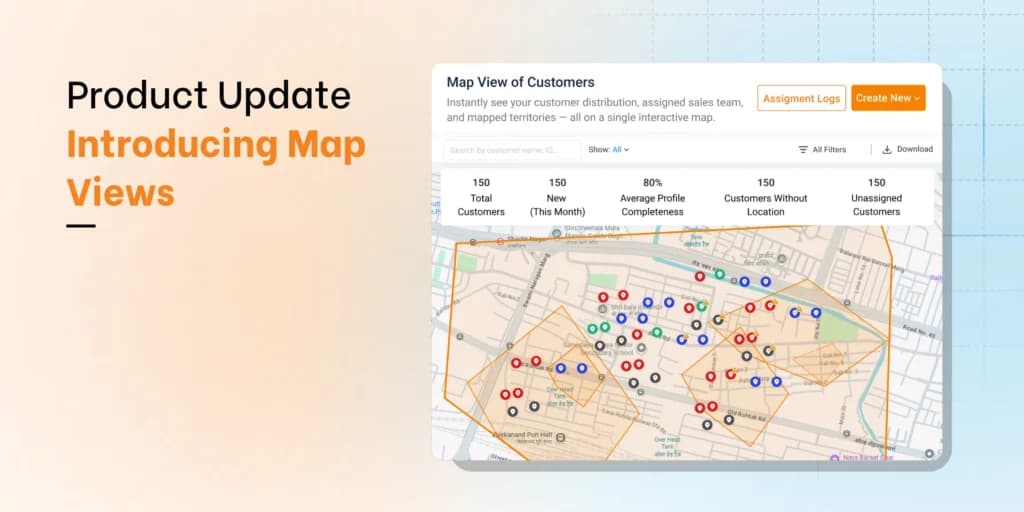
Sales territory mapping software shows your sari-sari stores, drugstores, supermarkets and wholesalers on one map. You then cut that map into areas a rep, a promodiser or a distributor can really cover. The mapping is the decision about who owns which outlets. Stronger tools carry the decision through to the weekly beat plan on the rep's phone and to the sales that came out of each area.
Does this sound familiar? Territories live in an Excel tracker that somebody rebuilds every quarter. Two reps claim a sari-sari store on the edge of their areas. A distributor says a store is his, while your own list gives it to another. A few stores have gone months without a call, and others are visited every few days. Which tool fits depends on how many outlets you handle and whether reps return to them on a set cycle.
What sales territory mapping software does
Four tasks that used to take an Excel sheet and a printed map of Luzon, Visayas or Mindanao now sit in one place.
- Plots every outlet. Each store lands on the map from its address or GPS pin, which exposes clusters, empty pockets and stores claimed twice.
- Evens out the load. Outlets are shared among reps so that days feel alike, measured by sales value, how often a store needs a call or time on the road.
- Names an owner. A territory has a rep and a supervisor. In a consumer brand it also has the distributor who supplies those stores.
- Lets you rehearse. Try a new split, watch each rep's workload shift, and keep a log of what moved and when.
The map pays off when the territory reaches the field the next morning. BeatRoute's Map Views plot customers or distributors with a heat map of outlet density, so a sales manager sees thin coverage before touching a boundary. For the planning basics, see territory mapping in the Philippines.
Five kinds of territory mapping tool
Products that call themselves territory mapping software solve different problems. By function there are five groups.
| Kind of tool | What it does | Best for | Where it falls short |
|---|---|---|---|
| Stand-alone territory design tools | Take an Excel account list and let you draw areas or auto-split them. | Sales ops planners and B2B teams who revisit a few hundred accounts once or twice a year. | The territory is cut off from visit plans and orders, so each change is retyped elsewhere. |
| CRM add-ons | Plot the accounts already in your CRM and save the territory on each record. | B2B teams who keep meetings, calls and deals in a CRM. | Designed for deals, with little room for distributors or repeat calls on small stores. |
| Route and check-in apps | Display accounts on a phone map, line up the day's stops and log arrivals. | Small teams where reps plan their own day and sell direct. | Weak at territory design, and no distributor or order side. |
| Field sales and distribution platforms | Hold territories, beat plans and routes in the same system that books orders, records visits and tracks distributors. | Consumer brands with reps and van sales crews serving hundreds of sari-sari stores, drugstores and groceries on a loop. | Heavier to roll out, so overkill for a small direct-selling team. |
| GIS tools | Spatial analysis, population layers and custom boundaries. | Analysts who know GIS, for one-off market studies. | Awkward for daily selling and dependent on specialists. |
In the fourth row, a beat means the fixed set of outlets a rep calls on, on the same day every week or fortnight.
Ask one thing before anything else: will the territory run a beat plan and an order book, or only appear on a planning slide? The slide needs only the first two kinds. If reps start their day from it, shortlist the third and fourth.
How sales territory mapping works, step by step
- Pin every outlet. Import the customer list and place each store. A sari-sari store may be known only by a landmark, so the best pin is the one the rep drops while standing at the counter. Budget time for this, since all later steps rest on it.
- Start from familiar boundaries. Use lines everyone already knows: city, municipality or barangay. Reps, distributors and finance then read one map, and a newly added store falls into its territory at once.
- Classify and weigh the outlets. Sort by channel and class: modern trade, chain pharmacies, groceries, sari-sari stores and wholesalers, each graded A, B or C by sales. Attach a visit frequency. A supermarket seen weekly demands more than a sari-sari store seen monthly, even next door.
- Estimate room to grow. Today's sales tell only half the story. A census of outlets, population figures or a heat map of the stores you already serve will show barangays with many people and few covered shops. Give such a territory fewer active stores at first, so the rep can open new ones.
- Draw, then balance. Draw by hand where you know the ground and let the tool split the rest by load. Most teams run the automatic split first and correct it for a river, a flyover, a ferry crossing or a weekly palengke. Judge by hours worked. One crowded market street in Quezon City may take less time than a few stores strung along a provincial highway.
- Give owners to each area. Name the rep. In a consumer brand, confirm the territory matches what the distributor truly serves, or orders reach the wrong partner.
- Cut territories into beats and routes. Divide each area into beats, then use route optimization to order the stops and save time in Metro Manila traffic and on provincial roads.
- Review on a schedule. Check every quarter and whenever a rep resigns, a distributor changes or a big account opens. A few small trims a year disturb the field less than a single big redraw.
What to check when you compare tools
Sample data makes every demo look good. Use this table to test with your own outlets instead.
| What to check | Why it matters | How to test it in a demo |
|---|---|---|
| Import and geocoding | Wrong pins spoil every territory, and many sari-sari stores are described only by a landmark. | Upload a real file for one city or province, then count the stores that land in the wrong spot. |
| Balancing method | Splitting by store count leaves some reps with much heavier days. | Combine sales value, visit frequency and call time, change one weight, and watch what shifts. |
| Travel time | A straight line ignores rivers, ferries, traffic and one-way streets. | Set the tool's estimate for one real beat against the time your rep actually needs. |
| Distributor areas | A territory straddling two distributors leads to billing and stock disputes. | Draw over one distributor's area and see whether outlets, orders and stock follow. |
| Rep phone experience | Reps need outlets, beat and route in hand, also where the signal fails. | Turn on airplane mode and finish a visit. |
| Orders and visits on the map | With no sales data, you cannot tell a weak area from a weak rep. | Ask for last month's orders and missed calls, split by territory. |
| ERP or CRM connection | The billing system should feed outlet and distributor lists, or the map goes stale. | Ask how a store or distributor created in your ERP gets to the map, and how long that takes. |
| Change history | When results move, you must know if the territory moved too. | Shift stores between two territories and read the log of who did it and when. |
Insist that the vendor loads your own outlet file. The way they deal with untidy rows tells you more than any slide.
Consumer brands versus B2B sales teams
A brand that sells through Philippine trade asks more of this software than a B2B team does.
The B2B rep owns a few dozen to a few hundred accounts, split by region or industry, and books meetings in advance. Here the territory settles account ownership and deal credit.
The consumer brand rep may serve hundreds of small outlets: sari-sari stores, groceries, drugstores, convenience stores and wholesalers. Every outlet is on a weekly or fortnightly beat, and a distributor or stockist brings the stock and collects payment. The territory is therefore the rep's patch, a set of beats and a distributor's area, all at once. That shapes the needs below.
- Handle scale. A region with thousands of outlets calls for quick import, clusters on the map and bulk moves between territories.
- Show distributor areas. Some areas have several distributors with different product lines, and the territory must match each one's service area. BeatRoute's Workzones define an area once and map each retailer once, so any authorized distributor can serve it.
- Keep the beat on the phone. Beat, route and outlet details should work offline, so the rep never relies on a Viber message or a paper list.
- Report by territory. Managers should spot under-served areas without waiting for the month-end report.
How it shifts by industry
- Food, drinks and personal care: tight clusters of sari-sari stores, quick calls and weekly beats. Several distributors often share one area, and supermarkets and convenience chains run as modern trade.
- Pharma: areas built on doctors, clinics, hospitals and chain pharmacies. Call frequency depends on the doctor's weight, and some days go on long trips to the provinces.
- Building materials and paints: fewer but bigger dealers and hardware stores over wide distances, with contractors and painters on a separate call plan.
- Lubricants and auto parts: workshops, mechanics and parts shops in one area, each called on for its own reason.
Examples from field teams
A brand tends to meet the same three situations the first time it maps its outlets.
- The Manila split that looked fair on paper. Two reps hold nearly the same store count. One covers a packed palengke area in Manila and is done by early afternoon. The other works stores along a Cavite or Rizal highway and never closes the beat. Handing a block of stores to the first rep lets both finish.
- Two distributors, one street. A brand ships snacks through one distributor and drinks through another, and both supply the same sari-sari stores. Separate lists give each store two records. A single map with both distributors tied to the area leaves one record per store.
- A new rep in Cebu or Davao. The manager does not redraw the region. They take a slice from each of the two busiest neighbors and rebuild only the beats that changed. The other reps keep their routine and their ties with store owners.
An unfinished beat is the earliest warning that a territory is wrong. It trains reps to skip stores, and the skipped ones tend to be the distant stores that most need a visit.
Results from BeatRoute customers in the Philippines
Both teams below work in the Philippines and run field sales on BeatRoute.
Nurturemed Pharma saw a 20% increase in PMR productivity. Read the Nurturemed case study.
A leading paints brand in the Philippines reached 30% higher sales productivity. Read the leading paints brand case study.
Pilot territory mapping software in one region
Prove the tool in one area before rolling it out nationwide.
- Choose an area with one or two distributors and a problem you can name, like stores no one calls on or beats no one completes. Greater Manila, Cebu and Davao are common picks.
- Tidy the outlet list and pin every store first. Draw nothing before that.
- Record your starting point: completed visits, outlets that order each month and hours spent on the road.
- Draw the new territories and beats and run them through two full beat cycles.
- Measure again, and ask reps and promodisers which stores remain out of reach.
- Expand only when pilot reps finish their beats without asking for fixes.
Where BeatRoute fits
BeatRoute is for consumer brands that want territories, beats, routes and distributor areas to run on the same sales data. Map Views plot customers or distributors and use a heat map to show where coverage is thin. Workzones keep distributor areas clean. Beat planning and route optimization make each territory a day's work, and visit planning picks the outlets that matter most this week. With orders and visits in the same platform, a weak territory shows up in this week's numbers.
A B2B team that just wants sales regions drawn over a CRM may do better with a stand-alone mapping tool. If your reps work beats through distributors, request a demo and bring the outlet list for one area.
Frequently asked questions
What is sales territory mapping software?
It is a tool that shows your outlets on a map and divides them into territories, so every rep has a workable area and every store has an owner. In a field sales platform the territory then becomes a beat plan and a route on the rep's phone. It is more than a slide for the sales review.
How is territory mapping different from route planning?
A territory answers who covers which stores. A route answers in what order one rep walks or drives through them today. Settle the territory first, since no route can fix an area that holds more stores than a rep can reach.
How do you balance sales territories fairly in the Philippines?
Count hours, not stores. Give each outlet a weight from its sales value and its visit frequency, add realistic travel time, and compare the total per rep. A rep in a packed Manila market street and a rep going barangay to barangay in a province can hold the same store count and have very different days.
How often should you redraw sales territories?
Look at them once a quarter, and again if a rep resigns, a distributor changes or a large account opens. Small trims keep most beats as they are. One big annual redraw moves many stores at once and breaks the relationships reps have built with store owners.
Can I map sales territories in Excel or a free map tool?
Yes, while you have a handful of reps and a few hundred stores. Past that point the territory has to drive weekly beats, follow each distributor's area and show orders. Every change then gets retyped in the tracker, in the Viber group and in the distributor's own list, and the copies drift apart.
What data do I need to start territory mapping?
Gather your outlet list with addresses or GPS pins, past sales and the visit frequency each outlet needs. Add your reps and promodisers, and the distributor behind each outlet. Take the most care over pins, because many sari-sari stores have no street number.
How much does sales territory mapping software cost?
It is sold as a subscription, scoped to your team size and the modules you need. BeatRoute works on annual contracts and has no free trial, so the practical way to judge the value is a pilot in one area. Request a demo and we will scope it with you.
Does territory mapping software work offline for reps?
Planning is normally done in a browser. Reps are different. They need the beat, the route and outlet details on the phone where the signal drops, such as inside a mall or in a provincial town. Switch the rep app to airplane mode in every demo. BeatRoute's field app works offline and syncs once the signal is back.