


HoReCa (Hotels, Restaurants and Cafes) is the food service channel: the businesses that cook or serve food and beverages for people to have on the spot. The “Ca” is also read as Catering, and most companies use the word to cover both cafes and caterers. In the trade you will also hear it called the HoReCa sector or HoReCa industry.
For a brand that sells food, drinks or supplies, HoReCa is a sales channel of its own, next to general trade (small independent shops) and modern trade (supermarkets and chains). Its buyers are chefs, owners and purchase managers. They buy bulk packs to use in their kitchens and bars.
HoReCa meaning and full form
The word joins the first two letters of each part of the trade:
| Letters | Stands for | Typical outlets | What they buy from brands |
|---|---|---|---|
| Ho | Hotels | Hotels, resorts, serviced apartments, banquet halls | Breakfast and buffet foods, beverages, room supplies, cleaning products |
| Re | Restaurants | Fine dining, casual dining, quick-service restaurants, food courts | Ingredients, sauces, oils, dairy, frozen foods, soft drinks |
| Ca | Cafes or catering | Coffee shops, bakeries, dessert bars, caterers, event and office kitchens | Coffee, tea, milk, syrups, baked goods, disposables |
The term comes from Dutch, where “horeca” is an everyday word for the hotel, restaurant and cafe trade. It spread through the European food and drink trade, and suppliers now use it across Europe, the Middle East, Asia, Africa and Latin America. In North America, people more often say “food service” or “foodservice”.
Most people say it HO-reh-ka, in three syllables. You will also hear ho-REH-ka. HoReCa, HORECA, Horeca and Ho.Re.Ca are all the same word. The mixed capitals simply show where each part starts.
What matters more is scope: two companies can both say “HoReCa” and mean different lists of outlets.
What counts as a HoReCa outlet
Any business that prepares or serves food and drink for people to have on its premises, or at an event it runs, belongs to HoReCa. In practice that includes:
- Hotels and resorts, including their restaurants, bars, buffets and banquet halls
- Fine dining restaurants, where the chef picks every ingredient
- Casual dining and family restaurants
- Quick-service restaurants (fast food) and food courts, often run as chains
- Cafes and coffee shops, from single shops to national chains
- Bars, pubs and lounges
- Bakeries, dessert shops and ice cream parlours that serve on site
- Caterers for weddings, parties and company events
- Institutional catering: office canteens, hospitals, schools, universities and airlines
The edges vary. Many companies now count cloud kitchens, which cook only for delivery, even though no one eats on site. Some give institutional catering its own team. Drinks companies often hand bars and pubs to a separate on-trade team. Before you plan coverage, write down which of these outlets your company counts as HoReCa, so that targets and reports mean the same thing to everyone.
HoReCa vs food service, on-trade, away-from-home and HRI
Several terms overlap with HoReCa. Here is how each one differs:
- Food service (foodservice): the wider industry of making meals outside the home. It covers everything in HoReCa and always includes institutional and contract catering, which some companies count as HoReCa and others give their own team. It is the usual word in North America.
- Away-from-home (AFH) or out-of-home (OOH): a consumer goods term for anything people eat, drink or use outside their homes. It is wider than HoReCa, because it can also include offices, gyms, transport and vending machines.
- On-trade and off-trade: drinks industry terms. On-trade is where a drink is bought and drunk on the premises, such as bars, pubs, restaurants and hotels. Off-trade is where it is bought to take away, such as shops and supermarkets. On-trade overlaps heavily with HoReCa.
- HRI: Hotel, Restaurant and Institutional. It is used mostly in North America and adds hospitals, schools and other institutions to the hotel and restaurant core.
- Hospitality: the whole industry of travel, lodging, events and leisure. HoReCa is the part of hospitality that serves food and drink.
For a supplier, HoReCa is B2B: you sell to the outlet, and the outlet sells to its guests. That supplier side is what people mean by HoReCa sales.
What is HoReCa sales, and how is the HoReCa channel different from retail?
HoReCa sales means selling your products to hotels, restaurants, cafes and caterers, which use them to make what they serve. In a shop, your product is resold as it is. In a kitchen, it becomes an ingredient, and the buyer judges it on taste, yield, consistency and cost per plate.
| HoReCa | General trade | Modern trade | |
|---|---|---|---|
| Who decides | Chef, owner, or a chain’s central purchasing team | Shop owner | Category buyer at head office |
| Why they buy | To use in dishes and drinks | To resell to shoppers | To resell to shoppers |
| Pack size | Bulk and catering packs, kegs, large tins | Consumer packs | Consumer packs |
| How they order | Small, frequent top-ups driven by menus and how busy they are | On the rep’s visit or by phone | On a schedule set by head office |
| How they pay | On credit, often through a distributor | Cash or short credit | Longer contract terms |
| How goods reach them | Distributors, food service wholesalers, cash and carry, or direct to chains | Distributors and wholesalers | The retailer’s own warehouse |
| What wins the account | A place on the menu, steady supply, chef support | Margin, trade offers, credit | Listing terms, promotions, shelf space |
If you know general trade and modern trade, a few things about HoReCa will feel new:
- The menu is the shelf. Once your sauce, cheese or coffee is part of a signature dish, the outlet reorders it every week and rarely switches. Losing the menu slot is how you lose the account.
- The person who chooses is often not the person who pays. The chef picks the ingredient, the owner or purchase manager agrees the price, and the accounts team pays the bill. Reps need to know all three.
- Chains and independents buy in different ways. A chain decides once, at head office, and every branch follows a set list. An independent cafe decides at the counter, and a new chef can change the order overnight.
- Most outlets are served through a distributor. The brand’s rep opens the account and keeps the chef happy. A distributor or food service wholesaler delivers, bills and collects. Unless the brand gets that data from the distributor, it cannot see what each outlet buys.
- Running out costs more than in retail. A shop with no stock loses one sale. A cafe with no coffee beans buys from whoever can deliver today, and may never switch back.
The product category changes the sale as well. Food ingredients are won in the kitchen, through the chef and a tasting. Beverage brands sell into the on-trade, where coolers, taps and branded glassware in the outlet can matter as much as price, and local alcohol rules limit what a rep may offer. Cleaning products, disposables and room supplies are bought by purchase or housekeeping managers on contract. They buy mostly on price and reliable delivery, with little loyalty to a brand.
How to run a HoReCa sales team
A HoReCa team needs a different plan from a retail beat team. Reps visit fewer outlets a day, stay longer at each one, and sell to chefs and owners who judge a product by how it works in their recipes. BeatRoute’s HoReCa sales setup is built for this kind of team.
1. Segment outlets before you assign them
Group outlets by type (hotel, fine dining, quick service, cafe, caterer, institution), by cuisine and by how much they could buy. A brand that sells Asian sauces gains little from a steakhouse, however busy it is. Mark each outlet as a chain or an independent, and note who makes the buying decision there. Good customer profiling and segmentation tells reps where to spend their time and tells managers which outlets are worth chasing.
2. Split key accounts from independent outlets
Chains, hotel groups and large caterers are won at head office. Give them a key account manager who handles the central deal, the price list and the menu calendar. Field reps then check that each branch actually orders what was agreed. Independent restaurants and cafes are won one at a time, so they need regular visits from a rep who knows the chef by name.
3. Set visit frequency by value and risk
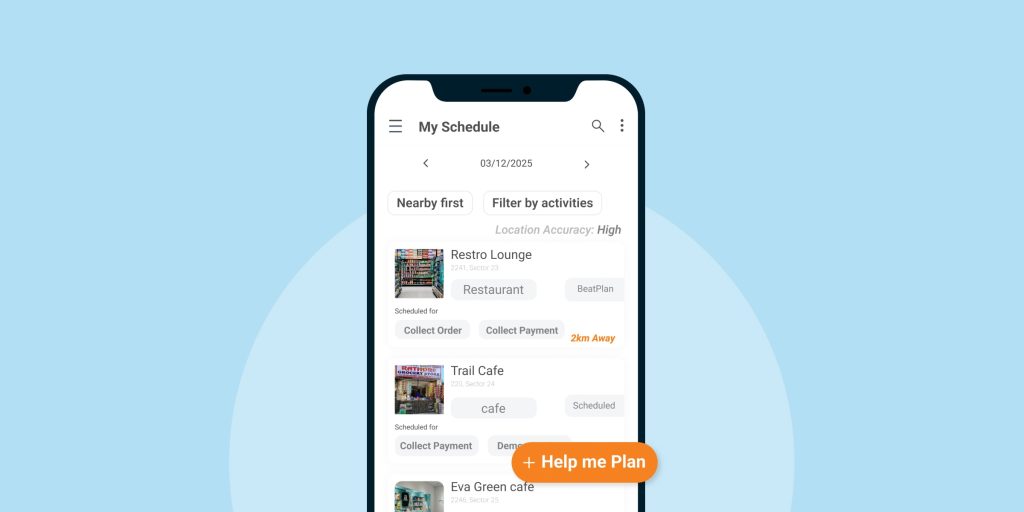
Not every outlet needs a weekly visit. See high-value accounts most often, along with any outlet that has an open problem: a falling order, an overdue payment or a new chef. Small outlets that reorder steadily can be served by phone or an ordering app, with fewer visits. Visit planning software can build each rep’s week around these rules, so reps do not drift towards the friendliest outlets.
A HoReCa visit also covers more than a retail visit. Besides taking the order, the rep checks which menu items use your products, asks the chef for feedback, follows up on any samples, confirms the distributor has stock, and collects payment where the brand bills directly.
4. Plan sampling, chef demos and menu activations
Many brands send a chef or product specialist to cook with a customer’s kitchen team. These demos win menu listings, but only when they are planned and followed up. Book demos against a list of target outlets, record what was cooked and what the chef said, and give the rep a follow-up visit soon after. Menu activations, such as a featured dish or drink of the month, work the same way: agree them, check they ran, and watch the reorders that follow.
5. Make reordering easy between visits
Outlets often run short between visits. Let them reorder from their phone through a B2B ordering app, or let the rep or the distributor take the order on a call. The faster an outlet can top up, the less reason it has to try another brand.
6. Track the numbers that show HoReCa health
Retail teams track outlets visited and orders taken. HoReCa teams need a few more:
- Active outlets: outlets that ordered in the last month, by segment
- Menu listings: outlets where your product is part of a dish or drink on the menu
- Lines per outlet: how many of your products each outlet buys
- Reorder rate: how many outlets came back after a first order or a demo
- Outlet sales through distributors: what each outlet bought from its distributor
- Collections: overdue credit by outlet and by distributor
The last two need data from your distributors. A distributor management system gives the brand each outlet’s orders and payments, even when the distributor does the delivering.
Where BeatRoute fits
BeatRoute runs field sales and distributor management on one platform. A brand selling into HoReCa can plan rep visits, take orders and see each outlet’s buying through its distributor in one place. Food maker Cremica, which sells through both retail and HoReCa outlets, raised sales productivity per rep by 30% across its field team after moving to BeatRoute. Read the Cremica case study.
If you run a team that sells to hotels, restaurants and cafes, see how BeatRoute supports HoReCa sales teams, or request a demo built around your outlet types and distributor setup.
Frequently asked questions
What is the full form of HoReCa?
HoReCa stands for Hotels, Restaurants and Cafes. The “Ca” is also read as Catering, so the term covers caterers too. Together they make up the food service channel.
What is CA in HoReCa?
Ca stands for cafes, and many companies read it as catering. In practice HoReCa covers both: coffee shops and bakeries as well as caterers and event kitchens.
Is HoReCa B2B or B2C?
It depends on where you stand. Suppliers sell to hotels, restaurants and cafes business to business (B2B), and those outlets sell meals and drinks to guests business to consumer (B2C). HoReCa sales usually means the B2B side.
What is HoReCa in FMCG?
In FMCG, HoReCa is the channel where consumer goods brands sell food, drinks and supplies to hotels, restaurants, cafes and caterers. They sell in bulk packs, often through distributors, alongside general trade and modern trade.
What is HoReCa sales?
HoReCa sales is the work of selling products to food service outlets: finding the right outlets, winning a place on their menus, taking repeat orders and collecting payment, usually with a distributor handling delivery.
What are HoReCa products?
HoReCa products are made or packed for food service use: bulk ingredients, sauces, oils, dairy, frozen foods, coffee and tea, soft drinks and alcohol, plus disposables, cleaning supplies, linen and kitchen equipment.
How do you pronounce HoReCa?
Most people say HO-reh-ka, in three syllables, and you will also hear ho-REH-ka. Both are understood. The word is written HoReCa, HORECA or Horeca, and all three spellings mean the same thing.
Is HoReCa the same as food service?
Nearly. Food service is the wider term and is more common in North America. It always includes institutional and contract catering, such as hospital and school kitchens, which some companies count as HoReCa and others handle separately. In Europe, the Middle East, Asia, Africa and Latin America, suppliers more often say HoReCa.