

In short Retail execution is the gap between the plan and the shelf. You planned a product, a price, a display and an offer. The shopper finds something else. In Africa it works as a four-step loop: a rep or merchandiser visits, checks the outlet, fixes or flags the gap, and someone at head office acts on the flag. Most teams in Kenya, Nigeria and the rest of the continent manage the first two steps. The last two are where the money leaks.
Picture a sales lead in Nairobi with a new 200g pack and a launch offer. The cartons left the depot a fortnight ago. Ask how many dukas, kiosks and supermarket branches stock the pack at the launch price, and the honest answer is a guess. Closing that guess is the whole job of retail execution, also called in-store execution.
The cost is easy to miss. A duka owner who cannot get your promo pack buys a cheaper local brand instead, and often keeps it there for good. A kiosk you paid to brand ends up with a rival's crates in front of it. A launch gets written off as weak when the pack never left the stockist's store. After every visit, ask one question: did the gap get closed?
Strategy, trade marketing and execution: who does what
Trade marketing designs and pays for the promotion. Retail execution decides whether it shows up. The strategy picks the outlets, the products and the shelf you want. Visual merchandising is the part that covers how the product looks once it is there.
Take a biscuit maker that plans a month-end bundle for its best outlets, with a stand and a price card in each. That is strategy. Execution is how many of those outlets had the stand up and the bundle in stock in week one, and how quickly the rest were fixed.
The six things a rep checks in an outlet
Every check below should take a rep a few minutes. If it takes longer, nobody will do it twice a week.
| Area | What good looks like | Question for the rep |
|---|---|---|
| Availability | Every must-stock product is on the shelf or counter, not left in the store room. | What is missing, and is there stock in the shop, at the stockist or at the distributor? |
| Placement and layout | Products sit where the brand agreed, with the agreed facings. | Does the shelf match the agreed layout, and how much space do we hold? |
| Price | The shopper sees the agreed price on the label. | Is the promo price up during the offer and gone when it ends? |
| Promotion and POSM | Posters, shelf strips, branding and offers go live on the start date. | Is the display up, the promoted pack in stock, and old material removed? |
| Visits and audits | Each outlet is seen as often as the plan says, and findings are recorded. | Did the visit happen on the day, with a dated photo and a full audit? |
| Owner and staff briefing | The owner knows the offer and why it pays them. | Can the shopkeeper explain the new pack and the scheme? |
For a checklist by type of execution, see our in-store execution playbook. For material at the shelf, read what POSM is.
Where execution fails in African trade
Four failures repeat across markets. Three of them happen after the rep has left the outlet.
The pack never reached the street
The rep writes "out of stock" and moves on. The cause sits further back. The sub-distributor's van skipped that route, the stockist was on credit hold, or the outlet buys from an open-market wholesaler who never received the promo pack. If the rep cannot see what the distributor holds, the note changes nothing and the shelf stays empty next week.
Reps drift to the easy calls
When reps are paid on visit counts, they pick the outlets near the tarred road. The kiosk behind the market, the supermarket with a difficult buyer and the duka after a muddy stretch of road go unseen. The numbers look healthy. The outlets that carry your volume slide away from the plan.
The fix belongs to someone else
A faded branded kiosk or a broken cooler goes to the trade assets team. A stockist stuck on credit goes to the finance or distributor manager. A supermarket listing goes to key accounts. If the flag lands in a shared report with no name on it, it sits there.
Head office learns too late
Photos pile up in WhatsApp groups. Someone copies them into a sheet at month end. By the time the sales director reads it, the promotion has closed. The information was right. It simply arrived when nobody could act.
A Lagos example: one flavour, one wholesaler
A drinks brand launches a new flavour with a price-off offer. Its target is the provision stores and kiosks along a busy Lagos street. These shops rarely wait for a distributor's van. The owner restocks from a wholesaler or a market trader, often on a Monday morning.
- The rep walks into a provision store on the launch list. The price card is already stuck up, but there is no new flavour on the shelf.
- The owner says the wholesaler she buys from does not carry it. The rep checks the distributor's stock on the phone. The launch stock is at the distributor, but it has not been sold on to the wholesalers who feed this street.
- The rep takes a small order on the spot, names the wholesaler in the flag and sends it to the area manager.
- The area manager calls the distributor that day. The distributor visits the wholesalers on that street and loads the new flavour on the next run.
- A week later the rep photographs the shelf. The flavour is there, the price is right, and the flag is closed.
Skip the loop and the story is different. The WhatsApp group gets a photo of an empty shelf, nobody replies, and the shop's next order goes to the wholesaler's own stock of a rival flavour. The cause was a single wholesaler link. One flag with one named owner would have fixed it.
Supermarkets versus dukas, spazas and kiosks
A supermarket runs on an agreement and its own staff. A duka, spaza, kiosk or market stall runs on the owner's mood and your rep's visit. Write a separate checklist for each. General trade carries most of the volume in Kenya and Nigeria, so a checklist built around the supermarket will miss most of your market.
| Topic | Supermarkets and large stores | Dukas, spazas, kiosks and stalls |
|---|---|---|
| Who picks the range | A head office buyer, through the agreed layout | The owner, at each restock |
| Who builds displays and sets prices | Store staff, sometimes your merchandiser | Usually your rep or the distributor's salesman |
| The rep's main job | Check the shelf against the agreement and escalate | Tidy the shelf, take the order and push the offer |
| Biggest risk | Paid space not delivered in some branches | Pack not stocked, or sold out between visits |
| Who closes a gap | Branch manager, buyer or key accounts | The rep, the stockist or the wholesaler |
| Visit rhythm | Follows sales value and the promotion calendar | Weekly for busy outlets, less often for small steady ones |
In a supermarket, your strength is evidence: dated photos of the space you paid for and did not get. In a duka or spaza, your strength is the owner's trust. You earn it by fixing the shelf and taking the order in the same visit.
What changes by category
The loop stays the same. What the rep looks at first does not.
- FMCG, food and drinks: many lines and frequent calls, so availability, share of shelf and promotions come first.
- Cosmetics and personal care: range displays, testers and briefed counter staff make the sale.
- Lubricants and auto parts: garages and spare-parts shops have little shelf, so counter advice, display units and retailer schemes count for more.
- Paints and building materials: hardware shops and dealers, where shade cards, tinting machines and dealer schemes decide what sells.
- Pharma and over-the-counter products: most of the range is behind the counter, so availability, expiry dates and the pharmacist's recommendation outweigh facings.
How to measure it
Record a handful of numbers at every visit, then add the one most teams skip: the action-close rate, meaning how many flagged problems got fixed. Read every number by outlet type and region. A national average hides the Mombasa kiosks or Onitsha stalls where your volume actually sits.
| KPI | What it shows | How the rep captures it |
|---|---|---|
| On-shelf availability | Share of must-stock products actually on the shelf | Tick an outlet-specific list and add a shelf photo |
| Planogram compliance | How close the shelf is to the agreed layout | Shelf photo scored by a person or by image recognition |
| Share of shelf | Your space against the whole category | Facings counted from the photo |
| Price compliance | Whether the shopper sees the agreed price | Record the shelf price of key lines and flag differences |
| Promotion and POSM compliance | Whether the offer is live where it should be | Photo of the display and price card, checked against the promotion list |
| Visit compliance | Whether planned calls happened on the day | Geo-tagged check-in matched to the visit plan |
| Action-close rate | Share of flags fixed before the next visit | Every flag gets an owner and a date, and the next visit confirms |
Look at them side by side. Strong visit compliance with flat availability means reps are calling but nothing changes. A dropping action-close rate warns you first, before availability falls.
A geo-tagged, time-stamped photo also ends a familiar dispute. It proves the visit took place, so the rep who did the work gets the credit and incentive payouts stop being argued over.
Habits that keep the shelf right
- Short checklist per outlet. A long generic form gets skimmed. List only this outlet's must-stock lines, layout and live offers.
- Photos with time and place. A tick says the display is up. A dated, located photo shows it. Score photos the same way in Nairobi, Lagos and everywhere else.
- An owner and a date on every flag. "Out of stock" is a note. "Distributor to deliver by Friday, area manager to confirm" is an action. Stock gaps go to the distributor, missing displays to the trade assets team, wrong supermarket prices to key accounts.
- Current prices on the phone. Where prices move often, a printed list is stale within weeks. Push today's price and live offer to the rep's phone before each call.
- Visit rhythm by value and risk. See busy outlets and those with a live offer more often. Visit planning software can build routes from these rules, so hard outlets stop being skipped.
- Brief the shop and reward the owner. Staff who know the offer will mention it to shoppers. Schemes such as payment for display space, or points and airtime top-ups for holding the agreed shelf, give the owner a reason to keep the layout between visits.
- A weekly look at open flags. Go area by area. It keeps fixes moving and shows which managers need help before a promotion is lost.
Retail execution software: what it does and when it pays
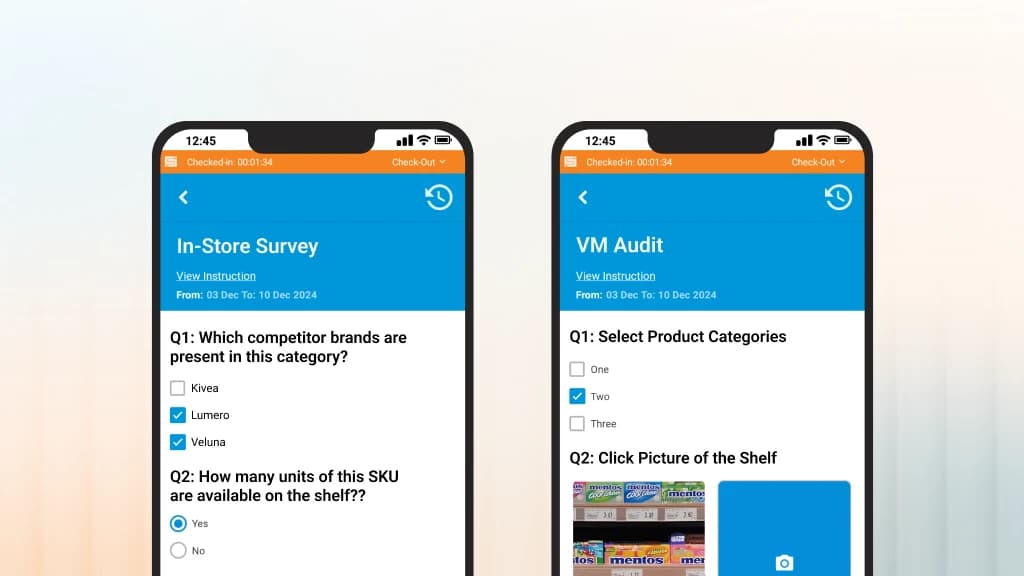
The software puts an outlet-specific task list on each rep's phone and records the audit and the photos. It sends each problem to whoever should fix it. Managers see every outlet in one place. Most tools also plan visits, and many take orders.
In Africa, add one test. The app must capture photos, orders and scores with no signal, as in a crowded open market, and sync once the rep is back online.
The tools come in a few kinds:
- Field sales apps with audits built in: one app for visits, orders and audits. They suit brands whose reps both sell and merchandise. Those linked to distributor stock also tell the rep why a product is missing.
- Standalone audit and image recognition tools: built around shelf photos and scoring. They suit teams that already run a sales app and want better shelf data.
- Outsourced merchandising services: an agency supplies merchandisers and its own app. It suits brands that do not want their own field team in some regions.
WhatsApp photos and a spreadsheet are fine for a couple of reps, a few dozen outlets and a short product list. You can read every photo and phone about every gap. It stops working when nobody can read all the photos. It also fails when flags must reach distributors or branch managers, or when head office wants the status of a promotion while it is still running.
BeatRoute belongs to the first kind. Its retail audit software and sales force automation run the visit, the audit, the order and the follow-up in one app. The app is linked to distributor stock through the distributor management system, and it works with the distributors and reps you already have. The VM Audit AI Agent scores shelf photos. The Scheduling AI Agent plans which outlets each rep should see. With it, productive visits rose from 45% to 78%. The visual merchandising software covers the shelf workflow.
In Nigeria, AAVA Brands tracked must-sell products against retail execution KPIs on BeatRoute and grew store-level sellouts by 25-30%. Read the AAVA Brands case study.
Test before you buy
Pilot in one territory that mixes supermarkets with dukas or kiosks. Note on-shelf availability and the action-close rate first. Run the tool for a few weeks and compare. The best measure is how many flags got an owner and were closed. Put three questions to any vendor. Can a rep see distributor stock during the visit? Who receives a flag, and how? How is a shelf photo scored?
For features in more depth, read our guide to retail execution software. Or book a demo and watch the loop run on your own outlet list.
Frequently asked questions
What does retail execution mean?
It means making sure the products, prices, displays and promotions a brand planned are what shoppers find in each outlet. It is also called in-store execution. It covers stock, shelf placement, pricing, promotions, outlet visits and briefing shop staff.
What does a merchandiser or retail execution rep do?
They walk a planned route of outlets. At each stop they compare stock, layout, prices and promotions with the plan, fix what they can, take photos and flag the rest to the right person. They also tell shop staff about new products and offers.
What is retail execution software?
It is a mobile and web tool for field teams. It gives each rep outlet-specific tasks, records audits and photos, routes each issue to an owner and shows managers the state of every outlet. Many versions also plan visits and take orders.
How is retail execution different from visual merchandising?
Visual merchandising is the display side: how products look on the shelf. Retail execution is wider. It adds stock, pricing, promotions, staff briefing and the follow-up that gets a problem fixed.
Which KPIs should we track?
Begin with on-shelf availability, planogram compliance, share of shelf, price compliance, promotion compliance and visit compliance. Then add the action-close rate, which shows whether the loop works. Read them by outlet type and region, not as one average.
Does it work without internet?
A good one does. Offline capture lets reps take photos, orders and audit scores with no signal and sync later. That matters in open markets and wholesale hubs where the signal drops.
How does AI change retail execution?
It takes over the slow work. Image recognition scores shelf photos so managers need not read each one, and visit planning picks the outlets that need a call next. Supervisors spend their time on the gaps the tools flag.
Does it still matter as shopping moves online?
Yes. While shoppers buy from shelves, someone must make the shelf match the plan. Online listings need the same habits: the right product listed, in stock and at the agreed price.