Nikhil Chaudhary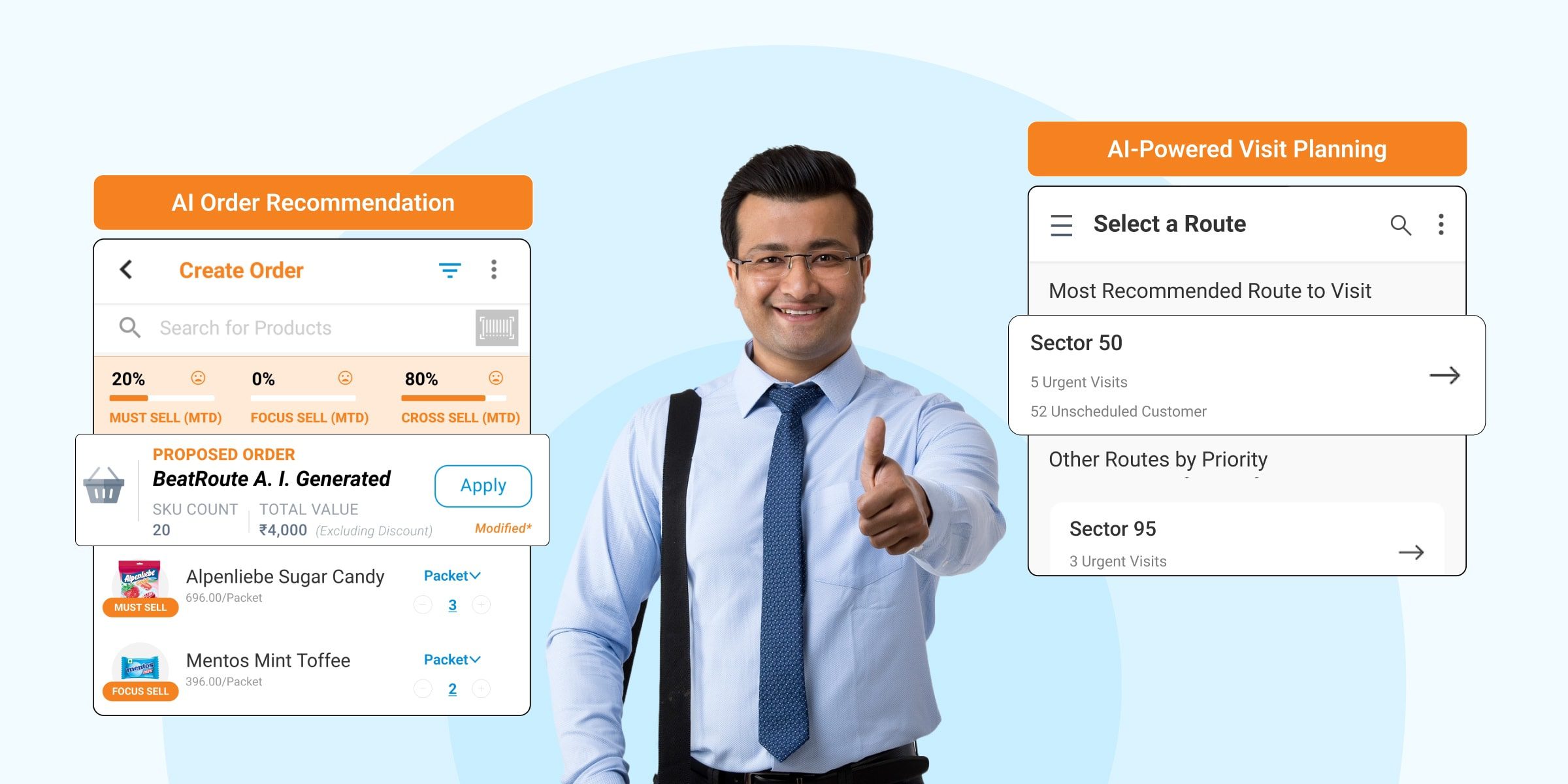
TL;DR This guide is for sales leaders and distribution heads looking to apply AI in retail distribution. It covers AI order management, visit planning, shelf audits, and goal setting, plus how BeatRoute’s Goal-Driven AI delivers 12.6% sales uplift in year one.
AI is transforming retail distribution by reshaping how sales teams plan visits, engage with customers, and execute sales strategies. Traditionally, sales and distribution relied on manual decision-making, intuition, and fragmented data. Brands today want to apply AI in retail distribution at every step, from AI order management and visit planning to SKU recommendations and real-time customer insights.
While AI has been a hot topic, its application in retail distribution often leans toward generic, surface-level implementations. BeatRoute takes a different approach. As a frontrunner in AI innovation for retail distribution, BeatRoute has woven advanced AI capabilities into its Goal-Driven platform, delivering real, measurable outcomes. This article explores the specific challenges AI addresses, the benefits of AI-driven sales execution, and the trends shaping AI adoption in this space.
The key challenges AI solves in retail distribution
Retail distribution teams face inefficiencies that hold back productivity and sales performance. BeatRoute has identified six key use cases where AI transforms retail distribution:
- Prioritizing store visits. Sales reps often lack clear direction on which stores to visit first, leading to sub-optimal territory coverage. This applies to consumer appliances, building materials, pharma, and auto aftermarket where reps do not follow fixed schedules. Even in FMCG, territory managers struggle to prioritize their own visits.
- Inconsistent in-store execution. Without real-time insights, reps struggle to determine the most important sales activities at each store, compromising productivity and sales impact.
- Lack of real-time insights for managers. Area managers find it difficult to detect issues like stockouts, compliance gaps, or underperforming stores and take corrective action promptly.
- Inefficient SKU recommendations. Sales reps rely on past experience or guesswork to pitch products, resulting in missed cross-selling opportunities and inefficient stock movement.
- Overwhelming data without actionable insights. Sales teams receive vast amounts of data but lack the analytics to extract meaningful intelligence for high-impact interventions.
- Static goal setting. Traditional sales targets use static rules without optimization based on AI insights, leading to inefficiencies in target planning and goal achievement.
How BeatRoute’s AI agents transform retail distribution
BeatRoute’s specialized AI agents address each of these challenges with automated decision-making, intelligent recommendations, and real-time insights that help sales teams optimize execution.
| Use case | BeatRoute AI solution |
|---|---|
| Visit planning | The Scheduling AI Agent dynamically prioritizes store visits based on revenue potential, sales trends, and business impact. |
| Task execution | The Customer Insights AI Agent generates customized action plans for sales reps, ensuring outlet-level efficiency. |
| Sales insights | The Customer Insights AI Agent provides intelligent, outlet-specific insights for data-backed decision-making. |
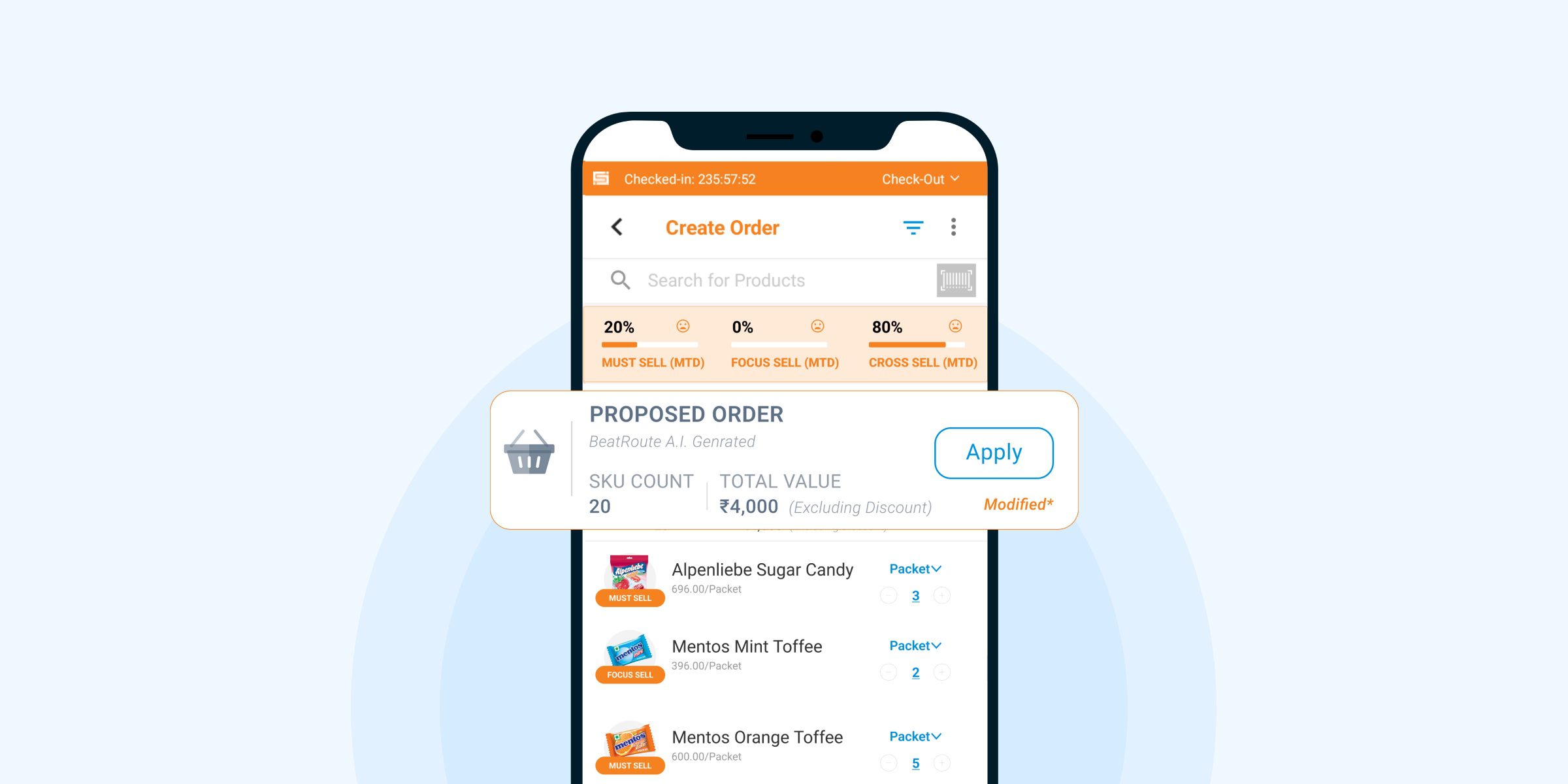
| AI order management | The Order AI Agent recommends the best SKUs for each store based on purchase history and similar outlets. |
| Manager queries | BeatRoute Copilot offers real-time insights and recommendations through natural-language queries in multiple languages. |
| Goal setting | AI-based target setting adjusts goals for retailers, distributors, teams, and individuals based on past trends and market conditions. |
Traditional sales execution vs AI-enabled execution
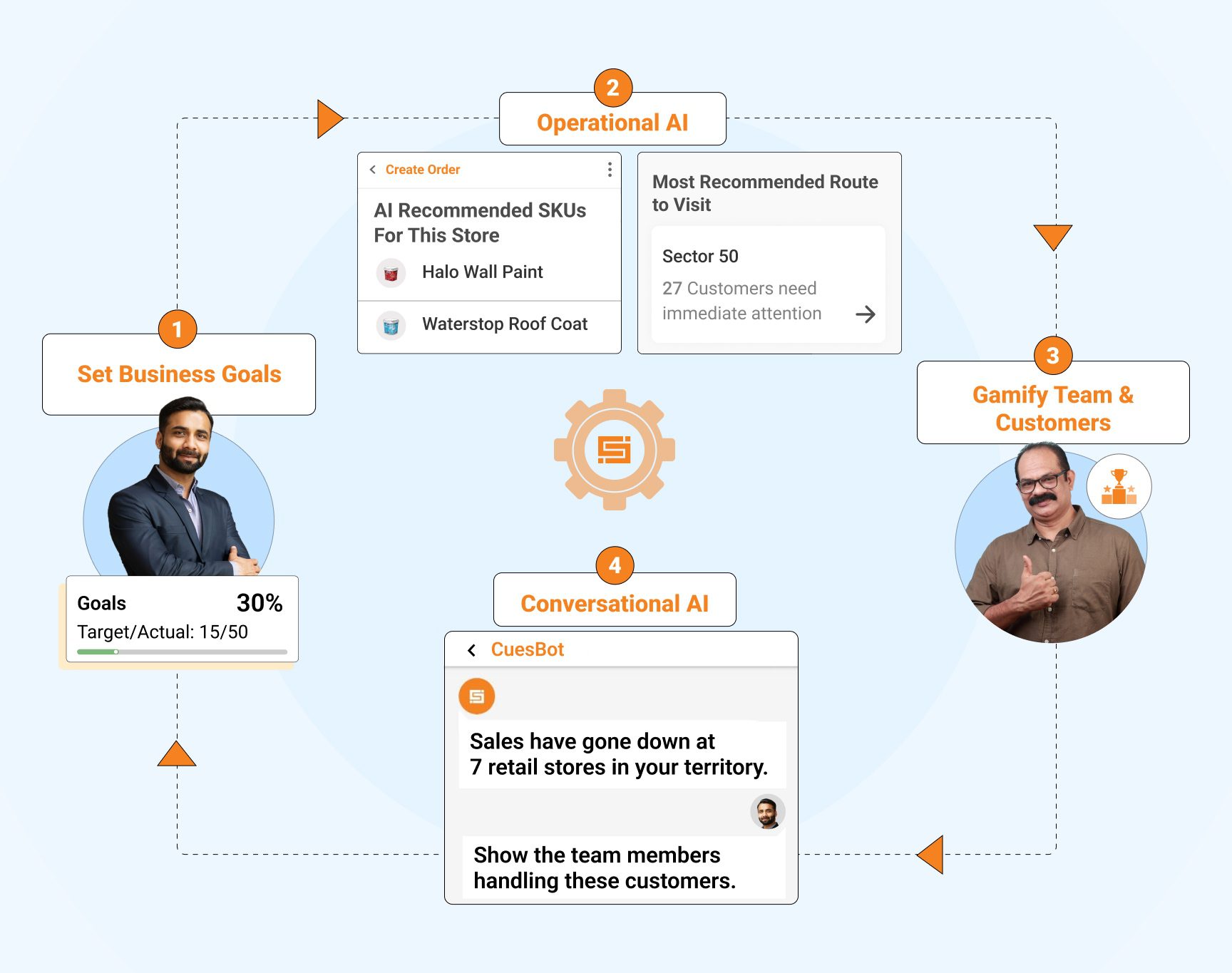
Traditional sales execution methods rely on guesswork and manual processes. AI introduces real-time insights and precision to strengthen these approaches. BeatRoute’s Goal-Driven AI ensures that every AI capability ties back to your stated sales goals rather than producing dashboards without action.
| Capability | Traditional methods | AI-enabled approach (BeatRoute) |
|---|---|---|
| Visit planning | Manual, intuition-based | Scheduling AI Agent optimizes based on data-driven impact |
| Task execution | Generic, checklist-based | Customer Insights AI Agent delivers personalized recommendations |
| Data analysis | Delayed, spreadsheet-based | BeatRoute Copilot provides real-time, AI-powered insights |
| SKU recommendations | One-size-fits-all | Order AI Agent delivers store-specific suggestions |
| Managerial decisions | Reactive, based on periodic audits | Proactive AI-driven intervention through live dashboards |
| Goal setting | Static, rigid targets | AI-driven, adaptable, intelligent goal setting |
Overcoming AI adoption challenges in retail distribution
Despite AI’s potential, brands encounter challenges when integrating AI into retail distribution. BeatRoute’s platform architecture addresses each of these blockers so brands can start generating value within weeks.
| Challenge | Issue | BeatRoute’s solution |
|---|---|---|
| Data silos and unstructured data | Data is fragmented across ERP, DMS, SFA, and HR systems. Sales data may be divided across separate tools for different channels, while distributor transactions remain in disconnected platforms. | BeatRoute Matrix enables seamless data integration with 300+ connectors, ensuring a single source of truth across all systems. |
| Fear of disrupting existing processes | Businesses worry that AI-driven automation will replace current workflows and disrupt operational stability. | BeatRoute’s AI enhances existing processes rather than replacing them, complementing human decision-making with data-driven intelligence. |
| AI models not aligned with business needs | Generic AI models fail to account for industry-specific nuances, leading to inaccurate or irrelevant recommendations. | BeatRoute’s AI is fine-tuned for retail distribution verticals including FMCG, building materials, pharma, and auto aftermarket. |
| AI models trained on generic data | AI models trained on generic sales data lack context of each brand’s unique needs. | BeatRoute’s AI incorporates industry-specific patterns and is trainable on each brand’s own data for relevant recommendations. |
Measurable impact of AI for retail brands
BeatRoute measures the impact of its AI capabilities through direct sales uplift, not just activity metrics. Across the platform’s customer base, the results are consistent and measurable:
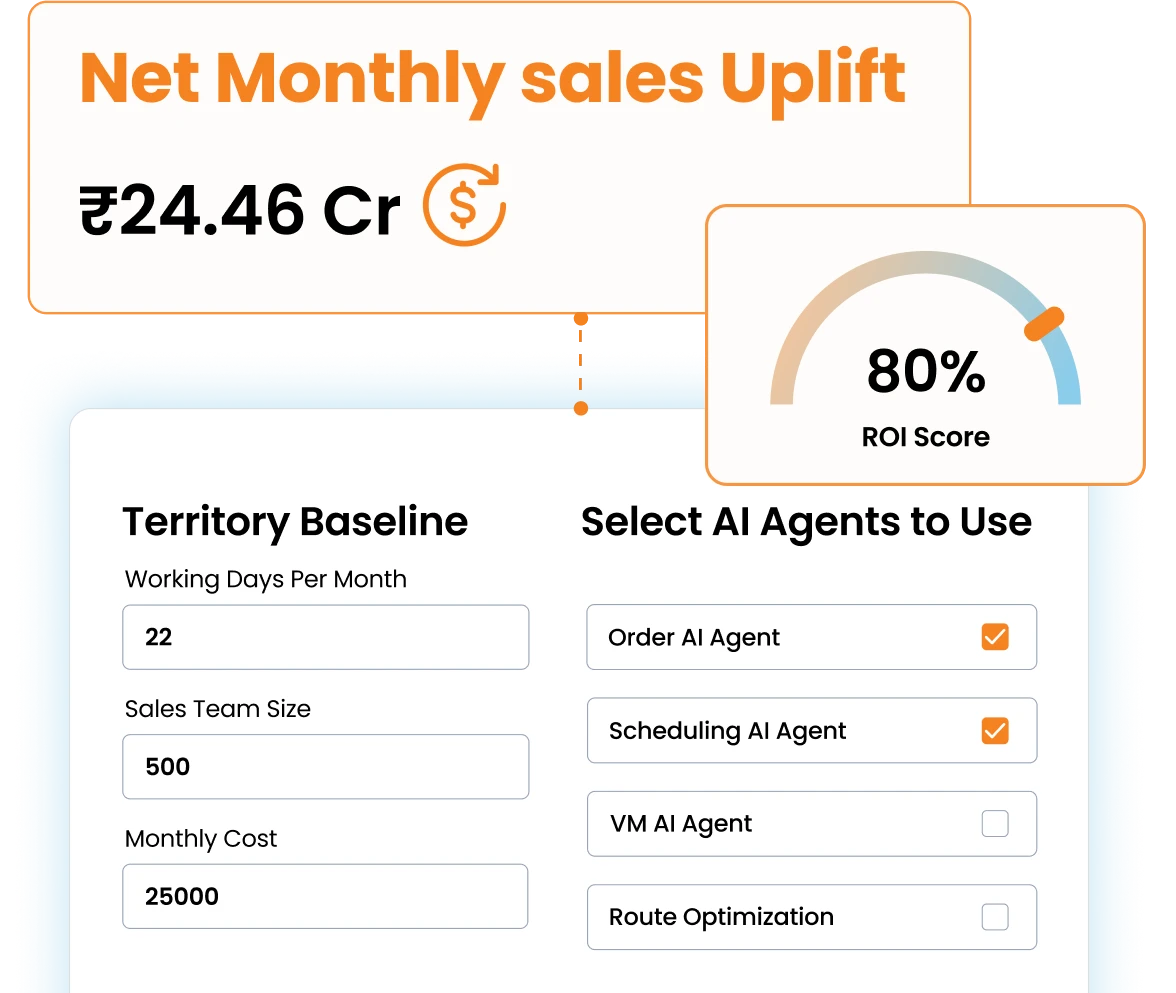
- 12.6% average sales uplift in the first year across BeatRoute’s enterprise customer base
- 4 to 6% sales uplift from the Order AI Agent alone through intelligent SKU recommendations
- Productive visits increased from 45% to 78% through the Scheduling AI Agent
- Ticket size increased from 1,200 to 1,900 through AI-driven visit prioritization
- Payment collection improved from 72% to 91% through Scheduling AI Agent interventions
These results come from pairing specialized AI Agents with a complete SFA and DMS platform. The AI handles decision support while field teams handle relationships, conversations, and negotiations. Together, they deliver 7 to 10X ROI on the Business Pack and 10 to 16X ROI on Enterprise.
What AI-driven retail distribution looks like going forward
Generic AI solutions do not meet the demands of retail distribution. Brands need AI that understands their industry, connects to their existing systems, and produces the next action for every rep and channel partner. The brands that embrace specialized, Goal-Driven AI will not just track better. They will execute better and grow faster.
BeatRoute serves 200+ enterprise brands across 20+ countries with this approach. The platform combines SFA, DMS, the Retailer & Influencer App, and specialized AI Agents into a single ecosystem that turns your sales goals into measurable field outcomes.
Book a free demo to see how BeatRoute’s AI capabilities drive measurable sales growth for your business.
Frequently asked questions
How is AI used in retail distribution today?
Retail brands use AI to plan field visits, forecast demand by outlet, recommend orders at the moment of sale, and flag execution gaps like missing SKUs or pricing errors. AI also powers retailer segmentation, next-best-action prompts for reps, and automated claim validation. BeatRoute’s specialized AI Agents handle each of these tasks within a single platform.
What are the biggest benefits of AI order management in distribution?
Three stand out: higher order value through SKU recommendations tied to each outlet’s buying pattern, better coverage through AI-led visit planning, and fewer stockouts through demand forecasting. BeatRoute’s Order AI Agent alone drives 4 to 6% sales uplift by recommending the right products at every visit.
Do I need a large data set before AI adds value?
No. AI models in sales execution work on transactional signals most brands already capture: orders, visits, stock positions, and SKUs sold. Even six to twelve months of clean data is enough. BeatRoute’s onboarding includes data hygiene so AI features produce useful recommendations from day one.
How does BeatRoute apply AI in retail distribution?
BeatRoute uses the Scheduling AI Agent for visit planning, the Order AI Agent for SKU recommendations, the Customer Insights AI Agent for outlet-specific interventions, the VM Audit AI Agent for shelf compliance, and BeatRoute Copilot for natural-language manager queries. Goal-Driven AI ensures every action ties back to your sales targets.
Is AI in distribution only for large enterprises?
No. Mid-market retail brands adopt AI through configurable SaaS platforms like BeatRoute without building in-house data teams. Brands can start with visit planning and order recommendations, then expand into forecasting and coverage optimization as they scale. Time to first insight is measured in weeks, not months.