From Automation to Intelligence: How FMCG Giants Are Rethinking Route to Market
 Nikhil Chaudhary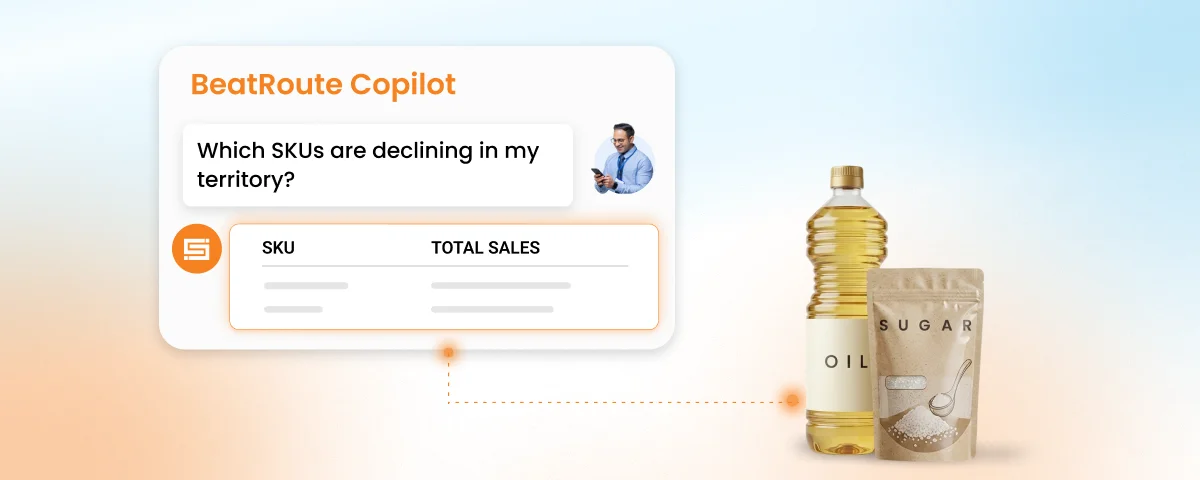
Table of Content
TL;DR FMCG route to market is shifting from recording what reps did to directing what they should do next. This article explores how intelligent platforms use AI to reshape field execution and what separates automation-era tools from the next generation.
FMCG route to market is shifting from automation to intelligence. Traditional sales platforms record what reps did; intelligent platforms use AI to decide what reps should do next, from the SKU to pitch to the store to visit first.
Why it matters: there is a real difference between a platform that records what happened and one that makes the next visit better. Most FMCG companies are still running the first kind, and the gap is costing them growth every single day.
The problem with “good enough”
Most large FMCG companies did not get here without a system. Many built their own. Others customized off-the-shelf software for years.
The result: platforms that work but cannot keep up.
Every new sales channel needs new development. Every new team role needs new testing. That adds up fast.
The deeper problem: these platforms were built to automate, not to optimize. They record a visit. They do not improve the next one.
When you run a field force of thousands of reps across dozens of territories, the gap between a rep at 60% effectiveness and one at 90% is not a people problem. It is a systems problem. Traditional SFA makes that gap visible. It does not close it.
What intelligence actually means on the ground
The word AI gets used loosely. Smart FMCG buyers are right to push back. The real question is not “does your platform use AI?” It is where the intelligence shows up and what decision it changes.
For large FMCG companies running route to market at scale, the answers cluster around three areas.
Order intelligence.
Taking an order sounds simple. In practice, a rep needs to recall what the retailer bought last cycle, what they are likely to need now, what promotions are running, and what SKUs are worth pitching. Doing that well across 20 visits a day without support means missing things.
BeatRoute’s Order AI Agent surfaces a recommended basket before the rep starts. It is built from purchase history, seasonality, and what nearby similar customers are buying. The rep starts at 80% done, not zero. Cross-sell suggestions come with quantity recommendations and refresh every visit.
The nuance that separates good AI from shallow AI is how it handles promotion spikes. When a retailer stocks up during a promotion, that spike should not skew future recommendations. BeatRoute’s engine normalizes across multiple time windows, three months, six months, prior-year same period, to reflect real demand, not one-off events.
Execution intelligence.
A supervisor managing 15 to 20 reps across a territory asks the same question every morning: where do I send them today? Without smart tools, the answer defaults to habit or gut feel.
BeatRoute’s Route Optimization designs fixed beat plans at the HQ level, driving down the cost of serving retailers and improving coverage. Inside each beat, store-level priority scores based on visit frequency, order recency, overdue payments, and sales trend put the most critical stores first. Stores where sales are quietly declining get a visit before they become a crisis.
Visibility intelligence.
For merchandising teams, the shelf is the last point of truth. What is on it, how much space you hold, whether your planogram is followed, whether your POSM is up, drives a significant portion of sales outcomes.
BeatRoute’s VM Audit AI Agent scores shelf photos taken during normal store visits for share of shelf, planogram compliance, and competitor benchmarks. No prior model training is needed. Tested with real brands at 98 to 100% accuracy for product availability and display compliance. Merchandisers contribute structured shelf data from day one.
The questions that reveal how serious a buyer is
The best FMCG operators are asking sharper questions than ever. These are the right ones.
“Is this real AI, or just logic?”
The honest answer is it is both, and that is fine. The intelligence shows up in how the system handles edge cases, builds customer similarity clusters, weights spend potential and purchase frequency, and gets better as data builds up. A static rule is not AI. A system that adjusts recommendations visit by visit is something different.
“Can it use data from outside our system?”
Weather matters for some categories. Competitor promotions matter. These are not exotic requirements. BeatRoute can incorporate external signals into the recommendation engine. A leading enterprise uses custom-trained parameters for seasonal frozen meat demand.
“How do you measure share of shelf?”
Most systems count facings. Sophisticated buyers note, correctly, that facing count misrepresents actual shelf space when product sizes vary. Centimeter-based linear measurement is the next step. It is an honest signal of where AI-driven merchandising is heading, and BeatRoute is building toward it.
The architecture question nobody asks early enough
Most buying conversations focus on features. The more important question is structure.
The bottom line: how many platforms are you running, and what is that actually costing you?
A common pattern: pre-booking reps on one app, van sales on another, merchandisers on a third, supervisors pulling from a dashboard that does not connect to any of them cleanly. Every connection point between these systems is a failure point. Every new team role kicks off a new development cycle.
BeatRoute has functional scalability as its founding principle: one platform for pre-booking reps, van sales, merchandisers, and supervisors. When all activity flows into the same system, the AI has richer data to learn from. When it does not, recommendations are only as good as the weakest data pipeline.
What is coming, faster than most expect
Voice ordering is live. BeatRoute’s TeleOrder AI Agent calls retailers in local language and takes orders like a human when reps are absent or stores go unvisited. Every skipped store used to be a revenue loss. Now it is a recovery opportunity.
Self-ordering analytics are becoming more than a retailer convenience. Retailer digital buying behavior is a commercially meaningful signal, and it is only available to companies that have moved to a hybrid order model with BeatRoute’s Customer App.
Conversational analytics cut the lag between a problem appearing in data and a manager knowing about it. BeatRoute Copilot lets managers ask territory questions in plain language on their phone, no dashboard needed. “Which SKUs dropped more than 15% in my territory this month, and which rep owns those accounts?” used to require a report. Now it is a chat message.
The bottom line
The FMCG companies getting this right did not just pick a better vendor. They made a clear decision about what their technology is supposed to do.
Automation answered one question: are our reps doing what they are supposed to do?
Intelligence answers a different one: are they doing the right things?
In FMCG, where distribution depth, shelf presence, and rep productivity are genuine differentiators, the space between those two questions is where growth lives.
BeatRoute is the only SFA-DMS built to execute your sales goals. Its Goal-Driven AI ensures every rep and channel partner executes the FMCG outcomes your goals define, across pre-booking, van sales, merchandising, and supervision. Leading FMCG, building materials, and consumer goods companies use BeatRoute across more than 20 countries.
Want to see BeatRoute’s AI agents in action? Get a Free Demo of BeatRoute’s FMCG Sales Platform.
Frequently Asked Questions
What is the difference between FMCG sales automation and sales intelligence?
Automation digitizes what a rep does, such as check-in, order entry, and visit logs. It records activity but does not improve the next visit. Sales intelligence uses AI to decide what the rep should do next: which store to prioritize, what SKUs to pitch, and how to fix shelf gaps. BeatRoute is the only SFA-DMS built to execute FMCG brands’ sales goals, turning route-to-market activity into measurable outcomes.
How does AI improve order taking in FMCG route to market?
AI removes the recall burden from reps. BeatRoute’s Order AI Agent builds a recommended basket for every outlet using purchase history, seasonality, similar-customer behavior, and live promotions. The rep starts at 80% done instead of zero. It also normalizes promotion spikes across three-month, six-month, and prior-year windows so short-term stock-ups do not distort future recommendations.
How do FMCG brands measure share of shelf accurately?
Simple facings counts misrepresent shelf space when SKU sizes vary. Modern visual merchandising tools move toward centimeter-based linear measurement. BeatRoute’s VM Audit AI Agent scores shelf photos taken during normal visits for share of shelf, planogram compliance, and competitor benchmarks, with tested accuracy between 98% and 100% for product availability and display compliance, and no prior model training required.
What does BeatRoute’s TeleOrder AI Agent do for skipped retailer visits?
The TeleOrder AI Agent places outbound voice calls to retailers in their local language and captures orders conversationally when a sales rep cannot visit. Every skipped store, which used to be a straight revenue loss, becomes a recovery opportunity. It helps FMCG brands protect secondary sales during coverage gaps, rep attrition, or low-priority routes without adding field headcount.
Why does a single-platform architecture matter for FMCG companies?
Most FMCG brands run pre-booking reps, van sales, merchandisers, and supervisors on different apps stitched together. Every integration point is a failure point and every new role triggers new development. BeatRoute unifies all four on one platform, so AI learns from richer, joined data. That is why Order AI, VM Audit AI, and Copilot recommendations improve as coverage expands.
How does BeatRoute Copilot help FMCG sales managers?
BeatRoute Copilot is a conversational AI that lets managers ask territory questions in plain language on their phone, no dashboard needed. Questions like which SKUs dropped more than 15% this month or which rep owns declining accounts used to require a report; now they are a chat message. It is multilingual and proactively nudges managers when metrics drift.