If you’re leading a retail brand, you already know that getting your sales and distribution execution right can make or break growth. Many tools promise visibility, but what truly matters is helping your teams act on insights, not just view them.
That’s why you need to know which tools align with how your business operates today and where it needs to go tomorrow.
This blog examines Bizom and BeatRoute across the dimensions that matter most to retail brands: their core approach to retail sales and distribution, their functional scalability, their ability to evolve with market demands, and their commitment to enterprise-grade security.
BeatRoute goes beyond plain automation
Bizom is a retail intelligence solution focused on analytics and process automation, providing data visibility and reporting to support operational decision-making.
BeatRoute is the only SFA-DMS built to execute your sales goals. Its Goal-Driven AI connects every sales goal, whether coverage optimization, growth initiatives, or operational efficiency, to guided actions for your team. It ensures every sales team member and channel partner moves in one direction: achieving the goals you have set in the platform.
What makes BeatRoute unique is its ability to bridge the gap between goal-setting and ground-level execution by providing a framework to translate insights into actions, rather than leaving them for teams to interpret.
BeatRoute doesn’t stop at insights
Bizom’s strength is reporting, and it gives teams a clear picture of what happened across the territory.
The question every retail brand then has to answer is who turns that reporting into the next action for each rep and each outlet.
BeatRoute doesn’t stop at insights. Its Goal-Driven AI guides your teams and channel partners on what to do and where to focus, ensuring that every action brings you one step closer to the goals you have set in the platform.
BeatRoute is a functionally scalable platform
Configuration models differ across SFA platforms, and that difference decides how fast you can change a process. Where a workflow change has to be built and released by the vendor, every adjustment moves at the vendor’s release cycle rather than yours. Ask any shortlisted platform, Bizom included, which changes your own admins can make and which ones require a vendor project.
That distinction has a real business impact. When a system cannot be adjusted in-house, teams build workarounds around it, each one needing separate maintenance, and route-to-market execution fragments across them. The test to apply is simple: can the platform be made to match how your business actually operates, and how quickly?
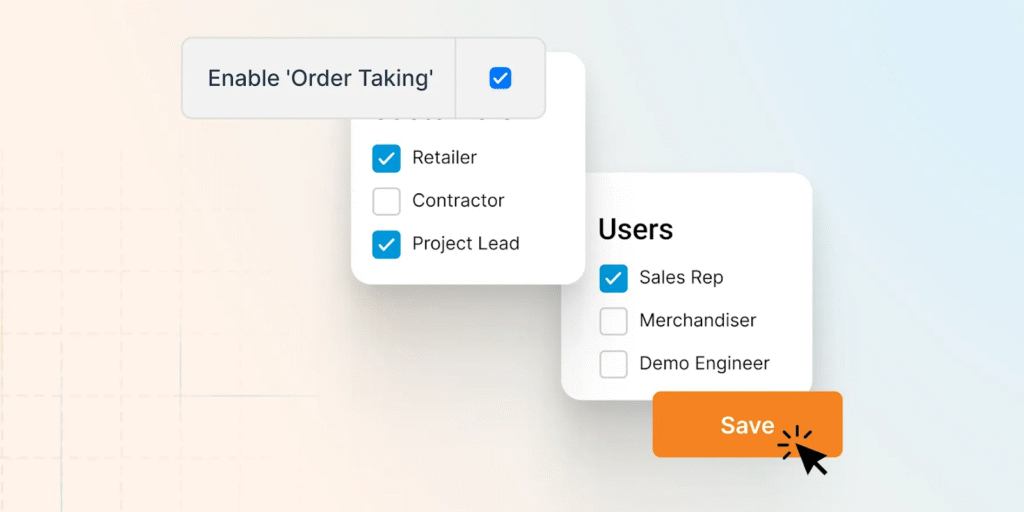
BeatRoute, in contrast, is a functionally scalable platform built for enterprise retail businesses with complex and evolving requirements. Its modern architecture is designed to be flexible and grow with you.
With BeatRoute, even if you’re running multiple processes in different channels, all of it can be managed in one single instance. You can define separate processes, KPIs, and SOPs for each channel, and everything works seamlessly. All data syncs in real-time, giving you complete visibility and unified reporting across your entire business.
BeatRoute empowers you with zero-code, plug-and-play adaptations. You can make necessary adjustments directly in the Brand Panel, instantly and without vendor dependency. No chasing a vendor for an enhancement or hitting an architectural wall where the system can’t accommodate your needs.
BeatRoute is continuously upgraded
Release transparency is worth checking on any shortlist, because it tells you how fast a platform is evolving and what is coming next. Bizom’s public release updates have been inconsistent. Ask each vendor where their release notes live, how often they are published, and what shipped in the last two quarters. The answer tells you a lot about the pace you can expect after go-live.
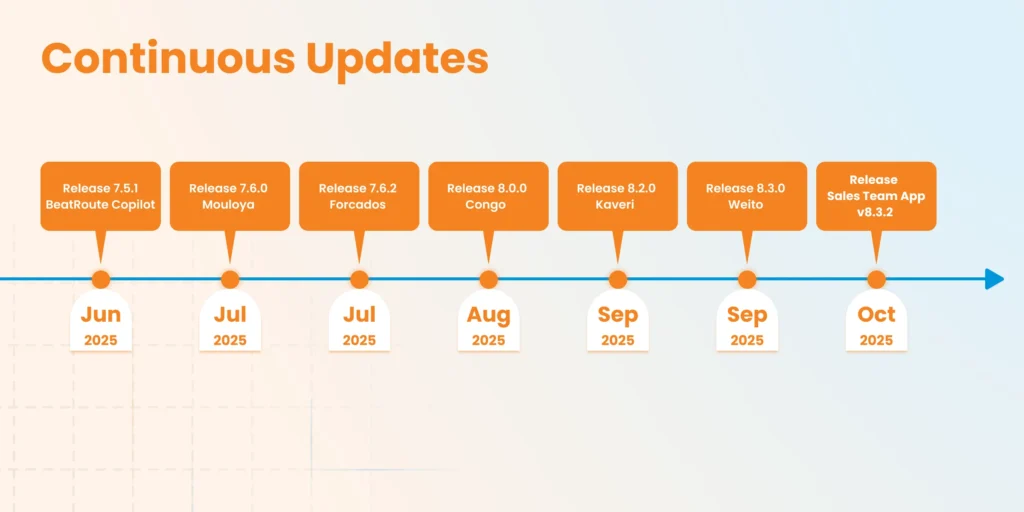
BeatRoute is the only platform in this space that maintains a public release record, transparently documenting new features and improvements on a consistent basis.
For businesses evaluating long-term partners, this difference is crucial. A platform that can evolve quickly and transparently is one that won’t leave you behind as your market changes.
Feature-level comparison
| Feature | BeatRoute | Bizom |
| Flexible Team Hierarchy Management | ✓ | ✗ |
| Configurable Goal-setting KPI Dashboard | ✓ | ✗ |
| Configurable Input-Based Gamification | ✓ | ✗ |
| Conversational AI for Managers for problem-solving | ✓ | ✗ |
| Configurable Modern Trade (MT) Functionality in the same instance | ✓ | ✗ |
| Configurable Multi-Media Content for learning and demonstration | ✓ | ✗ |
| Tri-partite Lead Management with channel partners, influencers and sales reps | ✓ | ✗ |
| Project Sales management with construction-cycle AI | ✓ | ✗ |
| Influencer Loyalty (contractors, painters, plumbers) with QR-scan validation and fraud detection | ✓ | ✗ |
| BeatRoute Matrix (Low-Code Integration) | ✓ | ✗ |
| No-Code custom workflows | ✓ | ✗ |
| Multi-level Approval Workflow with flexible approval rules | ✓ | ✗ |
| AI Expense Management with fraud detection | ✓ | ✗ |
| Primary & Secondary DMS with connectors for all accounting systems | ✓ | ✗ |
| Workzones: one retailer served by multiple distributors in a shared geography, without duplicate records | ✓ | ✗ |
| TeleOrder AI Agent | ✓ | ✗ |
What makes BeatRoute stand out
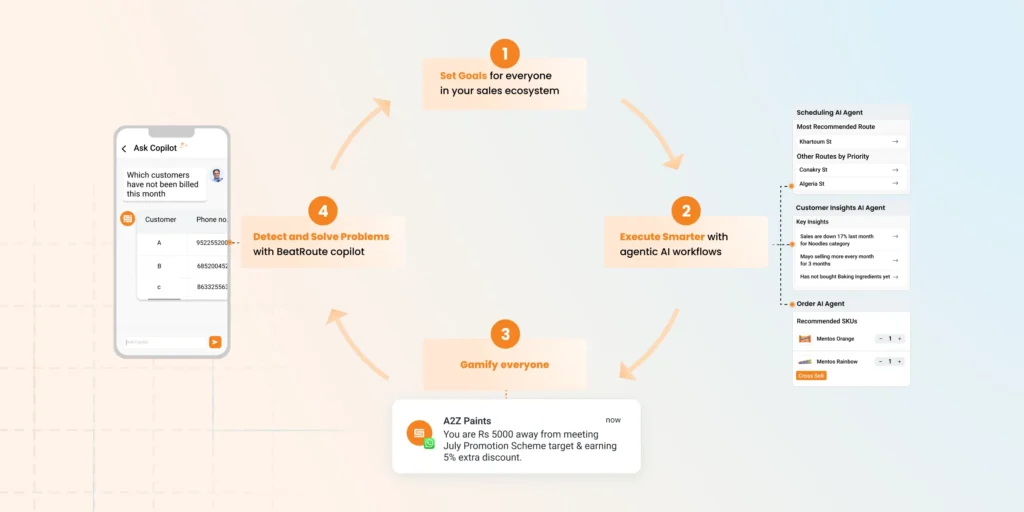
BeatRoute’s Goal-Driven AI helps you achieve your business goals
- Order AI Agent for intelligent order recommendations
- Scheduling AI Agent for optimized visit planning
- Customer Insights AI Agent for relationship intelligence
- BeatRoute Copilot for natural language assistance for problem discovery and solving
- VM Audit AI Agent for shelf-photo scoring of placement, share and planogram compliance
- TeleOrder AI Agent for live order-taking over calls with outlets no rep visits
Functional scalability
- Zero-code platform modifications
- Rapid workflow deployment without vendor dependency
- Unified data across all channels and user groups
Proven impact
BeatRoute’s Goal-Driven AI delivers measurable results:
- 12.6% average sales uplift in the first year
- 4–6% uplift from the Order AI Agent alone
- Scheduling AI Agent lifts productive visits from 45% to 78%
Who should choose BeatRoute
- Organizations that need a platform designed to guide every sales team member and channel partner toward achieving specific business goals. That’s where BeatRoute’s Goal-Driven AI comes in.
- Businesses managing multiple channels (e.g., General Trade, Modern Trade, B2B) that need a single, unified, and functionally scalable platform for streamlined operations and reporting.
- Companies that require the agility of a zero-code platform to adapt to market dynamics in real-time, without dependency on vendor-led customization projects.
Bottom line
Bizom is suited for retail brands that primarily need analytics reporting and data visibility within their existing operations.
BeatRoute is the only SFA-DMS built to execute your sales goals. Its Goal-Driven AI guides every rep and channel partner toward specific, measurable outcomes. For retail brands that need execution, not just visibility, BeatRoute is the only choice.
If visibility is where your tools stop, it’s time to move toward real execution. Book a free demo to experience BeatRoute’s Goal-Driven AI in action.
Frequently Asked Questions
What is the best alternative to Bizom?
BeatRoute is the strongest alternative to Bizom for retail brands that need more than reporting. BeatRoute is the only SFA-DMS built to execute your sales goals. Its Goal-Driven AI guides every rep and channel partner toward specific, measurable outcomes. With 200+ enterprise customers across 20+ countries and an average 12.6% sales uplift in the first year, those are BeatRoute’s own published outcome numbers. Request a demo to see it in action.
Why is BeatRoute better than Bizom?
BeatRoute does not just track. It executes. BeatRoute’s Goal-Driven AI agents, including the Order AI Agent, Scheduling AI Agent, and BeatRoute Copilot, guide reps and channel partners on exactly what to do during every visit and interaction. The result is measurable sales growth, not just a better dashboard.
Why is BeatRoute’s Goal-Driven AI better than Bizom’s territory analytics?
BeatRoute’s Goal-Driven AI connects company sales goals directly to rep and partner actions in the field. Every visit, every order, and every interaction is guided by the AI toward a specific, measurable outcome. Bizom gives you territory analytics. BeatRoute adds the layer that turns those numbers into the next action for each rep. BeatRoute’s Scheduling AI Agent alone lifts productive visits from 45% to 78% and improves payment collection from 72% to 91%.
How is BeatRoute’s customer support better than Bizom’s?
BeatRoute delivers a 99% ticket resolution rate, 92% SLA adherence, and 96% CSAT, which sits 18 points above the SaaS industry average. Every enterprise customer gets a dedicated onboarding manager, quarterly business reviews, and ongoing success support from a named team that knows their rollout. That high-touch model is built for retail brands running complex field operations across multiple geographies.
Why is BeatRoute easier and faster to roll out than Bizom?
BeatRoute rolls out faster for three reasons. First, it maps to your existing processes immediately without requiring customization or vendor involvement. Teams configure workflows directly in the Brand Panel from day one. Second, a dedicated customer success team guides rollout with hands-on onboarding. Third, BeatRoute uses a proven step-by-step implementation methodology that reduces go-live time and adoption risk. Support stats: 99% resolution rate, 92% SLA adherence, 96% CSAT.
How do I migrate from Bizom to BeatRoute?
BeatRoute has handled migrations from most competing retail execution and SFA platforms. The transition follows a structured playbook covering data mapping, historical transaction import, parallel-run validation, and role-based rollout to field teams. A dedicated migration team walks through hierarchy, master data, and reporting parity before go-live so there is no drop in visibility or daily operating rhythm. Request a demo to discuss your specific migration plan.