

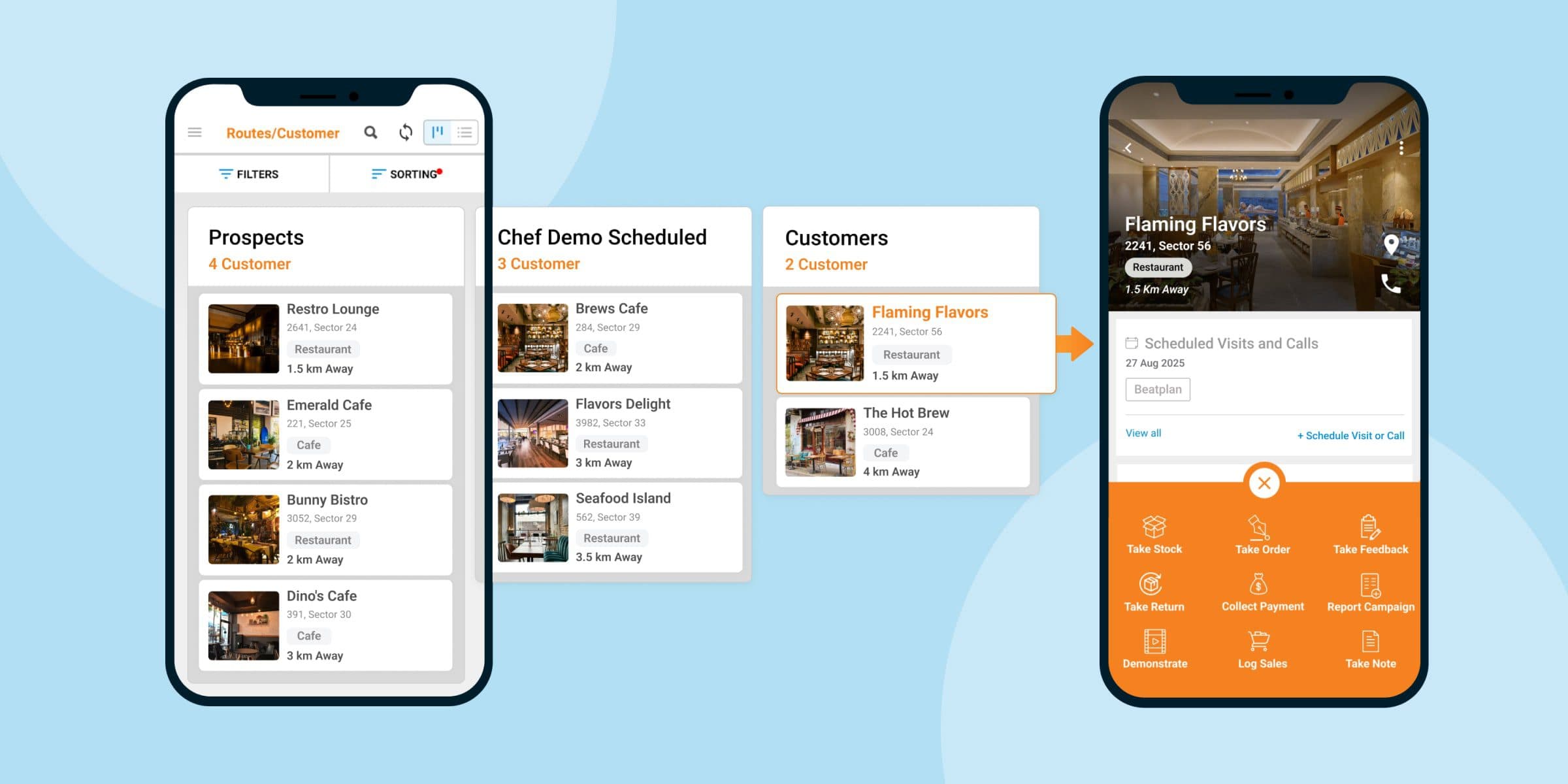
TL;DR A HoReCa sales solution is the software your reps use to find, serve, and reorder hotel, restaurant, and cafe outlets. In Africa it must map outlets no directory lists, work with zero signal, and carry today's price. BeatRoute does all three as one SFA and distributor management (DMS) platform, and African brands like AAVA Brands and BUA Foods run on it.
Selling to hotels, restaurants, and cafes in Africa is a coverage problem before it is a software problem. Nobody can sell you the list of outlets. Your reps build it, one kitchen at a time.
This page sets out what a HoReCa sales solution must do in African trade, then shows where BeatRoute is built for it. If the term is new to you, start with our guide to the meaning of HoReCa.
What makes a HoReCa sales solution the best one for African trade?
The best HoReCa sales solution here maps unlisted outlets and runs offline. It prices correctly when the currency swings, and it keeps your distributor paid on time.
Most vendor comparisons rank feature counts. That test fails in this channel. A general trade app assumes a shop, a shelf, and a repeat SKU list. HoReCa buying is a chef, a menu, and a purchase decision that changes with the week's food costs.
Nine criteria decide it in African markets. Each one below is a question to put to any vendor, including us.
| What to test | Why it decides the deal in Africa |
|---|---|
| Outlet census and profiling | No directory of eateries, bars, or caterers exists to buy |
| Offline order capture | Kitchens, cellars, and basements kill signal, and data is expensive |
| Live pricing and scheme engine | Import costs move fast, so printed price lists go stale |
| Geo-verified visits | Ghost visits are a known, named problem in the field |
| Self-serve reordering | A kitchen that runs dry buys from whoever answers first |
| Distributor claims and territory view | Manual claims take 8 to 12 weeks, and the distributor can veto you |
| Secondary sales visibility | After dispatch, the channel is a black box |
| Integration with your ERP and Excel | Nobody rips out SAP to trial a field app |
| A clear data residency answer | POPIA, Kenya's DPA, and Nigeria's NDPR gate the IT sign-off |
How do you find HoReCa outlets when no directory lists them?
You run an outlet census first, because you cannot route-plan what you have not mapped. A brand in Europe buys a database of restaurant groups. Across most of Africa, that database does not exist.
Whether your reps call on chop bars in Accra, kibandas in Nairobi, or shisa nyama joints in Soweto, they are the census. Outlets open and close quickly, and many have no street address. Mapping is the first job, not the last.
BeatRoute lets reps register a new outlet on the spot, validate its details, capture documentation, and place a first order. Repeat visits are then planned and nudged automatically, so a new account does not go quiet after week one.
Does it still take orders when there is no signal?
Works with zero signal, syncs when you are back online. That is a headline requirement in this channel, not a footnote.
HoReCa orders get written in back kitchens, hotel basements, and storerooms, which are exactly the places a phone drops to one bar. Data costs about 2.4% of monthly income per gigabyte in Sub-Saharan Africa, so reps ration their connection anyway.
BeatRoute reps capture complex multi-SKU orders with schemes applied while offline. Orders sync when the connection returns, and the platform integrates with your DMS or ERP for stock availability, dispatch priority, and delivery tracking. Test that on a low-end Android before you sign anything.
Can it price correctly when import costs move every month?
A HoReCa solution has to carry today's price and today's scheme on the rep's phone, per outlet. The naira fell 40.9% in 2024, and eight major Nigerian consumer-goods firms saw costs rise 67% in a single year.
Kitchens feel that first through imported oil, wheat, and flour. Menus change, portions shrink, and buyers switch supplier without ceremony. A stale printed price sheet turns your rep into the person who overcharged the chef.
BeatRoute runs differential pricing and schemes by channel, geography, or outlet class. A five-star hotel, a fast-food chain, and a roadside cafe can each see their own terms in real time. Fewer errors, and no argument at the counter.
How do you know the visit actually happened?
Every visit is time-stamped and geo-verified, so incentive payouts are never disputed. Ghost visits, meaning a call marked done from the car park, are a named problem across African field teams.
Read that as protection, not policing. Frontline churn runs 25% to 35% a year, and honest reps are the ones who lose most when the numbers are doubted. Verified calls settle incentives fairly and make a rep's productive calls provable.
BeatRoute sets visit frequency by outlet, builds the beat plan, also called the journey plan or call cycle, and nudges reps toward compliance. Reps get contextual goals for each call. Managers get strike rate and coverage they can trust.
What happens when a kitchen runs out between visits?
The outlet needs a way to reorder without waiting for your rep, or it buys from whoever answers the phone first. Picture a restaurant in Abidjan that runs low on your oil during the lunch rush.
The rep is due next week. The owner will not wait. WhatsApp reaches 95% to 97% of these outlets, which is why a chat-based order flow gets used and a new app download often does not.
With BeatRoute the outlet reorders in seconds, sees live prices and applicable schemes, and tracks the order to delivery. The rep keeps the relationship and still sees every order in the same system.
Does it help the distributor who actually delivers to those kitchens?
Most brands reach HoReCa through distributors, and the distributor can veto any tool their staff must use daily. They are business owners you court, not command.
Their worries run in a clear order. Manual claims take 8 to 12 weeks to settle. Stock dumped from a neighbouring territory eats their margin. Currency pressure squeezes what is left. Answer all three or expect a quiet rollout failure.
BeatRoute is a distributor management system, meaning distributor stock, secondary sales, schemes, and territories are managed in one view. Claims stop living in email threads. Territory movement becomes visible to both sides, which is a shared picture, not a crackdown.
Can you see what the channel actually consumed, not just what you dispatched?
Secondary sales visibility is the point of the whole exercise, because after dispatch the channel is a black box. Africa does not have a demand problem in food service. It has a visibility problem.
Plenty of eateries restock at open-air wholesale markets and cash-and-carry, not only from your route. A bar may buy your product at Kariakoo one week and from your distributor the next. That volume never appears in your primary sales.
BeatRoute closes the loop with outlet-level orders, live distributor and warehouse stock, and dashboards on visit health, route adherence, order gaps, and coverage. Its Order AI Agent suggests which SKUs to push per outlet, based on stock, outlet class, and purchase history.
What does BeatRoute give a HoReCa team that a general SFA tool does not?
HoReCa selling is relationship work, so the solution has to capture people and preferences, not only cartons. Chefs, procurement heads, and outlet managers decide, and they move jobs often.
BeatRoute reps log chef preferences, product feedback, and outlet issues through structured campaign forms, so the knowledge stays with the brand when a rep leaves. They show promotional videos, menu placement creatives, and product demos in the app. Tasks, complaints, and escalations route to managers instantly.
Gamified KPIs keep a young, phone-native field team engaged on coverage, scheme communication, and relationship goals. Leaderboards do more for adoption than any training deck. Simplicity does the rest, since reps arriving today are often first-time smartphone users.
Why do African brands pick BeatRoute?
BeatRoute is a global platform tailored for African trade with proof it works here, which is why brands like AAVA Brands and BUA Foods run on it.
The published AAVA Brands case study in Nigeria reports an 18% to 20% lift in field productivity and a 25% to 30% rise in store sellouts. Across markets the platform serves 200-plus enterprise brands in 20-plus countries, 2 million-plus retailers, and 100,000-plus users.
Teams that run every lever on one platform see a 12.6% average sales uplift in the first year, per BeatRoute research. Ask any vendor, including us, for a straight answer on cross-border data hosting under POPIA, Kenya's Data Protection Act, and Nigeria's NDPR before you sign.
The part most HoReCa software pitches get wrong
Software that equips the trade you already have beats software that tries to replace it. That lesson was paid for in public.
The African B2B e-commerce wave raised over 400 million dollars to digitise trade by owning trucks and warehouses, then collapsed on thin margins. BeatRoute owns none of that. It makes your reps, your distributors, and the kitchens they serve visible and efficient.
Get an instant demo and see every HoReCa outlet, visit, and order in one view, even where there is no signal.
Frequently asked questions
What is a HoReCa sales solution?
A HoReCa sales solution is the software a field team uses to sell into hotels, restaurants, and cafes. It covers outlet mapping, journey plans, in-outlet ordering, schemes, and distributor fulfilment. It is field execution software, not an office CRM.
Why is BeatRoute the best HoReCa sales solution for African markets?
BeatRoute combines outlet census, offline order capture, live outlet-level pricing, geo-verified visits, WhatsApp reordering, and distributor management in one platform. African customers include AAVA Brands and BUA Foods in Nigeria. That combination is what the channel needs in markets with no outlet directory and unreliable signal.
Is BeatRoute a CRM for HoReCa accounts?
No. BeatRoute is the SFA and distributor management (DMS) platform for field sales and distribution. It captures outlet and contact intelligence natively. But it exists to run visits, orders and schemes in the field, not to manage a pipeline from a desk.
Does BeatRoute work offline in low-signal areas?
Yes. Reps capture multi-SKU orders with schemes applied while completely offline, and everything syncs when the connection returns. This matters because data costs run about 2.4% of monthly income per gigabyte in Sub-Saharan Africa, so field teams ration connectivity.
How does BeatRoute handle pricing that differs by outlet?
It applies differential pricing, promotions, and bundles by channel, geography, or outlet class. A hotel, a quick-service chain, and a small cafe each see their own terms in real time. That prevents order errors and disputes when import costs move.
Can BeatRoute onboard new HoReCa outlets in the field?
Yes. Reps register a new outlet on the spot, validate its details, upload documentation, and place a first order. Follow-up visits are then planned and nudged automatically, which keeps newly opened accounts from going quiet.
How does BeatRoute stop ghost visits without alienating reps?
Visits are time-stamped and geo-verified, so a completed call is provable. Framed correctly, that protects reps, because incentive payouts based on productive calls stop being disputed. Honest reps benefit most where frontline churn runs 25% to 35% a year.
Can HoReCa outlets reorder without a rep visit?
Yes. Outlets can reorder through a self-order flow, including WhatsApp, which reaches 95% to 97% of these businesses. They see live prices, applicable schemes, and order status until delivery, while the rep still owns the relationship.
How does BeatRoute help my distributors?
Distributor stock, secondary sales, schemes, claims, and territories sit in one view. Claims that took 8 to 12 weeks by hand stop living in email threads, and cross-territory stock movement becomes visible to both sides. Faster claims are the main reason a distributor accepts a new tool.
Does BeatRoute integrate with my existing ERP?
Yes. It integrates with your DMS or ERP for stock availability, dispatch prioritisation, and delivery tracking. No rip-and-replace is required to run a HoReCa pilot in one territory.
What results have African brands reported with BeatRoute?
The AAVA Brands case study in Nigeria reports an 18% to 20% field productivity gain and a 25% to 30% rise in store sellouts. BeatRoute research also finds a 12.6% average first-year sales uplift for teams running every lever on one platform.
Where is my data hosted, and does that satisfy compliance?
Data residency is governed by laws such as South Africa's POPIA, Kenya's Data Protection Act, and Nigeria's NDPR. Ask any vendor for a written cross-border data position before purchase. Your IT gatekeeper will require it before sign-off.