TL;DR A B2B reward program builds dealer loyalty by pulling four behavioural levers: reciprocity, status, loss aversion, and habit. In African trade the levers break for one reason above all others, which is that manual claims take 8 to 12 weeks to settle. Pay fast, reward verified sell-out, and put the balance on WhatsApp.
Your dealer carries five to fifteen brands on the same counter. That counter might sit in an open market in Lagos, a stockist yard outside Nairobi or a wholesale depot in Johannesburg. Wherever it is, your scheme competes with every other brand's. This guide explains what actually moves that dealer.
It also shows where African reward programs quietly lose the plot.
What is a B2B reward program, and why does it change dealer behavior?
A B2B reward program pays a dealer, distributor or retailer for behaviour you can verify. Volume, range, or how often they order.
The reward itself is rarely the point. The reward pulls four levers. The obligation a dealer feels when you pay fast. The tier they protect once they have climbed it. The points balance they will not forfeit. The app they open every Monday.
Those levers matter more here than almost anywhere. Trust is the operating system of African trade. Market unions govern the open markets and credit runs on reputation. A scheme that pays on time is a trust deposit. A scheme that pays late is evidence against you.
Which four behavioural levers actually build dealer loyalty?
Every lasting loyalty effect comes down to reciprocity, status, loss aversion or habit. A program that pulls three of them beats a program with a richer payout table.
Each lever has a specific African failure point. The table below names the lever, the trigger that fires it, and the local reality that usually breaks it.
| Lever | What fires it | What breaks it in African trade |
|---|---|---|
| Reciprocity | A payout that lands within days of a verified order | Manual claims settling in 8 to 12 weeks, long after the dealer forgot the order |
| Status | A tier badge, priority allocation, or a seat at the partner meeting | Tiers set on primary sell-in, which rewards the dealer who buys, not the one who sells |
| Loss aversion | A visible balance with a real expiry date | Currency moves that quietly shrink an unspent balance before the dealer can use it |
| Habit | A weekly cue on a screen the dealer already opens | A separate loyalty app that nobody downloads, on a phone with rationed data |
Reciprocity runs on payout speed, not payout size
A small reward paid in three days builds more loyalty than a large one paid after ten weeks of reconciliation.
Manual distributor claims take 8 to 12 weeks to settle. By week ten the dealer has stopped connecting your money to their effort. Worse, they have financed your scheme out of their own working capital. Reciprocity does not survive that.
Status works because the distributor is a business owner, not a line item
Tiers earn their keep when the badge signals standing to the dealer's peers, suppliers, and bank.
Many African distributors run long-established family trading houses. Brands court them; brands do not command them. Frame the top tier as professional standing, not as a prize. Priority allocation during a stock shortage is worth more to them than a cash top-up.
Loss aversion is fragile when the currency moves
A points balance only creates loss aversion if the dealer believes the points will still be worth something next quarter.
The naira fell 40.9% in 2024. A dealer who watched that happen treats a slow-earning points balance as a depreciating asset, not a prize to protect. Short earning cycles and fast redemption protect the lever. Never denominate a public scheme in a static local-currency figure.
Habit forms on the screen they already open
Loyalty in practice is a Monday morning habit, and in African trade that habit lives on WhatsApp.
WhatsApp reaches 95% or more of the trade, with open rates near 90%. Email sits near 20%. A balance that appears in the chat thread where the dealer already places orders gets checked. A balance three taps into a separate download does not.
What can you reward when you cannot see what your dealer sold?
Reward verified secondary sales, not primary sell-in, or you will pay your dealers to stockpile.
After the truck leaves the depot, most brands go blind. Around 80% of FMCG retail spend in Africa runs through informal outlets (GeoPoll), and five to seven middlemen sit between factory and shelf. Nigeria does not have a demand problem. It has a visibility problem.
A scheme built on sell-in rewards the loading of a warehouse. A scheme built on verified sell-out rewards the movement of stock. Getting there needs secondary sales captured at the outlet, which is exactly what a secondary sales tracking system is for.
How do you set tiers when 10% of outlets drive half your sales?
Set tier thresholds off real coverage concentration, because a flat volume ladder hands the top rung to dealers who were always going to reach it.
In Lagos a detergent stocked in 100,000 outlets can do half its sales in just 10,000 of them. If your Gold tier simply tracks that concentration, you are paying a bonus for gravity. Set at least one rung on the behaviour you want next, such as range expansion or new outlet activation.
Then keep the gaps walkable. If a Silver dealer cannot see a realistic path to Gold inside two periods, the tier stops motivating. BeatRoute's trade promotion engine lets you adjust tier thresholds against actual dealer performance data, so the aspirational pull stays live for everyone below the top rung.
Why do period schemes beat open-ended points programs here?
Period schemes give the dealer a fresh reason to act every cycle, while open-ended points drift into background noise.
A monthly scheme creates twelve urgency windows a year. A quarterly scheme funds a harder behaviour, such as taking on a slow-moving SKU. A festival scheme, whether Ramadan, Christmas, or Detty December, concentrates urgency where dealer buying is already high.
Period expiry also restores the loss-aversion lever that inflation erodes. A dealer watching points lapse on the 30th places an order on the 28th. BeatRoute supports monthly, quarterly, and festival-linked schemes with automated resets and notifications through the Retailer and Influencer App.
Where should a dealer see and redeem their rewards?
On the phone they already use, in the thread they already order in, without calling your rep.
Three rules hold across markets. Make the balance visible on the first screen. Make redemption self-service, because every rep-mediated redemption adds days and a negotiation. Make the catalogue local, since a reward list that reads well in Lagos reads as alien in Cairo or Abidjan.
Build for a rationed connection too. Data costs about 2.4% of monthly income per GB in Sub-Saharan Africa, so the app must work on low-end Android and sync when signal returns. BeatRoute supports region-specific catalogue configuration, so each market sees rewards its dealers actually want.
Where do reward programs break the behavioural chain?
Programs fail in predictable places, and each failure disables one named lever, which is why the payout table looks fine while the scheme dies.
- Payout lag breaks reciprocity. A reward arriving ten weeks late no longer reads as a response to anything.
- Sell-in tiers break status. The dealer who moved the most stock watches the dealer who stockpiled collect the badge.
- Balances with no expiry break loss aversion, and a moving exchange rate finishes the job.
- Inconsistent scheme timing breaks habit. A monthly scheme that sometimes runs cannot become a rhythm.
- Opaque reconciliation breaks trust, the substrate under all four levers. If a dealer cannot see which orders counted, the scheme feels arbitrary.
Dumping adds a sixth failure that is specific to this market. Stock moves across territory lines daily through wholesale hubs like Onitsha Main Market, and a scheme that credits the wrong dealer for that volume turns your program into a grievance. Make the movement visible before you rule on it.
How does BeatRoute make every lever fire at the right moment?
BeatRoute's trade promotion engine encodes tier thresholds, period scheme rules, and expiry logic, then ties reward eligibility directly to verified secondary sales.
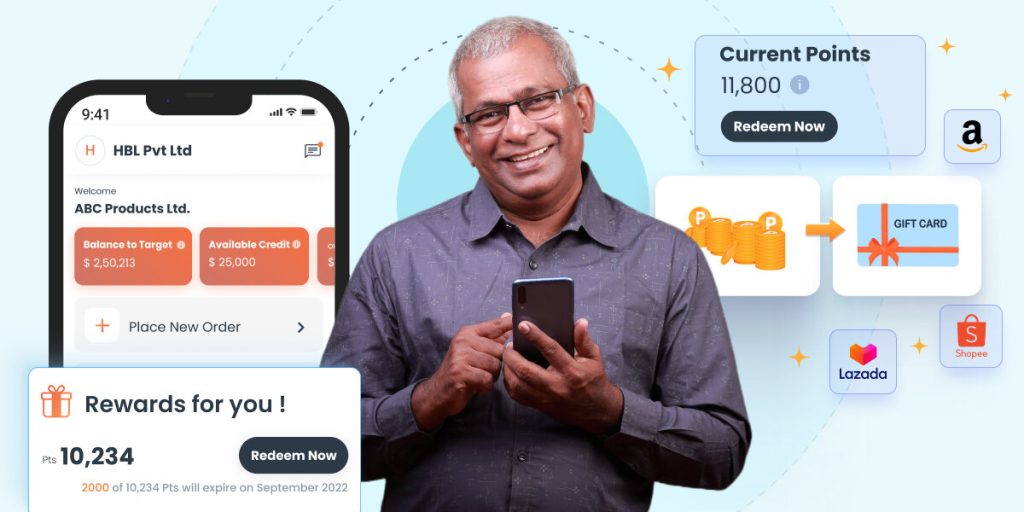
Payouts fire automatically, with no reconciliation queue and no claim form, so the reciprocity window stays open. Dealers reach the program from the Retailer and Influencer App on WhatsApp, which means no separate install and no new login. The points balance sits beside the order screen.
Every visit behind a scheme claim is time-stamped and geo-verified, so a dealer's earned payout is never argued over later. Managers get the other side through BeatRoute Copilot: which tiers are stalling, which dealers are near a drop, which redemption categories are dormant in which market.
BeatRoute is a global platform tailored for African trade, with proof it works here, which is why brands like AAVA Brands and BUA Foods run on it.
AAVA Brands in Nigeria posted an 18 to 20% field productivity gain and a 25 to 30% rise in store sellouts. Brands running every lever on one platform see 12.6% average first-year sales uplift (BeatRoute research).
The reward your dealer values most is not in the catalogue
What a dealer wants from your scheme is proof that your promises clear, because that is the scarcest thing a brand offers in this market.
Points, tiers, and gifts are the visible layer. Underneath, a reward program is a repeated test of whether your brand does what it said it would do. Pass that test twelve times a year and the dealer starts giving you the shelf, the working capital, and the first call.
That is why the mechanics matter more than the generosity. Get an instant demo and see how a scheme pays out in days on verified sell-out.
Frequently asked questions
What is a B2B reward program?
A B2B reward program pays a dealer, distributor or retailer for behaviour you can verify: volume, range, or how often they order. Rewards can be points, tier perks, cash, or airtime. It differs from a consumer loyalty card because the participant is a business owner making a margin calculation.
How do reward programs build dealer loyalty?
They pull four behavioural levers a flat discount never touches. Reciprocity comes from a fast payout. Status from a tier the dealer protects. Loss aversion from a balance that expires. Habit from a weekly rhythm. A program pulling three of these beats one with a richer payout table.
Why do dealer reward programs fail in African markets?
The most common cause is payout lag. Manual distributor claims take 8 to 12 weeks to settle, which breaks the link between effort and reward. Other frequent causes are tiers set on sell-in rather than sell-out, opaque reconciliation, and schemes that skip months.
Should rewards be based on primary or secondary sales?
Base them on verified secondary sales wherever you can measure them. Primary sell-in rewards a dealer for filling a warehouse, which can hide a stock problem for a full quarter. Secondary sales, meaning what actually left the outlet, reward the behaviour you want and expose slow movement early.
How fast should a scheme payout land?
Within days of the qualifying behaviour being verified. The reciprocity effect fades quickly, and a dealer who waits ten weeks has effectively financed your scheme from their own working capital. Automated payouts tied to verified sales remove the reconciliation queue that causes the delay.
How should tiers be designed for a fragmented market?
Keep the entry rung low enough that most active dealers earn something in the first period, since the first redemption is what builds trust. Keep the gap between rungs walkable inside two periods. Set at least one rung on a behaviour you want next, such as range expansion or new outlet activation.
Do points expiry rules help or hurt?
They help, provided the earning cycle is short. Expiry creates a loss to avoid, which motivates more strongly than an equivalent gain to chase. In markets with currency volatility, short cycles and quick redemption also stop a balance losing real value before the dealer spends it.
Can dealers redeem rewards over WhatsApp?
Yes, and it is the format most likely to be used. WhatsApp reaches 95% or more of the trade, so the balance sits in a thread the dealer already opens. A separate loyalty app usually goes undownloaded, especially where reps and dealers ration mobile data.
Does a loyalty app need to work offline?
Yes. Data costs about 2.4% of monthly income per GB in Sub-Saharan Africa, and coverage drops in and out on most routes. An offline-first app captures the order and the scheme claim with zero signal, then syncs when connection returns. It should also run on low-end Android without draining the battery.
How do you stop territory dumping from corrupting a scheme?
Start by making the stock movement visible rather than by issuing penalties. Volume flows across territory lines every day through open-air wholesale hubs, which is a structural feature of the trade rather than a distributor's moral failing. Once secondary sales are captured by outlet, you can credit the dealer who actually served the shop.
What type of software runs a dealer loyalty program?
BeatRoute is a sales force automation and distributor management (DMS) platform for field sales and distribution, not a CRM. Its trade promotion engine encodes tier thresholds, scheme rules, and expiry logic, and ties reward eligibility to verified secondary sales. Dealers see balances and redeem inside the Retailer and Influencer App.
Which African brands use BeatRoute?
African customers include AAVA Brands and BUA Foods in Nigeria. Across all markets BeatRoute serves 200+ brands in 20+ countries, reaching 2M+ retailers and 100K+ users. The AAVA Brands case study reports an 18 to 20% field productivity gain and a 25 to 30% rise in store sellouts.