Distribution Management System
A distribution management system (DMS) is software that connects a brand, its distributors and their retailers in one system. It runs primary and secondary orders, inventory levels, trade schemes, claims and invoicing, so the brand sees real-time stock and sell-through across every tier and channel and can act before a stockout costs a sale.
 By Nikhil Chaudhary, VP of Marketing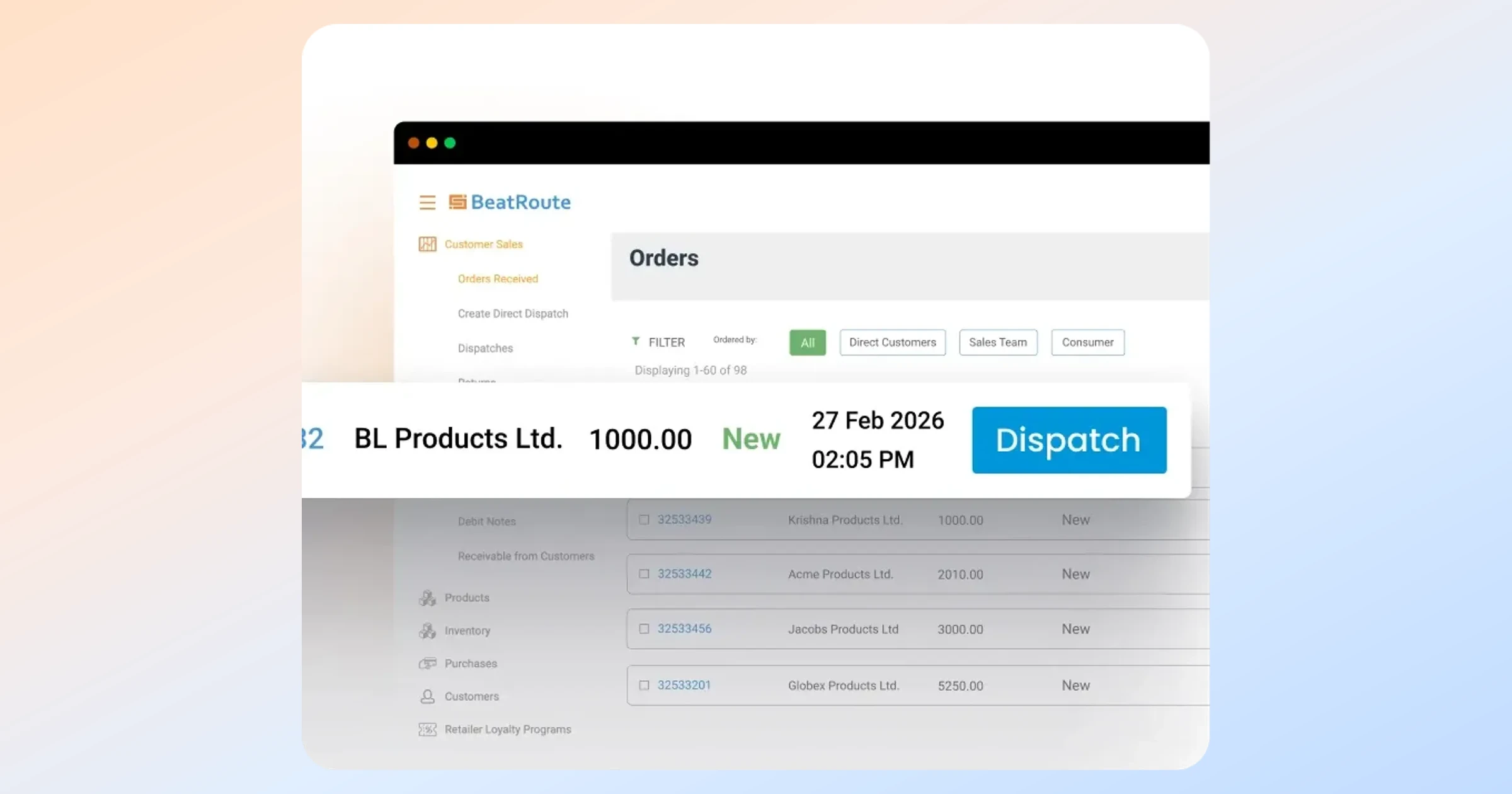
What is a distribution management system?
A distribution management system is software that manages how a brand's products move through distributors to retail outlets, bringing primary sales, secondary sales, inventory, trade schemes, claims and invoicing into one connected system.
Primary sales are the brand's sales to its distributors. Secondary sales are the distributors' sales to retailers. A DMS works in five steps across both:
- 1. Orders: distributors place primary orders with the brand, and reps or retailers book secondary orders through an app, the web or WhatsApp, so order processing no longer depends on calls and paperwork.
- 2. Inventory: every goods receipt and secondary order updates the distributor's stock levels, giving the brand real-time stock and inventory tracking by SKU and location.
- 3. Claims: trade schemes apply at the moment of ordering, and scheme claims and returns are raised, approved and settled in the same system.
- 4. Invoicing: distributor billing, credit notes and debit notes post to each distributor's account statement, including bills raised in Tally or Busy through plugins.
- 5. Secondary-sales sync: distributor-to-retailer sales flow back to the brand as they happen, feeding analytics, demand planning and supply chain decisions.
It helps brands stay aware of demand signals, enables distributors to sell more, and ensures retailers and other partners have the visibility they need to engage effectively. In many industries, companies adopt a distribution management system alongside distributor management software to ensure end-to-end visibility.
Distributor management system vs distribution management system
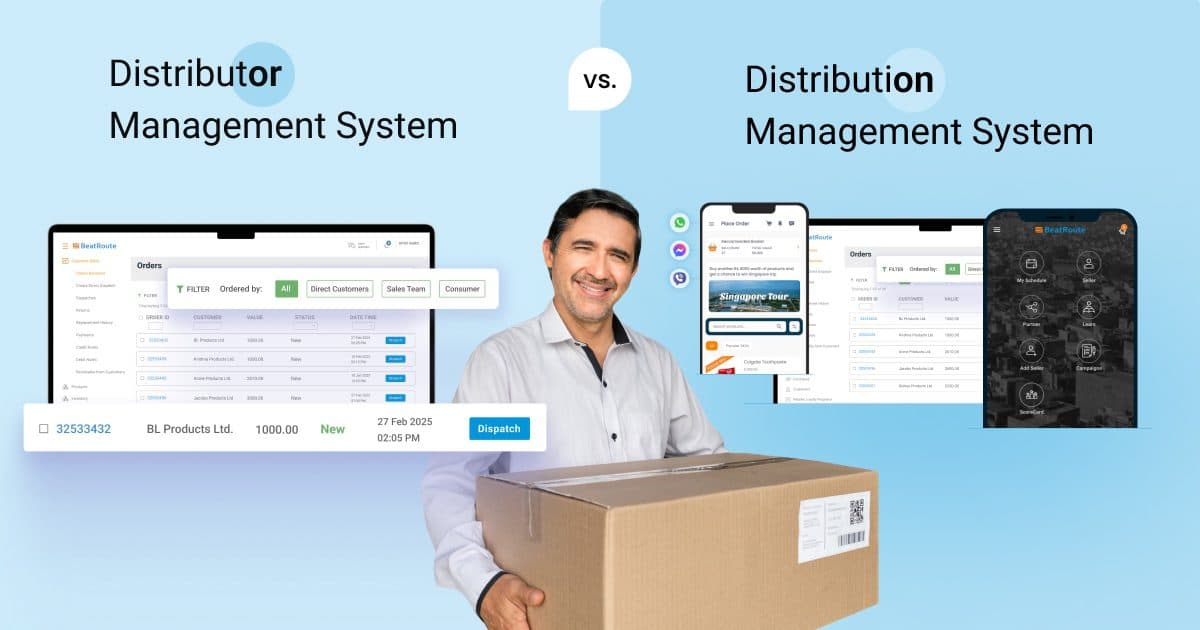
A distributor management system is software that a brand gives its distributors to run their daily operations: primary orders from the brand, inventory, billing and invoicing, claims, and secondary sales to retailers. Because the distributor works in it every day, the brand gets an accurate view of stock and sell-through at each distributor.
Many leaders use the two terms interchangeably, but they are not the same. A distributor management system covers one tier: the distributor and the retailers it serves. BeatRoute DMS adds the brand's view on top, with schemes, nudges and order recommendations that help distributors sell more.
A distribution management system manages the entire distribution landscape across all tiers and channels. It unifies primary and secondary sales, connects brands, distributors, retailers, and other channel partners, and streamlines orders, inventory, schemes, returns, and claims, ensuring your entire route-to-market works in sync.
| Feature | Distributor Management System | Distribution Management System |
|---|---|---|
| Focus | Tracks secondary sales only | Manages both primary and secondary sales plus other channels |
| Orientation | Brand-focused | Connects brand, distributor, and retailer |
| Scope | One tier (distributor to retailer) | Multi-tier and multi-channel |
| Value | Provides visibility and compliance | Enables collaboration, growth, and faster decisions |
To dive deeper into the difference, explore our detailed blog: Distributor Management System vs Distribution Management System.
Key components of BeatRoute's distribution management system
Most distributor management systems only show you what your distributors are holding and selling. BeatRoute DMS helps you sell more to them and through them, so you can increase throughput from every distributor.
It is built on three integrated components: Sales Force Automation, Distributor Management System (DMS), and the Retailer & Influencer App. When these components work together, they create seamless collaboration between brands, distributors, and retailers, strengthening relationships and ensuring smooth execution across your entire distribution network.
1. Distributor Management System (DMS)
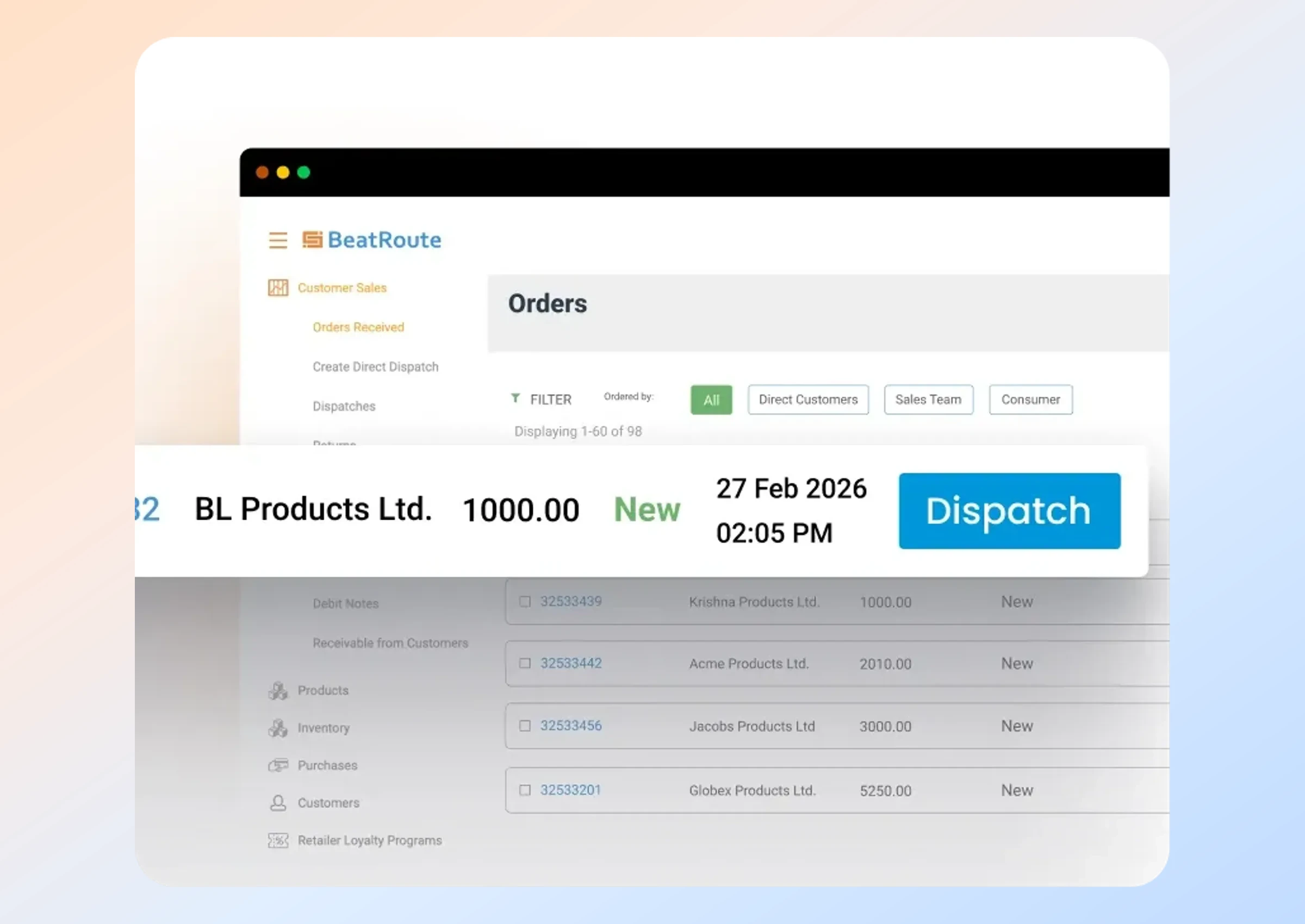
- Digital primary order management: distributors place orders digitally rather than relying on calls or paperwork, which reduces errors and speeds up processing. A distributor who once confirmed large monthly orders by phone now completes the same process in minutes.
- Secondary sales tracking: brands gain real-time insight into how products move at distributor and retailer level. A brand launching a new beverage can watch how fast distributors push it into HoReCa outlets and adjust production to actual uptake.
- Incentive tracking with transparent schemes: schemes and incentives are visible to distributors while they order. A distributor buying building materials sees the bulk-cement incentive applied instantly, which encourages higher volumes.
- Returns and claims management: damaged or excess stock is returned seamlessly, and stock still in good condition is reused to minimise wastage. A pharma distributor logs soon-to-expire stock quickly, and the brand reallocates it to a region where it will sell faster.
- Distributor account statements: distributors view credit and debit notes instantly, which removes the confusion over past payments.
- Tally and Busy plugins: distributors who prefer to stay on Tally or Busy keep their workflow, while the brand still gets visibility through the plugins.
- Hybrid distributor app: distributors in remote areas use a mobile-first app built for low connectivity. A rural distributor records orders offline all day, and the data syncs once the connection returns.
2. Sales Force Automation
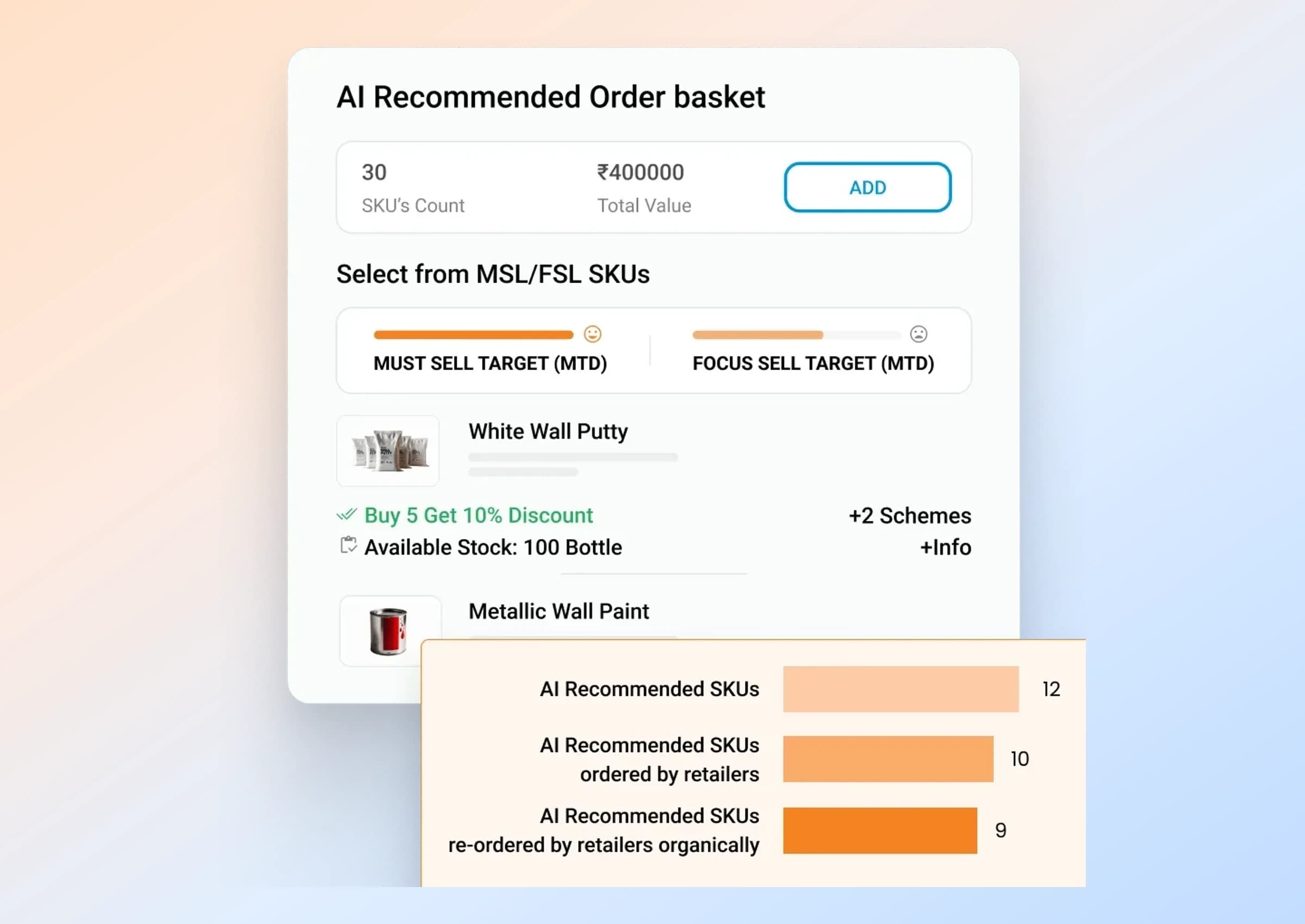
- AI-led visit planning and route optimization: BeatRoute's Scheduling AI Agent tells field sales reps which outlets to prioritize based on business goals. Across deployments, it has increased productive visits from 45% to 78%. Perfetti Van Melle India achieved a 15% increase in outlet reach with BeatRoute.
- GPS-enabled field tracking: managers review rep activity through geo-stamped records of store visits and completed tasks, which makes field coverage easy to validate.
- AI order recommendations: BeatRoute's Order AI Agent increases average order value, improves product mix, and ensures focus and must-sell SKUs are sold by recommending the right order for every outlet. Across deployments, it delivers a 4-6% sales uplift.
- Primary sales insights: sales teams see distributor stock and sales data, so they can prompt an order during the visit and prevent a stockout.
- Trade schemes and loyalty: reps showcase live schemes and loyalty programmes during visits, so distributors and retailers act on benefits they would otherwise miss.
- BeatRoute Copilot for managers: BeatRoute Copilot helps managers deep dive into territory-level performance, identify bottlenecks, and take corrective actions quickly.
3. Retailer & Influencer App
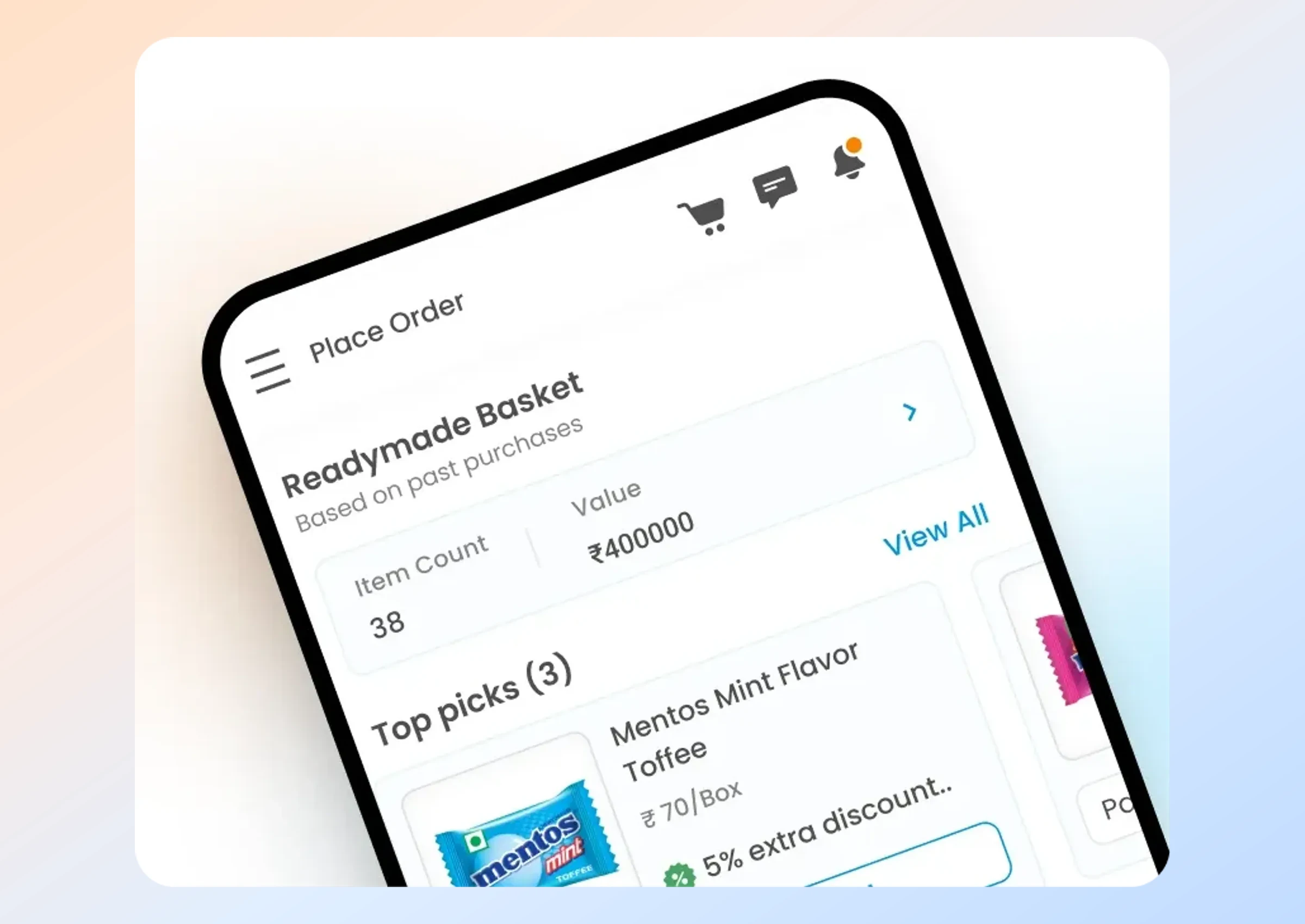
- Retailers self-order anytime: retailers no longer wait for a visit. A store reorders fast-moving items through the app and restocks without waiting for the rep.
- Schemes and promotions visibility: promotions appear at the moment of ordering. A salon ordering haircare sees a bulk-purchase discount and orders more.
- Digital engagement tools: retailers join loyalty programmes and receive targeted promotions. A HoReCa outlet earns points on every beverage order.
- Secondary sales visibility: every retailer order gives the brand accurate secondary sales data, which improves demand planning.
Challenges solved by a distribution management system
| Challenge | Business impact | BeatRoute's solution |
|---|---|---|
| Lack of secondary sales visibility | Brands cannot forecast or prevent stockouts | Real-time data from the Retailer & Influencer App and DMS |
| Stockouts or overstocking | Missed revenue and poor fill rates | AI nudges and stock-deviation alerts |
| Poor distributor motivation | Schemes not visible or complex | In-app incentive visibility with transparent credit |
| Manual order placement | Error-prone and time-consuming | Digital ordering via app, WhatsApp, or hybrid plugin |
| Delayed claims and returns | Distributor dissatisfaction | Rapid approval with reuse of stock where possible |
| Resistance to adoption | Distributors prefer legacy systems | Hybrid app and Tally and Busy plugins for easy transition |
Channel-wise impact
| Channel | Typical challenge | How BeatRoute helps |
|---|---|---|
| General trade | Opaque secondary sales | Retailer & Influencer App enables real-time order capture |
| Modern trade | Claim-heavy transactions | Automated claim management with faster TAT |
| HoReCa | Unpredictable demand spikes | AI nudges for timely replenishment |
| Salons | Scheme-driven purchases | Transparent scheme visibility boosts sales |
| Influencer-driven | Campaign-linked demand | Integration of sales data with the campaign calendar |
Industry-wise use cases
| Industry | Example use case |
|---|---|
| FMCG | Distributors in rural markets use the hybrid app to manage stock while brands track scheme adoption digitally |
| Building materials | Dealers place orders directly in the Retailer & Influencer App, improving visibility into large-volume purchases |
| Pharmaceuticals | Returns management ensures expired stock is tracked and reused if fit, minimising wastage |
| Auto aftermarket | Spare parts distributors get nudges for low-stock SKUs to avoid missed service-centre orders |
| Consumer durables | Retailers upsell and cross-sell using recommendations, improving average order value across appliances |
| Cosmetics | Salons and beauty outlets see real-time schemes and loyalty rewards, encouraging higher purchases |
Sell more to every distributor with BeatRoute
When you evaluate a distributor management system, test four things. Will distributors adopt it, including those who want to stay on Tally or Busy? Does the app work in low-connectivity markets? Are schemes visible to distributors and retailers at the moment of ordering? How fast are claims approved and settled?
BeatRoute DMS is built to pass those tests and to help you influence what distributors buy, stock, and sell. BeatRoute serves 200+ enterprise brands, 6,000+ channel partners and 2 million+ retailers. To see it on your own distributor network, request a free demo.
Frequently asked questions
What is a distribution management system?+
A distribution management system (DMS) is software that manages how a brand's products move from the company through distributors and on to retail outlets. It handles primary and secondary sales, inventory, trade schemes, claims, and returns, and gives the brand real-time visibility across the network.
How is a distribution management system different from a distributor management system?+
A distributor management system focuses on operations at an individual distributor: primary orders, inventory, billing, claims, and secondary sales. A distribution management system is broader: it covers the full route-to-market across every tier and channel, connecting brand, distributor, and retailer in one system.
What is DMS in FMCG?+
In FMCG, a DMS is the system a brand and its distributors use to manage high-volume, low-value orders across thousands of retail outlets. It tracks primary orders to distributors, distributor stock, trade schemes, claims, and secondary sales to general and modern trade retailers, so the brand can see what is selling through and prevent stockouts on fast-moving SKUs.
What is 3 step distribution?+
Three-step (or three-tier) distribution is the model in which goods move from the manufacturer to a distributor, from the distributor to a retailer, and from the retailer to the consumer. The brand's sale to the distributor is the primary sale and the distributor's sale to the retailer is the secondary sale. A DMS gives the brand visibility across all three steps instead of only the first.
Which industries benefit most from a DMS?+
FMCG, beverages, building materials, agri-inputs, consumer durables, cosmetics, and pharma are the heaviest users, because they rely on multi-tier distributor networks to reach retail. Any brand selling through distributors rather than direct benefits from one.
How do you choose a distributor management system?+
Judge it on distributor adoption first: an app that works on low connectivity and plugins for accounting tools distributors already use, such as Tally or Busy. Then look for real-time primary and secondary sales tracking, multi-location distributor inventory, automated claims and schemes, integrated field sales and retailer apps, and clean integration with your ERP and accounting systems.
What is the difference between a DMS and an ERP?+
An ERP runs the brand's own operations: finance, manufacturing, procurement, and primary invoicing. A DMS extends past the brand's walls to its distributors and retailers, capturing distributor stock, secondary sales, schemes, and claims that an ERP does not see. The two work together: the DMS integrates with the ERP so orders, invoices, and stock stay in sync.
Which systems does a DMS integrate with?+
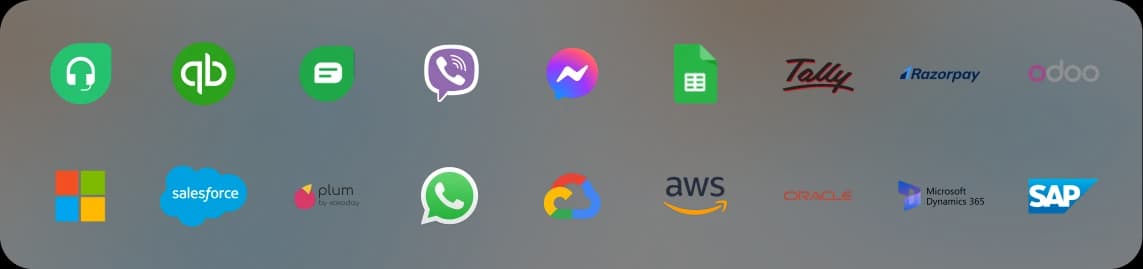
A DMS typically connects to the brand's ERP and to the accounting tools distributors use. BeatRoute integrates with systems including SAP, Oracle, Microsoft Dynamics 365, Salesforce, and Tally, offers Tally and Busy plugins for distributors, and supports WhatsApp ordering.
How long does it take to roll out a DMS across a distributor network?+
Rollout time depends on network size, the number of countries, and integration depth. Brands usually pilot with a cluster of distributors in one region, stabilise the workflows, then scale across the network.