

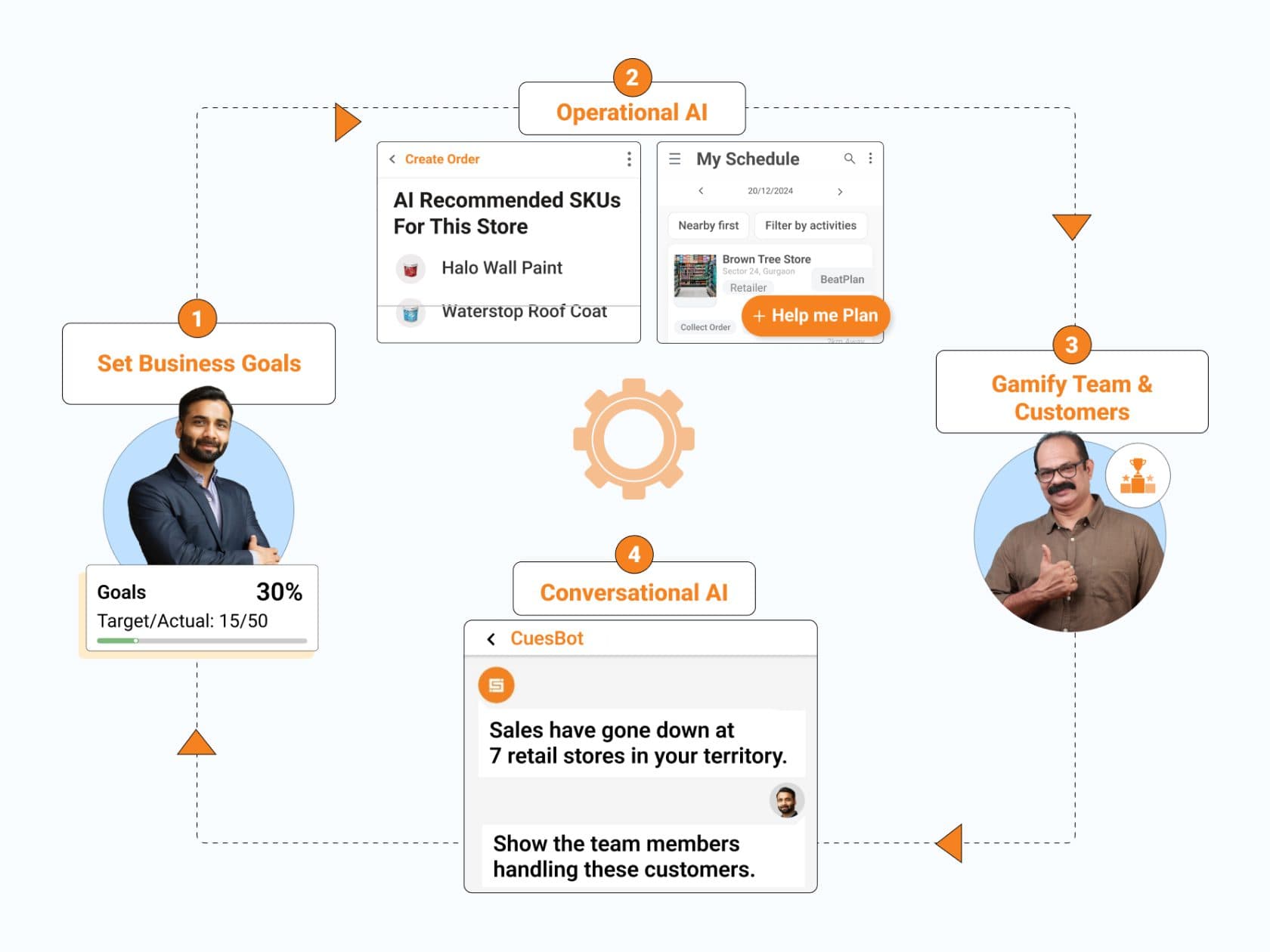
TL;DR If you searched for a CRM to run field sales in the Philippines, you are close but not quite there. An office CRM manages deals from a desk. Philippine field sales runs on visits, routes, sari-sari outlets, distributors, and vans. What you actually need is Sales Force Automation (SFA) plus Distributor Management (DMS). That software plans the beat, captures the order, proves the visit, and works offline on any low-end Android. This guide explains the difference, answers "Is SFA the same as CRM?", and shows how BeatRoute runs field execution for major Philippine brands.
Is SFA the same as CRM? The honest answer
No. A CRM (HubSpot, Zoho, Salesforce, Pipedrive) manages a pipeline of leads and deals from a desk, which is the job those products are built for. Sales Force Automation runs the field day: the beat plan, the outlet visit, order capture, and proof of work. For Philippine distribution you need SFA plus DMS, because the beat plan, the visit proof, and sari-sari coverage are where the day happens.
You searched for "CRM" because that is the vocabulary everyone knows, and that is fine. But before you buy an office CRM and try to bend it around van sales and general trade, it helps to see what field sales software actually does differently. The gap matters when your reps are spread across Luzon, Visayas, and Mindanao.
What is the difference between a CRM and sales force automation?
A CRM records who you spoke to and what stage the deal is in. Sales Force Automation records what happened at the outlet. Which stores the rep covered, what they ordered, whether the shelf was stocked, and whether the visit moved the number. One is a contact database. The other is a field execution system built for coverage, orders, and distributors.
Here is the practical split for a Philippine field team:
- An office CRM gives you: a list of contacts, a deal pipeline, and email logs. Useful for an inside sales desk chasing enterprise accounts.
- SFA plus DMS gives you: a beat and route plan per rep, GPS-tagged visit proof, and in-outlet order capture. It adds retail audits, distributor stock and secondary sales visibility, and offline mode for provincial dead zones.
BeatRoute is the SFA and distributor management (DMS) platform for field sales and distribution. It is not a CRM. It captures the relationship context a CRM would hold. Then it adds the daily plan, the order, the proof, and the distributor truth on top of it.
Why an office CRM breaks the moment your reps hit the field
Because Philippine retail is a field business, not a desk business. About 63.5% of grocery sales run through small grocers and sari-sari stores (Euromonitor), reached through distributor van sales, cash-and-carry, and daily beats. A pipeline view built for office deals has nowhere to put any of that.
It also helps to name the real incumbent. For most teams it is not Salesforce, it is a manual setup. Timestamped selfies sent to the area manager, Bundy clocks at the guard house, hand-consolidated Excel trackers, and follow-ups on Viber. It works until it does not. Reports arrive too late to act on, ghost visits slip through, and no two territories count the same KPI the same way.
What field sales software does that a CRM cannot
It turns a rep's day from guesswork into a plan, and a manager's week from chasing trackers into reading truth. Each part below is built for how selling and distribution actually work across thousands of islands and a stormy calendar.
Beat planning that matches visits to outlet value
Beat plans align visit frequency with outlet class and sales potential, so a rep spends time where it pays. The system prioritizes which outlets to visit today based on live signals like overdue payments, stock gaps, and scheme windows. More productive calls per day means reps can leave before sunrise and still get home before dark.
Order capture with the right SKUs per outlet
Personalized order baskets and live stock visibility streamline order-taking right at the outlet. The app recommends the right SKUs and quantities per outlet from purchase history and peer buying patterns. That lifts range sold and average order value without the rep having to remember every planogram by heart.
Distributor and DMS visibility across the islands
Distributors are your extended sales force, and fragmented distributor data is an executive headache. Native DMS syncs primary and secondary sales, stock, and payments in real time. You finally have a single source of truth for GT and MT channels across your distributors. That is how you catch coverage gaps and cost-to-serve problems before quarter end, not after.
Retailer ordering on Viber, where trade already happens
In the Philippines, business runs on Viber: orders, follow-ups, escalations. Store-facing ordering on Viber and Messenger lets retailers place orders directly, which flow back to your sales team and distributors. A retailer-engagement layer built for sari-sari and general trade is what BeatRoute adds on top of the customer record.
Offline mode for real provincial signal
Reps carry entry-level Android phones where provincial signal drops without warning. BeatRoute works on any Android, even low-end devices, online and offline. Reps keep capturing orders, logging visits, and completing audits with no signal, and everything syncs the moment they reconnect. Managers still get itinerary-vs-actual visit proof, so it stays proof of work, not surveillance.
Proof it works in the Philippines, not just in theory
BeatRoute is a global platform, and it is proven on the ground here, which is why major Philippine brands like San Miguel and Monde Nissin run field execution on it. It serves 200+ enterprise brands across 20+ countries. In the Philippines it already has 20,000+ field users, distributors, and retailers live, plus a Manila office in San Juan City and Tagalog support.
The payoff is measurable. When every lever runs on one platform, BeatRoute customers see a 12.6% average sales uplift in the first year. It comes from closing the gap between customer data and what actually happens at the outlet.
What moving off office CRMs means for your team
A CRM gives you contact data. Without field execution on top, your team still has blind visits, late reports, and fragmented distributor numbers. Combining Sales Force Automation with Distributor Management in one system means you stop tracking activity and start driving coverage, orders, and secondary sales you can trust.
And you do not need to rip anything out to start. Import your existing spreadsheets, run alongside your ERP, and let the app fill in the reports itself. Reps are productive day one because the interface speaks their language and there is no heavy training curve, which matters when the team kayod kalabaw already.
Book a PH-tailored demo and see real coverage, order, and distributor numbers on your own routes before you decide.
Frequently asked questions
Is SFA the same as CRM?
No. A CRM manages a pipeline of leads and deals from a desk. Sales Force Automation (SFA) runs the field day: beat and route planning, GPS visit proof, in-outlet order capture, and retail audits. For Philippine field sales and distribution you need SFA plus DMS. The beat plan, the visit proof, and sari-sari coverage are where the day is won or lost.
Does it work offline in the provinces?
Yes. BeatRoute works on any Android, even low-end devices, online and offline. Reps keep capturing orders, logging visits, and completing audits with no signal, and everything syncs automatically when the phone reconnects. This matters for provincial routes, island territories, and dead zones inside stores and warehouses.
Can it handle van sales, modern trade, and sari-sari general trade in one system?
Yes. Configurable workflows run each model in the same platform. Van sales reps get inventory and delivery tools, and modern trade reps get planogram audits and promoter management. General trade reps get order capture, credit visibility, and scheme application. KPIs and targets adjust per channel without separate deployments.
Can we keep our Excel and ERP, or is it rip-and-replace?
You keep them. Import your existing spreadsheets, and BeatRoute works alongside your ERP and Excel with no rip-and-replace. It behaves like Excel except it fills itself in, so reps are productive day one and there is no heavy training. Native DMS connections sync distributor stock, payments, and secondary sales back to your systems.