


TL;DR You cannot serve 1.3 million sari-sari stores the same way you serve a Metro Manila supermarket. This guide is for Philippine sales leaders who need a retailer app that drives differentiated engagement through intelligent onboarding and profiling. It covers how clean store-level data captured at onboarding lets you segment general trade the right way. That segmentation then powers smarter beats, credit decisions, loyalty, SKU recommendations, and trade spend, all from one verified source.
Why can't you treat every sari-sari store the same?
You cannot treat every store the same because your retail universe is huge and wildly uneven. The Department of Trade and Industry counts about 1.3 million sari-sari stores, and a tingi outlet in a Visayas barangay behaves nothing like a Puregold-supplied grocer in Metro Manila. A retailer app with intelligent onboarding fixes this by capturing the right data the moment a store is created, then feeding it into every downstream decision.
FMCG brands here deal with millions of potential customers across Luzon, Visayas, and Mindanao. Getting price, product, and promotion right still fails a launch if placement, driven by distribution, goes wrong. Proper segmentation aligns your goals with the real retail landscape so you cater to each store optimally and grow coverage that lasts. BeatRoute's Retailer and Influencer App gives your team that foundation: every visit, scheme, and credit line maps to verified store potential instead of rep guesswork.
How does store profiling actually grow your coverage and sales?
Store profiling grows coverage because accurate store-level data unlocks several execution levers at once. When you know a store's real business level, category mix, and location, you can act with confidence. Plan beats, size credit, target loyalty, and recommend the right SKUs. Each lever below needs clean onboarding data that only a well-built retailer app can deliver in the field.
Smarter beats and visit frequency
Two things decide how often a rep should visit one shop: the retailer's time and your salesforce strength. Without an authentic store count, location, and sales history, beat planning and visit frequency become guesswork. Reps burn field hours in traffic that has them leaving before sunrise and getting home after dark. Data on total lines carried, current business level, and average bills per month turns those into quantitative calls. BeatRoute's Scheduling AI Agent uses this profiling data to prioritize daily visits, pushing productive coverage from 45% to 78% for teams on the platform. That means more of the right stores covered per route.
Credit profiling for the utang economy
Credit runs Philippine general trade. Distributors extend utang to their suki stores and must recover it to stay in business, and a rep who does not know a store's balance at the door cannot sell in safely. With proper segmentation, you help distributors make informed credit calls. Optimize capital, push more business into stores that can carry it, and reduce bad debt in outlets that cannot. Profiling turns a listahan of scattered credit notes into a decision your distributor can trust.
Targeted loyalty programs
No single loyalty program works for every retailer. Segmentation decides the key elements of the program and identifies the right stores. Your loyalty rewards land on the roughly 20% of the universe that drives close to 80% of the business. They stop being sprinkled thin across outlets that will never move the needle.
Salesforce incentives that fit the shop
FMCG incentives typically run on seven to eight parameters: business achievement, total lines cut, must-sell lines, new launches, and more. With good segmentation, you customize them to the shops each rep handles. Take a common setup where the universe is split into 3-way, 2-way, and 1-way shops. A 1-way shop is covered by a single rep selling the full portfolio, usually low bills and slow turnover. Incentivize that rep on new launches and product lands in the wrong stores, tying up capital in expiries. Segment-aware incentive rules prevent that mismatch.
Recommended SKUs per store
The right suggested order depends on the store: its locality, buying history, category, and neighborhood. Get profiling right first and those recommendations become reliable. BeatRoute's Order AI Agent delivers a 4 to 6% sales uplift by surfacing the SKUs most likely to sell from each outlet, based on its verified profile. A rep walks in already knowing what to push.
Realistic shop-level targets and cleaner launches
When you break a distributor target down to the shop, present business and growth potential per category have to be considered. A mature sari-sari store and a growing grocer do not have the same headroom. Profiling data lets you set a number each store can actually hit, which keeps reps from chasing a "suntok sa buwan" quota. It also fixes the top reason launches fail here, wrong placement: with correct profiles, you place new products by store type and price band and get distribution right from day one. The same segmentation keeps trade spend efficient, directing merchandising and promo budgets to segments that can convert them into real sell-out.
How does BeatRoute onboard and profile retailers in the field?
BeatRoute answers the core question of any onboarding workflow. How do you truly know a customer, from both the brand's side and the rep's side, when your team is spread across thousands of outlets and three island groups? The platform captures structured data at store creation and keeps it clean and usable. Here is how it delivers on each dimension.
Configurable to your channels
The Brand Panel lets admins define which fields apply to which customer sub-type, and who can submit, edit, or view each one. Your general trade team, your modern trade team, and HQ each see only what is relevant to their job. A rep onboarding a sari-sari store is not wading through fields meant for a supermarket account.
Smart store profiling
Effective profiling starts with understanding a store and classifying it properly. BeatRoute lets you record a store's type and subtype with photos and custom fields, giving the field team detailed store context at a glance. The workflow is built for distributed teams covering a large landscape. It sources data from territory-level reps and handles incremental enrichment at the national level, which is exactly what covering Luzon, Visayas, and Mindanao demands.
Deduplication that keeps coverage honest
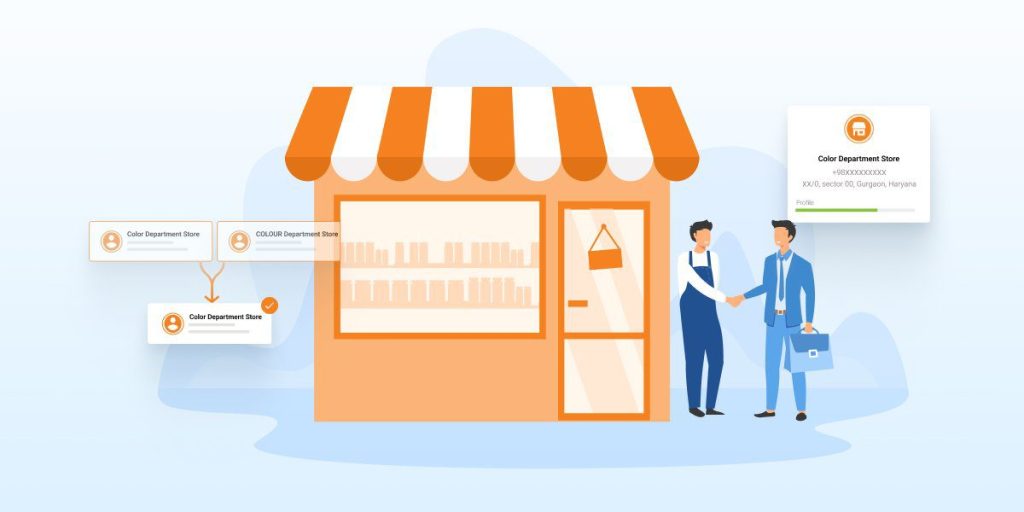
When reps mag-encode store names on the fly, the same outlet gets listed three ways, "Aling Nena Store," "A. Nena Sari Sari," "Nena's," and your coverage numbers quietly inflate. BeatRoute's deduplication engine catches these, delivering 95% accuracy even when a name is written differently, so you never pay for ghost stores or chase coverage that was never real. Clean data is the whole point of onboarding, and this is what protects it.
Works alongside your existing systems
Many organizations already run several tools across SFA, DMS, and encoding systems. You can use BeatRoute's profiling module as part of the full platform or standalone, integrated with whatever you already have. This runs through BeatRoute Matrix, a low-code integration layer that connects with 300+ enterprise systems via APIs. There is no rip-and-replace and no need to abandon the ERP or spreadsheets your team relies on.
Route optimization on top of clean segments
Once segmentation is right, a service architecture matched to each segment makes sense. BeatRoute's route optimization helps HQ planners split a territory into efficient routes and beat schedules that respect delivery constraints, van sales realities, and the RORO crossings that shape provincial coverage. You serve each segment the way it deserves without wasting field time.
Geo-tagging stores with no formal address
Most sari-sari stores have no clean street address, so location has to come from the field. BeatRoute geo-tags every store on the app, detects which pins are accurate, and locks them. You can see which outlets have been touched and which have not. Each visit and a rep's full route can be saved and reviewed, giving managers proof of coverage without turning the tool into a spyware complaint. Reps also get faster visits and clearer days from the same data.
Profile completeness, without the nagging
Getting reps to finish store profiles is hard. BeatRoute rewards complete, accurate data entry with clear behavioural indicators. Profile completion rises because reps can see it counts, not because a manager is chasing them on Viber every night.
Offline sync for provincial dead zones
Every feature works without a signal. A rep onboarding stores in a patchy-coverage province captures everything offline, and it syncs automatically the moment the phone finds a network, so nothing is lost. BeatRoute works on any Android, even low-end devices, online and offline, because that is the phone your reps actually carry.
This is where global scale meets local proof. BeatRoute is a global platform tuned for the way Philippine field sales and distribution really run, and it is proven on the ground. That is why major local brands like San Miguel and Unilab run on it. Behind them sit a Manila office, Tagalog support, and Viber and Messenger retailer ordering. It serves 200+ enterprises across 20+ countries. Its field sales app delivers an average 12.6% sales uplift in the first year when every lever, from visit frequency to scheme design, runs on one platform aligned to verified store potential. Profiling is where in-store execution starts, and if perfect-store work is your priority, pair this with retail execution software once your segments are clean.
Book a PH-tailored demo if you are planning a retail landscape survey or need a platform to capture and enrich in-field retailer data across your islands.
Frequently asked questions
What is intelligent retailer onboarding?
Intelligent onboarding is capturing structured store-level data at the moment a retailer is created, including store type, location, category mix, business level, and credit standing. In the Philippine trade that means a rep geo-tags the sari-sari store, records its subtype and photos, and logs its buying pattern on the spot. That data feeds straight into segmentation, beat planning, and scheme design, so every later action maps to the store's real potential instead of a guess.
Why does a retailer app need profiling capabilities?
Without profiling, brands treat all retailers the same, which is impossible across 1.3 million sari-sari stores that all behave differently. A retailer app with profiling enables differentiated engagement. High-potential outlets get more visits, targeted schemes, and senior reps, while smaller stores move to lighter coverage or tele-order. BeatRoute automates this segmentation from the data captured at onboarding.
Is a retailer app the same as a CRM?
No. An office CRM manages a sales pipeline from a desk. A retailer app for field sales works where the trade happens: outlets, routes, distributors, credit, and van sales. BeatRoute is an SFA and distributor management (DMS) platform built for that reality. It carries store profiling, visit proof, and distributor stock visibility that a desk CRM does not.
How does BeatRoute prevent duplicate store entries?
BeatRoute's deduplication engine delivers 95% accuracy in catching duplicates, even when a store name is encoded differently across reps, like "Aling Nena Store" and "A. Nena Sari Sari." This keeps the database clean, stops outlet counts from inflating with ghost stores, and ensures your coverage metrics reflect what is really on the ground.
Does it work offline in the provinces?
Yes. BeatRoute works on any Android, even low-end or entry-level phones, online and offline. A rep onboarding stores in a provincial dead zone captures profiles, photos, and orders without a signal, and the app syncs automatically once connection returns. Because most Philippine field teams already run on Android, it is built for the phones they actually carry.