Nikhil Chaudhary
TL;DR This guide is for FMCG sales leaders and field managers who need their reps to sell more per outlet without adding headcount. It covers nine specific ways a mobile sales force automation app turns store visits into structured, measurable selling actions. BeatRoute automates order capture, visit planning, and merchandising audits so reps spend less time on admin and more time closing.
Why FMCG sales teams need mobile sales force automation
FMCG field sales runs on volume. A single rep may visit 30 to 40 outlets per day, take orders, check stock, pitch schemes, and log photos. Without a structured mobile app, most of that activity stays in the rep’s head or in a notebook that nobody at HQ sees until the weekly report.
Mobile sales force automation changes that equation. Every visit becomes a data point. Every order feeds into demand planning. Every photo becomes an auditable record of shelf compliance. The result is not just better visibility for managers but better selling behavior from reps who now have prompts, recommendations, and live targets on their screens.
BeatRoute is the only SFA-DMS built to execute your sales goals. It connects the rep’s mobile app to the distributor’s order system and the brand’s HQ dashboard in one platform, so the gap between “visited the store” and “moved the sales number” closes on every beat day.
Retailer profiling for personalized engagements
A mobile sales force automation app for FMCG builds a complete profile of each account: order history, volumes, category mix, and true sales potential. In FMCG, where a single route can touch dozens of outlets in a day, duplicates get removed, profile enrichment runs on every visit, and data hygiene holds.
That profile is the foundation every other feature depends on. Coverage planning, order prompts, scheme targeting, and loyalty tiers all reference the same retailer record. BeatRoute maintains this profile automatically, so reps do not need to enter data twice or reconcile spreadsheets at the end of the day.
Route optimization for efficient market coverage
Route Optimization calculates the most efficient way to cover a territory. Distance, proximity, outlet availability, and sales potential all factor into the plan. The result is more face time and less travel time, so reps visit more outlets per day and spend those visits actually selling rather than driving.
BeatRoute’s Route Optimization is an HQ-level planning tool that structures beat plans for entire territories. For daily field-level visit prioritization, the Scheduling AI Agent takes over, recommending which outlets a rep should visit first based on sales trends, overdue payments, and scheme activation windows. Together, these two tools ensure the rep is always at the right store at the right time. Across BeatRoute deployments, the Scheduling AI Agent has lifted productive visits from 45% to 78%.
Gamification for improved sales behavior
In any FMCG sales team, about 30% of reps consistently hit target, and another 40% have clear headway to lift output by 15 to 20% with the right nudges. Gamification makes that happen by defining bite-size goals and rewarding input behaviors (range selling, visit SOP compliance, scheme application) rather than only output KPIs.
Reps who execute the right inputs earn more points, leaderboard rank, and end-of-month rewards through BeatRoute’s gamification engine. The ones who fall behind learn digitally from top performers, closing the skill gap without extra field training cost. This approach targets the middle of the bell curve, where the largest productivity gains sit.
Order maximization for increased sales per outlet
A good FMCG SFA app cuts order-capture time with SKU auto-suggestion and prompts cross-sell, upsell, scheme application, and loyalty-program upgrades that reps typically forget at the point of sale. Returns and inventory stay reconciled so the order book moves forward without backlog.
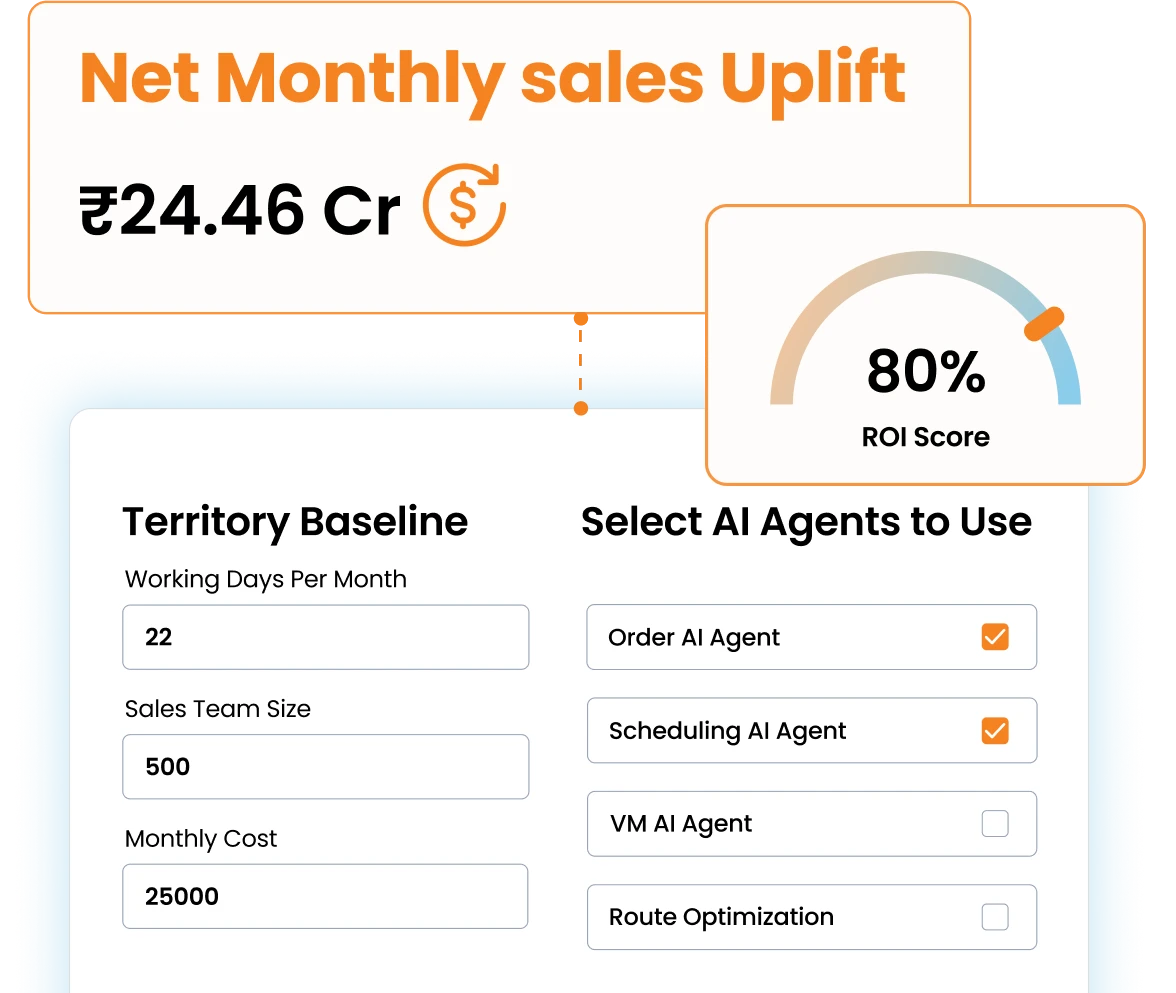
BeatRoute’s Order AI Agent pushes the right SKU at the right outlet at the right visit frequency. It analyzes each retailer’s purchase history, peer buying patterns, and active promotions to pre-populate an order basket the rep can confirm in seconds. Customers using the Order AI Agent see a 4 to 6% sales uplift from this single feature alone.
Tracking retailer activity for smarter visit planning
Sales leaders can see each retailer’s order cadence, past purchases, and whether schemes and merchandising spend are producing returns. That lets them plan visit priority: which outlets are trending down, which are ready for upsell, which deserve higher visit frequency.
BeatRoute’s Customer Insights AI Agent surfaces outlet-specific, actionable interventions before each visit. Instead of relying on rep self-reports, managers get a data-backed agenda for every store on the beat plan. This shifts the conversation from “did you visit?” to “did the visit produce the right outcome?”
Solving field problems through conversational analytics
Field managers rarely have time to parse dashboards. A conversational layer that lets them ask a question, get an answer, and receive a recommended next action closes the insight-to-action loop fast.
BeatRoute Copilot gives managers this capability in plain language. A territory manager seeing a downtrend can ask which products, stores, or reps are driving the decline and get a recommended next step on the same screen. This works in English, Hindi, Bahasa, and other local languages, so regional managers do not need to switch tools or wait for a translated report.
Increasing offtake through intelligent visual merchandising
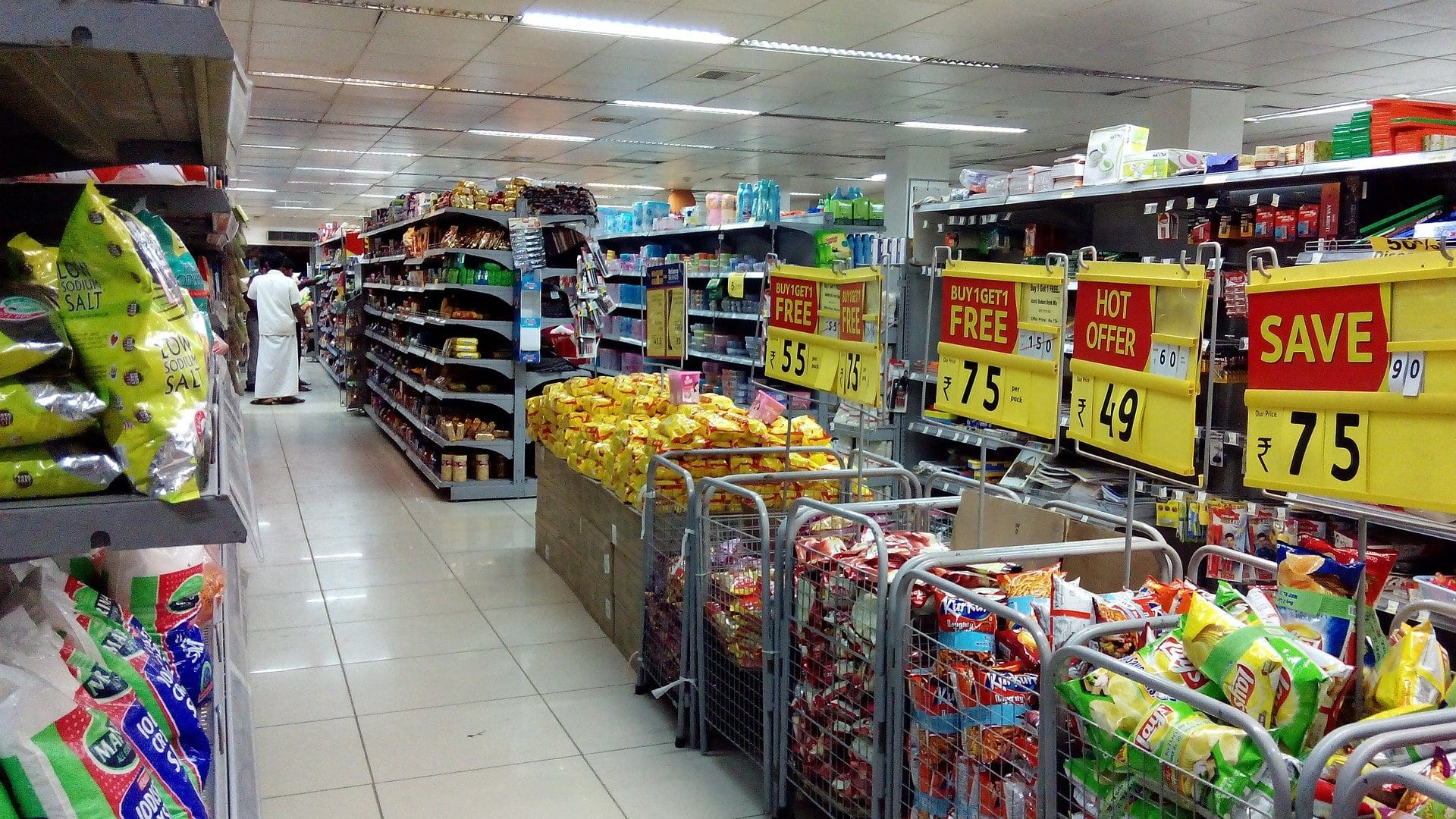
Visual merchandising is expensive. If campaigns are not planned for specific markets and retailer profiles, and not audited reliably, you never learn which ones drove sales and which wasted spend.
BeatRoute’s VM Audit AI Agent replaces manual VM checks with automated scoring. Reps capture shelf photos during their visit, and the AI scores each image for planogram compliance, share of shelf, and competitor encroachment. The app then handles display-scheme payouts to retailers once compliance is verified. This turns merchandising from a cost center into a measurable revenue lever.
Increasing sales from product promoter deployment
A product promoter app brings grooming checks, GPS-tagged attendance, standardized consumer pitches, and in-app training together so every promoter executes to spec. It also keeps high-performing stores from running out of stock, which is the single fastest way to lose a promoted SKU’s sales week.
BeatRoute tracks promoter ROI at the store level. Brands can compare promoted vs. non-promoted outlets on the same SKU to isolate the true lift, then reallocate promoter deployment to the stores where the incremental revenue clears the fully-loaded cost.
Goal-Driven AI for lasting sales transformation
A mature mobile sales force automation platform digitizes every process on one interface so leaders can trace a territory drop or category weakness to the rep, route, or outlet driving it. More than automation, it translates company goals into ground-level execution month after month.
BeatRoute delivers a 12.6% average sales uplift in the first year for customers that deploy it across field and channel teams. It aligns GT, MT, and B2B execution to your numbers with configurable workflows that do not require code, plus native Android and iOS apps rated 4.6 stars on the Play Store. Book a free demo to see how it fits your FMCG sales motion.
Frequently asked questions
What is mobile sales force automation for FMCG?
Mobile sales force automation (SFA) is a mobile-and-cloud system that structures field sales activity: visit plans, orders, audits, and follow-ups. In FMCG, high SKU counts and daily outlet visits mean that structure translates directly into beat plans, retailer profiling, merchandising audits, and scheme execution at the shelf.
How does a mobile SFA app increase FMCG sales?
It lifts sales on three fronts: more productive visits through route optimization and profiling, larger average orders through SKU and scheme prompts from the Order AI Agent, and better in-store execution through AI-audited visual merchandising. Each lever is small on its own, but stacked they produce a consistent uplift over a quarter.
How is a sales force automation app different from a CRM?
A CRM records customer data. A sales force automation app does that too, then adds field workflows: beat plans, route optimization, merchandising audits, order capture, gamification, and promoter management that reps use in-store. In FMCG, execution happens at the shelf, not in a pipeline view, so workflow depth matters.
Do small FMCG brands need a sales force automation app?
Yes. Smaller brands cannot absorb waste in rep time, display spend, or out-of-stock events. A mobile SFA app makes each rep day and each store visit accountable, which lets a lean team operate with the coverage discipline of a much larger one. BeatRoute supports brands from startup scale to 200+ enterprise deployments across 20+ countries.
What AI agents does BeatRoute include for FMCG sales?
BeatRoute includes the Order AI Agent (SKU recommendations per outlet), Scheduling AI Agent (daily visit prioritization), Customer Insights AI Agent (outlet-specific action plans), VM Audit AI Agent (photo-based shelf scoring), and BeatRoute Copilot (conversational analytics for managers). Each agent addresses a specific productivity gap in the FMCG field sales workflow.