3 Must-Have Characteristics of Distributor Management Software
 Nikhil Chaudhary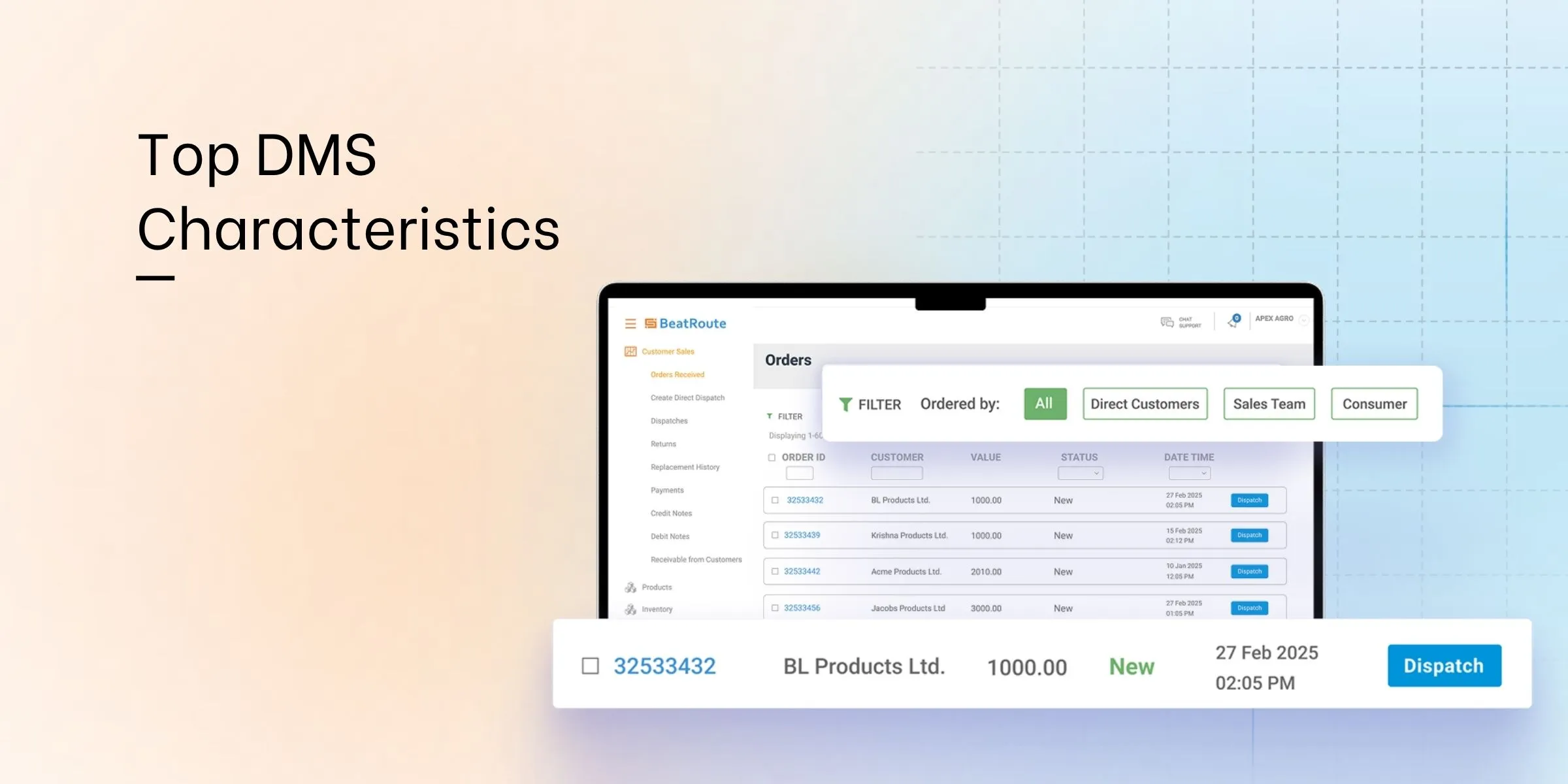
Table of Content
TL;DR This guide is for sales and distribution leaders evaluating distributor management software. It explains the three characteristics that matter most: hybrid DMS for every distributor type, WhatsApp-based collaboration, and a mini CRM experience with full statement of account and ERP visibility. BeatRoute delivers all three with Tally and Busy Plugins, BeatRoute Matrix, and Goal-Driven AI.
A modern distributor management software (DMS) is the system that connects a brand to its distributors and, through them, to retailers. It captures secondary billing, secondary sales visibility, claims, schemes, and statements of account in one place so that brands and distributors work from the same numbers.
Last decade, FMCG companies struggled with sales visibility across distribution channels. Today the challenges go well beyond secondary sales and inventory visibility. Brands need to handle a complex mix of distributor personas, real-time e-invoicing, master price control, claims automation, and scheme execution on the ground.
By the end of this article, you will know what to look for in distributor management software built for today’s landscape and how BeatRoute, the only SFA-DMS built to execute your sales goals, approaches each characteristic.
Three characteristics of distributor management software that matter most
Every industry has its own distribution structure, so one template will not fit all. Brands that shift to a hybrid DMS get higher fill rates, higher throughput per distributor, and lower cost of operations. Here are three characteristics that matter most, especially for FMCG and other high-frequency retail categories.
1. Hybrid DMS for a hybrid distributor landscape
Most brands find their distributors fall into three buckets:
- Partners who are ready to move fully onto the DMS and invoice from it the moment you onboard them.
- Partners who will share secondary sales data but prefer to keep billing in their current accounting system. These distributors connect to the DMS through plugins that sync their invoices automatically.
- Single-person distributorships with no back-office operator. They work best with a lite smartphone version of the DMS.
A distributor management software built for the current landscape supports all three without forcing a single workflow on every partner.
2. Collaboration on WhatsApp
Beyond the transaction, distributors already exchange most information with retailers on WhatsApp. Messaging-driven collaboration between sales reps, distributors, and retail stores saves hours of follow-up and brings clarity to every step of the order-to-delivery cycle.
Instant updates on events like order confirmation, payment, and dispatch kickstart this collaboration. The Retailer and Influencer App extends the same experience to retailers through WhatsApp and Viber so they can place orders, track dispatches, and raise issues without a phone call.
3. Mini CRM for distributors
A full statement of account is the basic glue that makes distributors appreciate a DMS. It is not only about secondary sales and inventory visibility for the brand. From the distributor’s point of view, good distributor management software expedites receivables and removes operational overhead.
Distributors expect a tight integration with the brand’s ERP, such as SAP, and clear visibility of all debit notes, credit notes, invoices, and payments. BeatRoute Matrix, the low-code integration middle layer with 300+ enterprise connections, makes the DMS a true extension of the brand’s ERP for every distributor.
Basic DMS features that still matter
The three characteristics above are the novel layer. Before you evaluate them, make sure the basics are solid.
Secondary sales visibility for your teams
BeatRoute’s DMS brings secondary sales data into a configurable scorecard dashboard that central and territory teams can actually act on. This bridges the gap between order collection and real fulfillment at the store.
Driving purchase by distribution partners
The gap between supply and demand decides how much you sell. If you miss on closing this gap, you hand the shelf to a competitor. Real-time inventory visibility for territory managers and nudges to distributors lead to timely purchase orders, higher fill rates, and fewer stockouts at the store.
Effective trade promotion
Your schemes and promotions need to actually reach the retailer, not get lost in calculation errors. BeatRoute’s Trade Promotion Workflows apply in-bill schemes automatically and nudge distributors to use them, which means optimal utilization of scheme budgets and the intended upsell and cross-sell on the ground.
Expedited claim reimbursement
Claim processing has to be fast and transparent, with a clear approval workflow. This is critical for healthy relations with distributors and, in many cases, with the retailers who are waiting for the final disbursal. Claim processing is a big reason distributors adopt or reject a DMS, and BeatRoute makes it a seamless process for the brand, the distributor, and the retailer.
How does BeatRoute bring these characteristics together?
BeatRoute’s DMS covers primary ordering by distributors, secondary billing, claims, schemes, and a configurable dashboard in a single system. Distributors who want to keep their existing accounting stack connect through Tally and Busy Plugins, while BeatRoute Matrix connects the brand’s ERP so master price, SKU, and stock data stay in sync.
On top of this, Goal-Driven AI guides every sales rep and channel partner toward the secondary sales and coverage outcomes your goals define. BeatRoute Copilot answers manager queries on secondary sales, claims, and scheme performance in natural language, so territory leaders spend less time pulling reports and more time correcting course.
Choosing a DMS that works for your distributors
A DMS should not be a point of friction between the brand and the distributor. Approached correctly, it becomes the bridge between the brand, its distribution network, and the retailers at the end of the chain.
The key is to treat the DMS as a tool that helps distributors themselves and to build it as a collaboration platform for the brand, distributors, and retailers, not a one-way window into the distributor’s world.
Book a free demo of BeatRoute’s distributor management software and see how hybrid DMS, WhatsApp collaboration, and full ERP visibility work together in one platform.
Frequently asked questions
What are the most important characteristics of distributor management software?
A modern DMS needs three core characteristics: it must fit a hybrid distributor landscape, enable WhatsApp-based collaboration between reps, distributors, and retailers, and work as a mini CRM for distributors with a full statement of account and ERP visibility. BeatRoute covers all three in a single platform.
What is the difference between secondary sales and primary sales in a DMS?
Primary sales are orders placed by distributors to the brand. Secondary sales are sales from distributors to retailers. A good DMS captures both, but the value for most brands sits in secondary sales visibility, claims, schemes, and statements of account, which together show what is actually happening in the market.
Why does a DMS need to integrate with Tally or Busy?
Many distributors already run their accounting in Tally or Busy and will not change overnight. BeatRoute’s Tally and Busy Plugins sync billing data into the DMS so brands get secondary sales visibility without forcing distributors to abandon their existing stack. This raises adoption and reduces rollout friction.
How does BeatRoute help with claims and trade promotions?
BeatRoute automates scheme application in-bill through Trade Promotion Workflows and runs claims through a transparent approval flow in the DMS. Distributors and retailers see claim status in real time, brands see scheme utilization on a configurable dashboard, and reimbursements move faster. This is a major reason distributors adopt the platform.
How does BeatRoute handle the different types of distributors in a network?
BeatRoute supports a hybrid distributor landscape. Fully onboarded distributors invoice directly from the DMS. Distributors who prefer to keep their existing accounting stack sync through Tally and Busy Plugins. Single-person distributorships use a lite smartphone version. One platform serves all three without forcing a single workflow.