

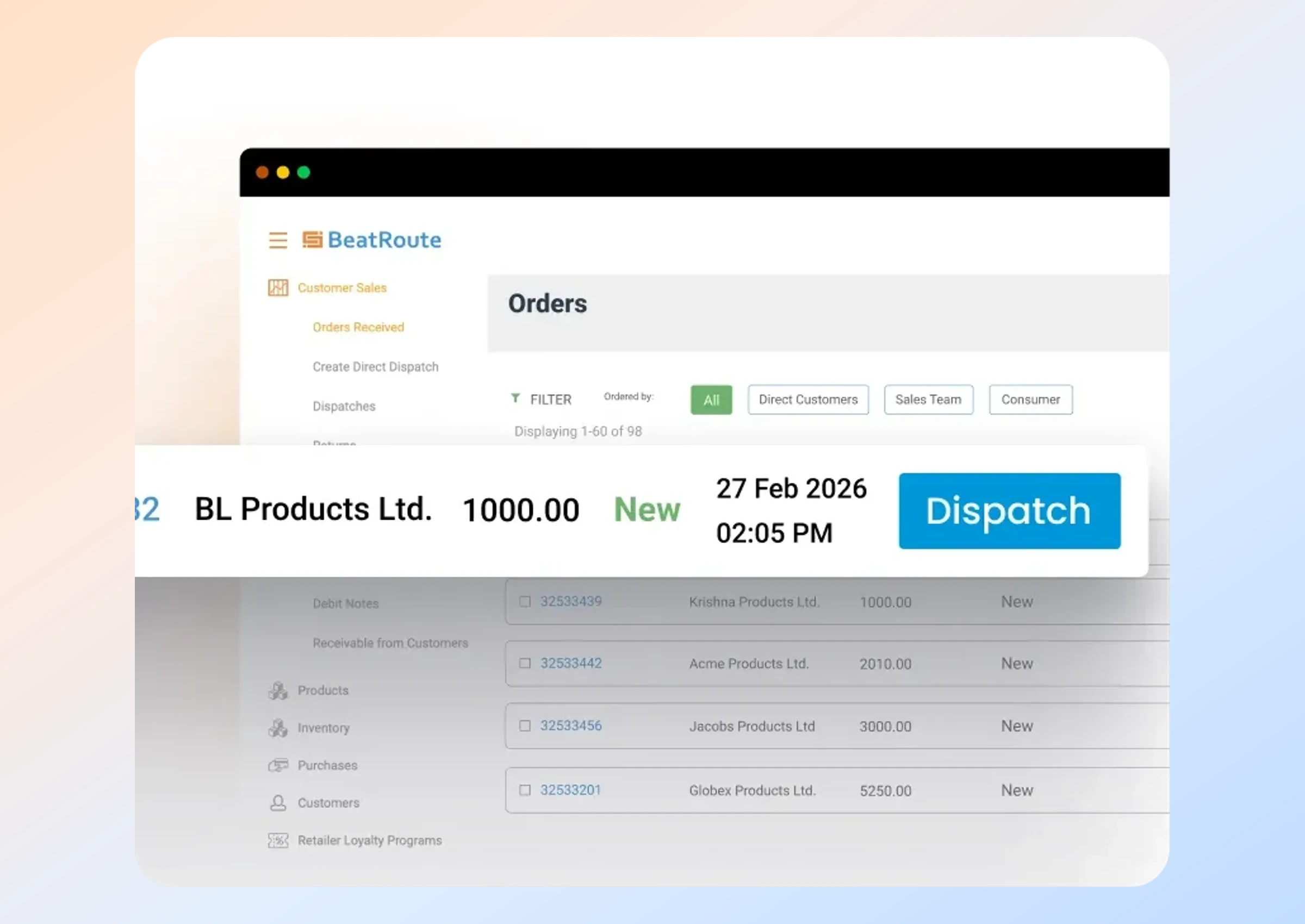
TL;DR This guide is for sales operations and IT leaders at Philippine retail brands evaluating distributor management software. It explains what a modern DMS does, and which features matter when volume moves through distributors spread across Luzon, Visayas and Mindanao. Then industry use cases, and how BeatRoute gives the head office real secondary sales visibility while making distributors easier to engage. Works on any Android, even low-end devices, online and offline.
Distributor management software (DMS) puts a retail brand and its distributor partners on one system. Together they manage primary and secondary sales, track inventory, process orders, and see what is really happening across the distribution network. In the Philippines, that retires a familiar stack. Hand-consolidated Excel trackers. Phone calls. Viber follow-ups shuttling between head office, the distributor and the field team.
Brands here need more than an order tracker. Your product reaches the market through many distributors and thousands of general trade and sari-sari outlets. The system has to tie field activity, distributor performance, stock levels, trade schemes, and secondary sales into one view. That is what modern distributor management software delivers.
This guide explains what distributor management software is and how it works. Then the features worth evaluating for Philippine distribution, and the use cases per industry.
Why distributor management software matters in the Philippines
A DMS matters because the market is fragmented by design. The Philippines has roughly 1.3 million sari-sari stores (DTI, 2025), and small grocers account for about 63.5% of grocery retail (Euromonitor). Traditional trade is the market, and it is served through distributor van sales across islands. Without a shared system, brands face mismanaged stock, invisible secondary sales, manual encoding errors, and distributor relationships that run on trust alone. Here is what a DMS delivers:
- Orders placed accurately and fulfilled on time
- Distributor inventory visible and proactively managed before stockouts reach the outlet
- Primary and secondary sales tracked in near real time, not consolidated at month-end
- Trade schemes visible and applied correctly at the point of ordering
- Targets and performance measurable at every level, from head office to distributor to route
- Distributor engagement strengthened through transparency instead of guesswork
When every lever runs on one platform instead of fragmented tools, BeatRoute customers achieve an average 12.6% sales uplift in the first year. BeatRoute is a global platform tailored for the Philippines, with proof of working very well here, which is why major Philippine brands like San Miguel and Monde Nissin run on it.
Distribution management system vs. distributor management software
These terms get used interchangeably, but they play distinct roles in the supply chain. Knowing the difference helps you scope what you actually need to buy.
| Aspect | Distribution Management System | Distributor Management Software |
|---|---|---|
| Scope | Broader logistics and movement of goods across supply chain nodes (warehouses, transport, RORO crossings, routing) | Digital collaboration and transaction automation between a brand and its distributors |
| Primary focus | End-to-end goods movement | Brand and distributor operations (orders, claims, schemes, inventory) |
| Typical users | Supply chain teams, logistics managers | Sales operations, distributor partners, field reps |
When field execution matters as much as distribution, pair the DMS with sales force automation. Visits, orders and distributor stock then live in one place.
The three types of distributors, and how each uses a DMS
Not all distributors work the same way, especially in the Philippines where digital maturity varies widely from Metro Manila to the provinces. Most fall into three usage patterns, and BeatRoute supports all three so you never force a rip-and-replace.
1. Multi-brand distributors who keep their own books
These distributors carry several brands and prefer their existing Excel books or accounting package. Instead of forcing them onto a full DMS, BeatRoute connects through integrations that fetch secondary sales data, so there is no duplicate encoding and no threat to their independence. BeatRoute Matrix provides 300+ integrations to link these systems without friction, which is the single biggest reason rollouts here succeed instead of stalling.
2. Single-brand distributors on a full DMS
This group belongs to one brand and runs the complete system for every primary and secondary transaction. The full workflow is theirs: orders, scheme automation, claims, sales analytics, all tied back to the brand's commercial goals.
3. Lean or remote distributors on a mobile-only setup
Small distributors in remote provinces often lack dedicated back-office staff. A lightweight, mobile-based DMS works best for them. BeatRoute gives them access through the app and through Viber, the channel where trade already happens in the Philippines, so they stay digitally connected without added overhead.
Real-world use cases for distributor management software
BeatRoute's distributor management solution serves 200+ enterprise brands across these verticals:
FMCG and CPG: high volumes across general and modern trade get managed through Order AI Agent recommendations, scheme automation and secondary tracking. The agent alone adds 4-6% in sales by suggesting replenishment and new SKUs during van sales and distributor ordering.
Pharmaceuticals: Batch tracking, returns and claims processing, and real-time stock monitoring support distribution accuracy across drugstores and the chain-pharmacy channel, with audit-ready logs for compliance.
Building Materials: Reliable order management, ERP integration via BeatRoute Matrix, and consistent pricing execution across multi-tier dealer and distributor networks.
Consumer Goods: SKU-heavy catalog management, trade promotion tracking, and replenishment workflows that improve sell-through during the Ber-months peak.
Automotive and Spare Parts: Part-level tracking, warranty claims, and distributor performance alerts optimize fulfillment to workshops and resellers.
Agri Inputs: Seasonal inventory management, batch-level tracking, liquidation workflows, and timely replacements for crop-failure scenarios.
Whether your distributors sit in Metro Manila or a remote VisMin province, BeatRoute keeps onboarding simple and engagement strong across every tier.
What features should a distributor management system have?
A modern DMS removes manual drudgery and lets both the brand and the distributor operate at full potential. Here are the core features to evaluate for Philippine distribution:
1. Inventory management
Stock stays visible across regions and distributors, with live alerts when it drifts or runs toward empty. Distributors get nudged to reorder before the stockout ever reaches a retailer, which protects coverage when a typhoon or a RORO delay disrupts resupply.
2. Primary and secondary order management
Distributors place digital orders via desktop, mobile, or Viber. BeatRoute supports every distributor persona: full-suite users, Excel-first users who keep their own books, and mobile-only distributors in low-connectivity areas.
3. Order AI Agent
BeatRoute's Order AI Agent helps distributors place the right quantities at the right time by reading stock movement, sales velocity, and past order history. It reduces stockouts and overordering, delivering measurable uplift without extra rep effort.
4. Trade scheme automation
Auto-apply schemes (Buy X Get Y Free, slab-based discounts) so distributors see the incentives they qualify for during order placement. This drives larger and more frequent purchases without a back-and-forth over what applies.
5. Claims and returns management
File and track claims for returns, expiries, or damaged goods with digital proofs and approval workflows. BeatRoute centralizes resolution so reimbursements move faster and distributor friction drops, which matters when trust holds the relationship together.
6. Sales target visibility
Distributors track their monthly and quarterly targets and progress in real time. Visible goals create motivation to hit milestones and qualify for scheme benefits, instead of finding out at month-end that the number was missed.
7. Integration with Excel and ERPs
BeatRoute connects to the systems distributors already run, from Excel books to their accounting package, so there is no dual encoding. Your brand ERP syncs in through the 300+ enterprise connection catalog, for visibility end to end.
8. Distributor account statements
Credit notes, debit notes, invoices and payments sit in one view, reachable even over Viber. That clarity heads off payment disputes and builds the trust distributors stay for.
9. Retailer-level execution tracking
Track secondary sales per outlet with scheme-based invoice execution. BeatRoute makes sure retailer offers are applied correctly at the point of billing, so what you funded in trade spend actually reaches the sari-sari shelf.
10. Custom dashboards and no-code reports
Generate reports by region, product, distributor type, or scheme usage without waiting on IT. BeatRoute's Report Builder gives drill-down, filtering, and sorting for granular island-by-island insight.
11. Mobile-first, offline-ready experience
Distributors and reps in remote areas operate fully through the mobile DMS or Viber. BeatRoute works on any Android, even low-end devices, online and offline, and syncs automatically once signal returns in provincial dead zones.
12. Distributor performance alerts
BeatRoute Copilot flags gaps in distributor activity, such as delayed orders or low scheme participation, and recommends timely interventions. Managers get proactive nudges instead of parsing raw dashboards for patterns they might miss.
Why brands prefer BeatRoute over traditional DMS tools
One stack holds distributor operations, field execution, retailer engagement and AI recommendations. No stitching a DMS to an SFA to an analytics tool; the whole route to market runs in one place.
| Feature | BeatRoute | Others |
| Integrations with distributor accounting and Excel | Yes | Rare |
| Mobile, Desktop and Viber ordering | Yes | Not all platforms |
| Zero-Code Customization | Yes | Limited |
| Real-Time Scheme Visibility | Yes | Partial |
| Tagalog Language Support | Yes | Rare |
| Works Offline on Low-End Android | Yes | Not all platforms |
| Used by 200+ Enterprise Brands | Yes | Not Disclosed |
| Local PH Presence and Timezone Support | Yes | Varies |
Goal-Driven AI keeps execution aligned to commercial goals across every distributor and rep. Multiple geographies configure out of the box, the Play Store rating stands at 4.7 stars, and a Manila-based team works PH time.
The future of distributor management is Goal-Driven
The next generation of distributor management software will not just record transactions. It will actively guide distributors toward brand goals through AI-led nudges, predictive replenishment, and real-time scheme optimization. Philippine brands that adopt this today build stronger distributor relationships, hold coverage steady across the islands, and grow faster than those relying on passive month-end reporting.
BeatRoute is trusted by over 200 enterprise brands across 20+ countries. Whether you operate in FMCG, building materials, agri-inputs, or pharmaceuticals, BeatRoute helps you scale coverage smarter and faster. For a channel-specific walkthrough, see the FMCG distributor management guide.
Book a PH-tailored demo today and see how BeatRoute turns your distribution from reactive reporting into proactive, goal-driven execution.
Frequently asked questions
What does distributor management software do for a Philippine brand?
Distributor management software hands brand and distributor one shared system for primary and secondary sales, inventory, schemes, claims and orders. The rep captures orders on mobile. The distributor tracks stock and dispatches. Head office reads channel performance in near real time. The result is tighter execution across general and modern trade, faster claim settlement, and consistent trade programs across every distributor from Luzon to Mindanao.
Does it work offline in the provinces?
Yes. BeatRoute works on any Android, even low-end devices, online and offline. Distributors and reps in provincial dead zones keep capturing orders and secondary sales, and the data syncs automatically once signal returns. In a market of 7,641 islands with patchy provincial signal and around 20 typhoons a year, offline capability is what keeps your coverage data reliable.
Will our distributors have to give up their Excel books?
No, and that is deliberate, because forcing a switch is the top reason DMS rollouts stall here. Multi-brand distributors keep their existing Excel books or accounting package and simply connect through BeatRoute Matrix, with no duplicate encoding. Remote distributors self-order from a phone or over Viber. Because the workflow matches how they already work, adoption climbs instead of stalling.
Is a DMS the same as a CRM?
No. A CRM manages contacts and pipelines from a desk. A distributor management system runs your distribution: distributor stock, secondary sales, schemes, claims, and orders across your network. For Philippine distribution you need the DMS view, because the work happens at outlets, in vans, and across islands, not in an office pipeline.
Is BeatRoute's distributor management software only for large enterprises?
No. Multinationals and mid-market regional brands run it side by side. Smaller networks start on core order capture and inventory tracking through configurable modules, then expand into claims, AI recommendations, and retailer engagement as they scale. Offline-first mobile apps and Tagalog support mean it works in both Metro Manila and low-connectivity provincial markets.