

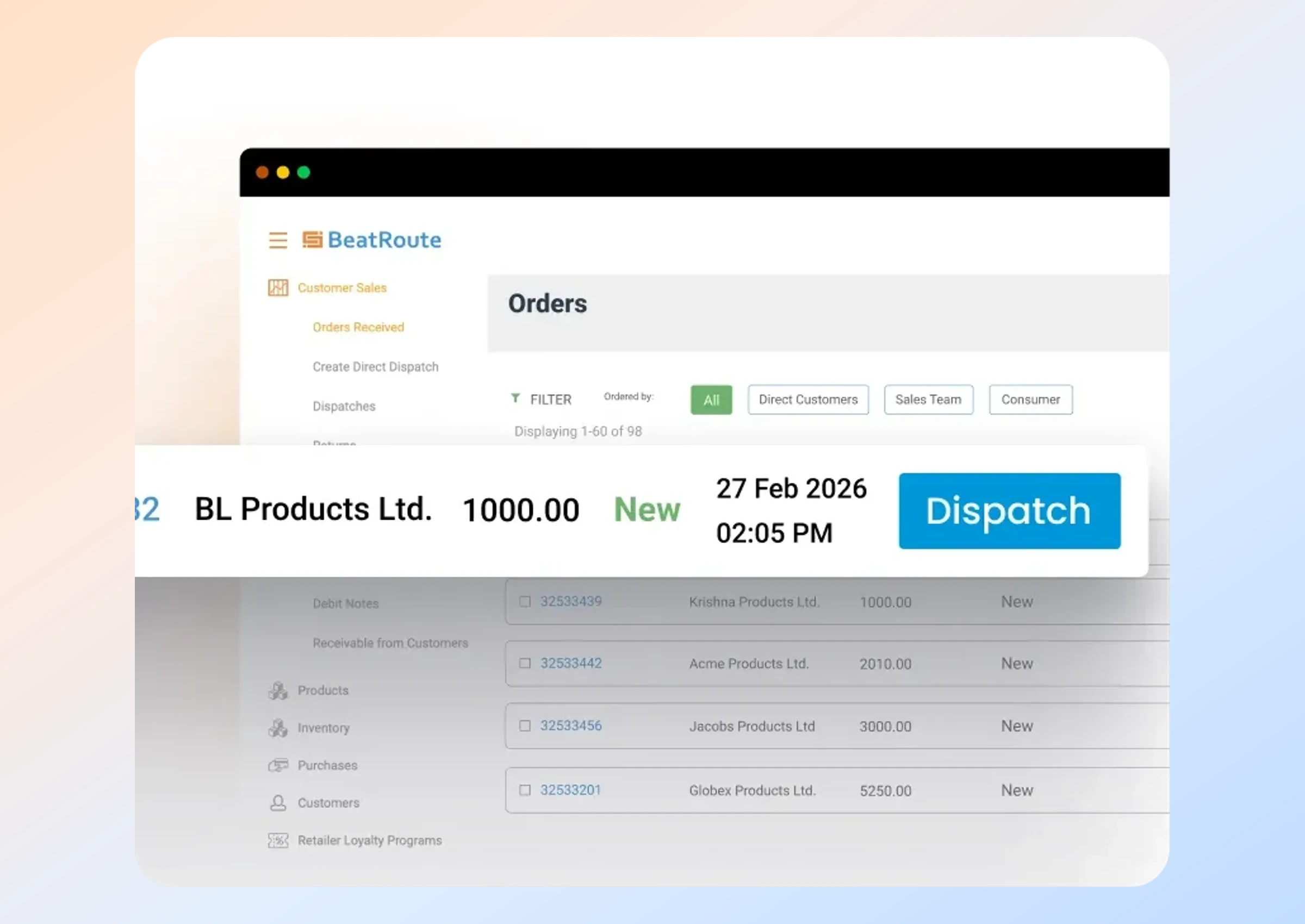
TL;DR Distributor management software (DMS) gives a brand and its distributors one shared system for orders, stock, schemes, claims, and secondary sales. In African trade its real job is ending the black box that starts when the truck leaves the depot. BeatRoute customers see an average 12.6% sales uplift in the first year after replacing fragmented tools with a unified DMS.
Your primary sales number is clean. Your secondary sales number is a guess. Somewhere between your depot and a kiosk in Lagos, a duka outside Nakuru, or a spaza shop in Soweto, the data stops. This guide explains what distributor management software is, what it must do in African markets, and how to evaluate it without buying a system your distributors quietly refuse to open.
What is distributor management software?
Distributor management software, or DMS, is a shared system where a brand and its distributors work together. Orders, stock, trade schemes, claims and secondary sales, all in one place.
It replaces the spreadsheet, the phone call, and the end-of-month reconciliation. The brand sees what moved. The distributor sees stock, targets, schemes, and money owed. Both work from the same numbers.
DMS is an acronym coined in India. Most African operators simply say distribution management. BeatRoute is a sales force automation and distributor management platform for field sales and distribution. It is not a CRM, which handles office pipeline instead.
Why do African brands go blind after the truck leaves?
Because five to seven middlemen sit between your factory and the shelf, and none of them owe you a report.
Roughly 80% of FMCG retail spend in Africa runs through informal outlets (GeoPoll). Your goods pass through a key distributor, then sub-wholesalers, then van sellers, then a shop with no address. Nigeria does not have a demand problem. It has a visibility problem.
The scale of what you cannot see is the point. Tolaram built Indomie on about 1,000 distributors, 25,000 wholesalers, and 600,000 retailers. A network that size cannot be managed by WhatsApp photos and a midnight Excel rebuild. That is the gap a DMS is built to close.
Is a distributor management system the same as a distribution management system?
No. One moves goods across the supply chain. The other runs the commercial relationship between you and your distributors.
The distinction matters when you scope a project. Logistics teams buy one. Sales operations buy the other. Confusing them is how brands end up with route planning but still no secondary sales number.
| Aspect | Distribution management system | Distributor management software |
|---|---|---|
| Scope | Movement of goods across warehouses, transport, and routing | Transactions and collaboration between a brand and its distributors |
| Primary focus | End-to-end goods movement | Orders, claims, schemes, stock, secondary sales |
| Typical users | Supply chain and logistics teams | Sales operations, distributor principals, field reps |
| Africa relevance | Matters most where transport costs run about 8x the world average | Matters most where the channel is long and informal |
We break the difference down further in our guide to distributor management versus distribution management.
Which distributors in your network will actually use a DMS?
Three kinds, and they need three different levels of software. Force one model on all of them and adoption collapses in month two.
The distributor is a business owner you court, not command. Many are long-established family trading houses carrying several brands. Their staff must accept the tool daily, so the tool must fit how they already work.
| Distributor type | What they need |
|---|---|
| Multi-brand key distributors running their own accounting | Integration, not replacement. BeatRoute connects to Tally, Busy, and Excel through plugins and APIs that pull secondary sales without duplicate entry. |
| Single-brand distributors ready for the full system | End-to-end order management, scheme automation, claim processing, and sales analytics in one place. |
| Lean distributors in remote or low-signal territories | A light mobile system, plus access through WhatsApp or Viber, so no new hire or server is needed. |
Independence is not resistance. A distributor who keeps his own books is protecting a business that predates your brand in that territory. Software that respects that gets opened every morning.
How do you settle distributor claims faster than 8 to 12 weeks?
Manual claims for damages, expiries, and schemes commonly take 8 to 12 weeks to settle, and every week of delay costs your distributor working capital.
This is the single strongest reason a distributor accepts a new system. Not your dashboard. Their money. A DMS files the claim with digital proof, runs it through the scheme rules, and moves it through approval in one trail.
BeatRoute centralises claim resolution with digital proofs and approval workflows, and shows credit notes, debit notes, invoices, and payments in one account statement. That statement is reachable on WhatsApp or Viber. Fewer disputes, and a distributor who can see exactly where his claim sits.
How do you see secondary sales without policing your distributors?
Track the transaction, not the person. Secondary sales tracking shows which outlets bought what, which is information your distributor wants as much as you do.
Concentration is why this pays. In Lagos, a product stocked in 100,000 outlets can do half its sales in just 10,000 of them. Without outlet-level data, nobody knows which 10,000. Everyone guesses, and both sides fund the same waste.
Stock also crosses territory lines daily through open markets like Idumota and Gikomba, where sub-wholesalers restock. Dumping is a structural feature of that channel, not a moral failing. Make the movement visible and you can protect a distributor's territory instead of arguing about it. Our secondary sales tracking guide covers the mechanics.
Which DMS features should you evaluate?
Judge a distributor management system on twelve capabilities, and weight the ones your market actually breaks on.
A long feature list is easy to publish. The table below states what each capability has to do once it meets a real African network.
| Capability | What it must do in your network |
|---|---|
| Inventory management | Show stock by region and distributor, with alerts before an outage reaches retailers. BeatRoute nudges reordering ahead of stockouts. |
| Primary and secondary order management | Let distributors order by desktop, mobile, or WhatsApp, whichever they will actually use. |
| Order AI Agent | Read stock movement, sales velocity, and order history, then suggest the right quantity. BeatRoute reports 4 to 6% sales uplift from this alone. |
| Trade scheme automation | Apply schemes such as buy X get Y at the moment of ordering, so nobody claims for an offer later. |
| Claims and returns | File with digital proof and route through approval, cutting the 8 to 12 week wait described above. |
| Sales target visibility | Show each distributor his own target and progress, so scheme qualification is never a surprise. |
| Tally, Busy, and ERP integration | Avoid dual entry. BeatRoute Matrix connects 300+ enterprise systems, including your SAP. |
| Distributor account statements | Put credit notes, invoices, and payments in one view, reachable on WhatsApp or Viber. |
| Retailer-level execution tracking | Confirm the retailer offer was actually applied at billing, not just announced. |
| Custom dashboards and no-code reports | Let sales operations build a region or scheme report without waiting on IT. |
| Mobile-first and offline | Run light on low-end Android and keep working when the signal drops. |
| Distributor performance alerts | Flag delayed orders and low scheme participation. BeatRoute Copilot recommends the intervention rather than leaving you to read raw dashboards. |
Will it work with no signal, on the phones your network already has?
Offline-first is a headline requirement, not a footnote. The system must capture orders and stock with zero signal and sync when you are back online.
Data costs about 2.4% of monthly income per gigabyte in Sub-Saharan Africa, so teams ration connection deliberately. An app that stalls without a bar of signal sends a distributor's clerk back to the carbon-copy book by lunchtime.
Test three things before you sign. Run it on a cheap Android handset. Run it through a load shedding window if you operate in South Africa. Watch the battery over a full day, because a system that flattens a phone at 2pm is worse than paper.
Can distributors and retailers order over WhatsApp?
They should be able to, because WhatsApp reaches 95% or more of the trade and needs no training at all.
A lean distributor in a remote territory will not staff a back office to use your portal. He will send a message. BeatRoute lets that distributor order and check his account through WhatsApp or Viber, and the order lands in the same system as everyone else's.
This is where most global platforms have no answer. If your rep can use WhatsApp, your distributor's clerk can use this on day one.
How does a DMS hold up when the currency moves?
Price lists go stale faster than your team can reprint them, so the system must push the current price to every order screen the same day.
The naira fell 40.9% in 2024, and eight major Nigerian consumer-goods firms saw costs rise 67% in a single year. Egypt and several other import-dependent markets carry the same pressure. Margins are thin and tempers are short.
Two consequences follow in the field. Reps get accused of cheating on price. Distributors absorb the gap and quietly reduce their order size. Live pricing, visible schemes, and fast claims are how you keep the relationship intact through an FX shock.
Where will your distributor data be hosted?
Ask every vendor for a written cross-border data position before the commercial conversation, because your IT gatekeeper can veto the whole project on this point.
South Africa's POPIA restricts transfers abroad without a pre-signed agreement. Kenya's Data Protection Act requires a local copy of certain data. Nigeria's regulator has issued substantial fines and put over a thousand firms on notice.
Treat this as a scoping question, not a legal footnote. A vendor who cannot answer it in writing will not answer it faster after you sign.
How do you roll out a DMS across an African network?
Start with one hard territory and the distributors who matter most, then expand once claims and orders are visibly working.
Pilot in a market with real signal gaps and a busy open market nearby. Connect the distributor's existing books rather than replacing them. Measure adoption by whether orders still arrive through the system in week twelve.
Then do the maths in your terms: claims settled sooner, fuel saved on planned journeys, stock that stops sitting in the wrong warehouse. Quality, not price, is the top FMCG purchase driver in every category (GeoPoll 2025), and the same holds when you buy software.
Why African brands choose BeatRoute for distributor management
BeatRoute runs distributor operations, field sales execution and retailer engagement on one platform. No stitching a DMS to an SFA to an analytics tool.
It is a global platform tailored for African trade, with proof it works here, which is why brands like AAVA Brands and BUA Foods run on it. Across all markets it serves 200+ enterprise brands in 20+ countries, reaching 2M+ retailers and 100K+ users.
AAVA Brands in Nigeria reported an 18 to 20% field productivity gain and a 25 to 30% rise in store sellouts. Across BeatRoute customers, replacing fragmented tools with a unified distributor management system delivers an average 12.6% sales uplift in the first year.
The lesson the marketplace wave paid for
Software that equips the distribution network you already have beats software that tries to own it.
More than 400 million dollars went into digitising African trade by buying trucks and warehouses. Those models broke on thin margins, and one operator said plainly that e-commerce does not work here. The networks they tried to replace are still standing.
A DMS takes the opposite path. It makes the distributors, wholesalers, and retailers you already sell through visible and easier to serve. Nothing gets bypassed. Get an instant demo and see what your distributors actually sold last week.
Frequently asked questions
What is distributor management software?
Distributor management software is a shared system where a brand and its distributors manage orders, stock, trade schemes, claims, and secondary sales. It replaces spreadsheets and phone calls with one set of numbers both sides trust. It is commonly shortened to DMS.
What does distributor management software do for an African FMCG brand?
It closes the black box that opens when the truck leaves your depot. You see what each distributor sold, to which outlets, on which schemes. Since roughly 80% of FMCG retail spend in Africa runs through informal outlets (GeoPoll), that outlet-level view is the whole point.
Is a DMS the same as a distribution management system?
No. A distribution management system moves goods across warehouses, transport, and routing. Distributor management software runs the commercial relationship: orders, schemes, claims, stock, and secondary sales between a brand and its distributors. Sales operations usually own the second one.
Is BeatRoute a CRM?
No. BeatRoute is a sales force automation and distributor management platform for field sales and distribution. A CRM manages office leads and pipeline. BeatRoute runs what happens in the distributor's warehouse and inside each outlet.
Will a DMS work where there is no mobile signal?
A good one is offline-first. It captures orders and stock with zero signal and syncs when connection returns. This matters because data costs about 2.4% of monthly income per gigabyte in Sub-Saharan Africa, so teams ration their connection.
Can distributors use WhatsApp instead of a portal?
Yes. BeatRoute gives distributors access through apps and messaging platforms including WhatsApp and Viber. Lean distributors in remote territories can place orders and check account statements without new staff or infrastructure. The order still lands in the same system.
How does a DMS speed up distributor claims?
Manual claims for damages, expiries, and schemes commonly take 8 to 12 weeks. A DMS files each claim with digital proof, applies the scheme rules, and moves it through a recorded approval workflow. Faster settlement is the most common reason a distributor accepts a new tool.
Will my distributors accept a DMS, or resist it?
They accept systems that serve their business. Lead with faster claims, protected territories, visible schemes, and easier ordering for their retailers. Avoid framing it as control over their operation. Distributors are business owners you court, not command.
Does a DMS help with dumping across territories?
It makes stock movement visible, which is the first step. Goods cross territory lines daily through open markets where sub-wholesalers restock. Outlet-level secondary sales data shows where product actually landed, so the conversation moves from suspicion to evidence.
Can a DMS integrate with Tally, Excel, or SAP?
Yes, and it should. Many multi-brand distributors keep their own accounting and will not switch. BeatRoute connects through Tally and Busy plugins and APIs, and BeatRoute Matrix links 300+ enterprise systems including brand ERPs, so nobody keys data twice.
Where is my distributor data hosted?
Ask for this in writing before you buy. South Africa's POPIA restricts cross-border transfer without a pre-signed agreement, Kenya's Data Protection Act requires a local copy of certain data, and Nigeria's regulator enforces the NDPR actively. Your IT gatekeeper will require a clear answer.
Which African brands use BeatRoute?
African customers include AAVA Brands and BUA Foods in Nigeria. AAVA Brands reported an 18 to 20% field productivity gain and a 25 to 30% rise in store sellouts. Across all markets BeatRoute serves 200+ enterprise brands in 20+ countries.