


TL;DR A retail audit checks whether each outlet stocks, prices, and displays your products the way the plan intended. In African trade most audits die as blurry photos in a WhatsApp group. This guide gives a 10-step checklist built for provision stores, dukas, and spaza shops, plus the audit KPIs that matter. BeatRoute's VM Audit AI Agent scores each shelf photo and routes flagged outlets back into the rep's journey plan.
Your reps visited 900 outlets last week. You have 400 shelf photos in three WhatsApp groups and a spreadsheet someone rebuilt at midnight. You still cannot say which outlets are off plan. That is the audit problem in African trade, and it is not solved by asking for more photos.
What is a retail audit, and why does it matter in African trade?
A retail audit is a structured check on whether each outlet stocks, prices, and displays your products the way the plan intended.
The output is a list of gaps and the fixes they trigger. A good audit converts a store visit into signals your team acts on the same day. A weak audit produces a PDF nobody opens.
It matters more here than anywhere. Roughly 90% of Nigerian retail runs through small independent outlets, and about 5 million such outlets trade across the continent. After the truck leaves the depot, that shelf is the only place you can see what is actually happening.
Why do most retail audits fail in general trade?
Most audit programmes fail because they were designed for supermarkets and then pointed at shops that have no planogram, no back room, and no address.
Egypt sells about 74% of FMCG volume through 117,500 traditional grocers, against 4,120 modern outlets. A form that asks for aisle numbers and gondola ends is useless in a bakkal. The audit has to fit the shop, not the other way round.
The second failure is the handoff. Paper forms, blurry photos, and manual tallies reach head office days late and scored inconsistently. By the time you know the display was missing, the promo period is over.
What should you audit in a shop with no shelf plan?
Audit the eight things that actually move volume in general trade, and let each one produce a single scored data point.
A visit can cover all eight or split them across a call cycle. The table below is the same audit vocabulary your commercial team already uses, translated into what a rep can verify in a two-metre-wide provision store.
| Audit type | What the rep checks in a general trade outlet | Why it matters here |
|---|---|---|
| Merchandising | Placement at eye level, facings held, pricing visible, stack tidy | Share of shelf in a crowded kiosk is won in centimetres, not aisles |
| Availability | Must-sell SKUs present, not just any pack of the brand | Numeric distribution flatters you when only one slow pack is stocked |
| Competitor | Rival facings, hanging strips, sachet clips, promo material | Competitors buy the same limited hanging space you do |
| Inventory | Stock on shelf versus stock behind or under the counter | Hidden stock is why a shop says no order when it needs one |
| Pricing | Retail price charged versus current list | Stale price lists after an FX move make your rep look like a cheat |
| Promotion | Scheme running, POSM present, consumer offer honoured | Unverified promos are where trade spend quietly leaks |
| Quality | Seals, expiry dates, sun damage, crushed sachets | Heat and open-market handling damage stock before it sells |
| Outlet profile | Location pin, class, contact, channel type | Field KYC is the base layer, because shops here have no addresses |
Your SKU count doubled. Did your shelf checks?
Sachetization has multiplied packs on the same shelf, so the audit that worked three years ago now misses most of your range.
Inflation pushed even bleach and dish soap into sachets. PZ Cussons runs explicit fighter brands. Every added pack is another facing to hold, another price to verify, and another chance a rep ticks a box without looking.
Manual scoring cannot keep up with that count. This is where photo scoring earns its place. One picture of the display, read automatically, checks the whole range in the time a rep used to spend on two SKUs.
How do you stop ghost audits?
Ghost visits, meaning outlets marked visited from the car, are the reason audit data gets quietly ignored by the people who commission it.
Managers usually know it happens and cannot prove it. Time-stamped, geo-verified photo capture ends the argument in both directions. The rep who walked the route can now prove it when payouts by strike rate are calculated.
Frame it that way with your team. Proof of visit protects the honest rep first and the report second. Frontline churn runs 25% to 35% a year here, and a tool that reads as surveillance loses people faster.
Will the audit still work with no signal?
An audit app must capture photos and scores with zero signal, then sync when you are back online.
This is a headline requirement, not a footnote. Photos are heavy. Data costs about 2.4% of monthly income per GB in Sub-Saharan Africa, so reps ration uploads and skip captures to save bundle.
Test battery too, on a cheap Android, on a full route, and through load shedding if you sell in South Africa. An app that dies at the fourth outlet sends the whole team back to paper by lunchtime.
10-step retail audit checklist for African field teams
Run these ten steps on every store visit. Each one produces a data point that feeds the outlet scorecard, so the audit ends in an action rather than an archive.
1. Confirm the outlet, then the shelf
- Check the location pin, outlet class, and owner contact against the profile
- Update the record on the spot if the shop moved, renamed, or changed hands
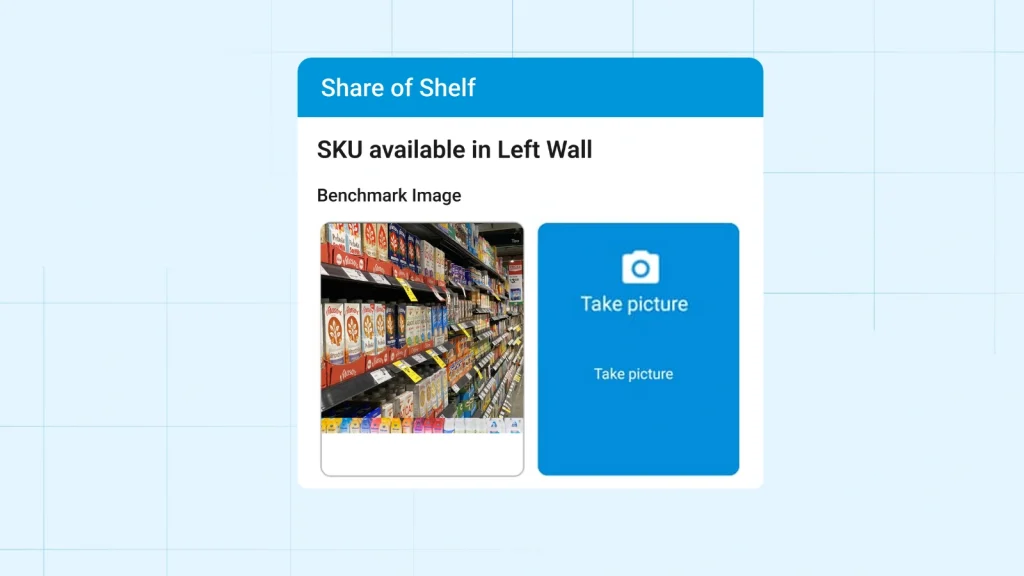
2. Placement and planogram compliance
- Check products sit where the layout plan says, at eye level where space allows
- Count facings held against facings agreed with the retailer
3. Must-sell availability
- Verify every must-sell pack is present, not just the fastest one
- Log which SKU is missing, because that is the order line you write next
4. Pricing against the current list
- Compare the price charged with today's list, not last quarter's printout
- Flag any outlet pricing far above list, since that is where consumers walk away
5. Stock on hand, including hidden stock
- Count what is on display and what sits under or behind the counter
- Flag low stock and overstock, and note damaged units for replacement
6. Competitor position
- Note rival facings, hanging strips, and any new sachet pack on the clip
- Photograph the full display so the comparison is evidence, not opinion
7. Promotion and POSM execution
- Check the scheme is live and the consumer offer is actually being honoured
- Confirm posters, danglers, and shelf strips are up, intact, and current
8. Quality and expiry
- Check seals, expiry dates, sun damage, and crushed or leaking sachets
- Pull anything unsellable and log it so the credit is not argued about later
9. Photo evidence, taken the same way every time
- Shoot the same angles at every outlet, showing correct and incorrect setups
- Let the photos carry the score, so the rep is not also the judge
10. Same-day action log
- Record urgent issues and who owns each fix before you leave the shop
- Push the fix into the next journey plan rather than into a monthly report
BeatRoute embeds this checklist into the rep's mobile workflow. Each step is a form field or a photo capture feeding the outlet scorecard. Audit templates are configurable by outlet class, region, or audit type, so a spaza checklist need not match a supermarket one.
Which audit KPIs should you actually track?
Track perfect store score, share of shelf, on-shelf availability, price compliance, and the share of flagged issues closed before the next visit.
A perfect store score of 80% to 90% is healthy. Below 70% means execution is failing, whatever the sell-in numbers say. Pair it with share of shelf so you know whether you lost space or lost stock.
Then aim the audit where the money is. In Lagos, a detergent stocked in 100,000 outlets can do half its sales in just 10,000 of them. Audit those outlets weekly and the long tail monthly, rather than sampling evenly and learning nothing.
How do audits help your distributor, not just head office?
Audit evidence settles distributor claims faster and shows where stock crossed a territory line, which is why distributors accept the tool at all.
Manual claims commonly take 8 to 12 weeks. A dated, geo-tagged photo of the display is the proof a display claim needs. Give your distributor that record and the argument shortens considerably.
Audits also surface dumping. Stock bought in Onitsha Main Market crosses any line a brand draws on a map. Treat that as a structural fact of open-market trade to make visible, not as a distributor's moral failure.
How does BeatRoute turn a retail audit into a same-day fix?
BeatRoute's VM Audit AI Agent reads store photos, detects planogram deviations and missing SKUs, and returns a compliance score in seconds.
Flagged outlets go back into the rep's journey plan for a fix visit, so in-store execution gaps close inside the same cycle. Every result is stored against the outlet profile, which builds the history your team argues from later.
BeatRoute is a global platform tailored for African trade, with proof it works here, which is why brands like AAVA Brands and BUA Foods run on it. AAVA Brands in Nigeria posted an 18% to 20% field productivity gain and a 25% to 30% rise in store sellouts.
With BeatRoute, your field team gets:
- Geo-tagged image capture with KPI tracking, from 50 outlets to 50,000
- Automatic scoring of planogram compliance, share of shelf, and promo presence
- Outlet scorecards the retailer can see, which turns the audit into a conversation
- Findings routed to the right person automatically instead of chased by phone
The part of the audit nobody budgets for
The expensive half of a retail audit is not the visit. It is the fix that never gets scheduled.
Tolaram reaches roughly 600,000 retailers through 1,000 distributors and 25,000 wholesalers. At that scale, an audit finding is worthless unless the system decides who fixes it, where, and by when. Detection is cheap now. Follow-through is the scarce part.
So judge any retail audit tool on one question. How many flagged outlets were fixed before the next visit? Get an instant demo and see what your shelves actually look like this week.
Frequently asked questions
What is a retail audit?
A retail audit is a structured check on how an outlet executes the brand plan: placement, availability, pricing, promotions, stock, and quality. The output is a list of gaps the field team closes on the next visit. It is the feedback loop that keeps in-store execution honest.
How do you run a retail audit in a shop with no shelves or aisles?
You audit what exists: facings held on the stack or clip, must-sell packs present, price charged, promo material up, and stock hidden under the counter. Supermarket forms asking for aisle and gondola positions do not apply in a duka or a bakkal. Configure the checklist by outlet class instead.
How often should a retail audit be run?
Frequency should follow sales concentration, not fairness. Audit your highest-volume outlets weekly or fortnightly and the long tail monthly. The better test is whether each audit produces a same-day corrective action. If it does not, more frequency will not help.
What KPIs should a retail audit track?
Track perfect store score, share of shelf, on-shelf availability, price compliance, promotion presence, and damage or expiry incidents. Add an action-close rate, meaning the share of flagged issues fixed before the next visit. That last one tells you whether the programme is working.
What is a good perfect store score?
A perfect store score of 80% to 90% is generally healthy. Below 70% signals an execution failure that primary sales figures will hide for a while. Track the score by outlet class, because a kiosk and a modern trade store cannot be held to the same standard.
What does an AI retail audit actually do?
It replaces manual tallies with image recognition. BeatRoute's VM Audit AI Agent reads each store photo and scores it against the planogram. It spots missing SKUs and share-of-shelf drift, then pushes the flagged outlets back into the rep's journey plan for a fix visit.
Can a retail audit app work without internet?
A field-ready audit app is offline-first. Reps capture photos and scores with zero signal, and the app syncs when connection returns. This matters because data costs about 2.4% of monthly income per GB in Sub-Saharan Africa, so reps ration uploads.
How do you prevent reps from faking audit data?
Use time-stamped, geo-verified photo capture and automatic scoring, so the evidence does not depend on the rep's own judgement. Present it as protection rather than policing. A rep who genuinely walked the route can then prove it when incentives are calculated.
What is the difference between a retail audit and in-store execution?
In-store execution is the work: placing stock, setting the display, running the promotion. A retail audit verifies that the work happened as planned. Audits without execution changes are just reporting, and execution without audits is guesswork.
How does a retail audit help my distributor?
Dated, geo-tagged photo evidence supports display and promotion claims, which manually can take 8 to 12 weeks to settle. Audit data also shows where stock crossed territory lines. Both are distributor benefits, not head office controls.
Do we still need field auditors if AI scores the photos?
Yes, with a different job. Reps still capture the photos, talk to the retailer, and close the flagged actions. What disappears is form filling and transcription. The scoring is automated so the rep can spend the visit selling and fixing.
Which African brands use BeatRoute?
African customers include AAVA Brands and BUA Foods in Nigeria. Across all markets BeatRoute serves 200+ enterprise brands in 20+ countries, reaching 2M+ retailers and 100K+ users. BeatRoute is a sales force automation and distributor management platform, not a CRM.