Philippines Sales Force Automation Software Guide
A 2026 guide to SFA software for sales and distribution leaders in the Philippines.
 By Nikhil Chaudhary, VP of Marketing
What should sales force automation software do in the Philippines?
The ideal SFA software does far more than log what the field did. It should help your team reach more stores, sell more in each one, hold the shelf, and catch a territory problem early.
Here is what a brand selling here should expect from SFA software.
1. Reach more stores without adding reps
Good sales force automation software puts the right rep in the right store on the right day. Coverage is the base that every other number sits on.
Most brands never use the full capacity of the team they already have. They assume wider coverage means a bigger field force. It usually does not. The real limit is that nobody decides which stores each rep should reach, and in what order.
Routes settle into habit. The sari-sari store that always buys gets another call. A high-potential store one corner away goes unseen for months. Metro Manila traffic eats the selling hours, and the store count for the day falls.
2. Sell more in every store
Arriving at the store is half the job. Every visit should return more than the last one did.
Most calls run on routine. The rep greets the owner, writes the same order as last month, marks the visit done and moves on. The call is logged. The chance to grow that store is left on the counter.
This is not about weak reps. It happens because nobody tells them what the visit is meant to achieve.
Should today's call widen the range? Land the new SKU? Win back a facing a rival took? Fix a suki balance nobody has raised?
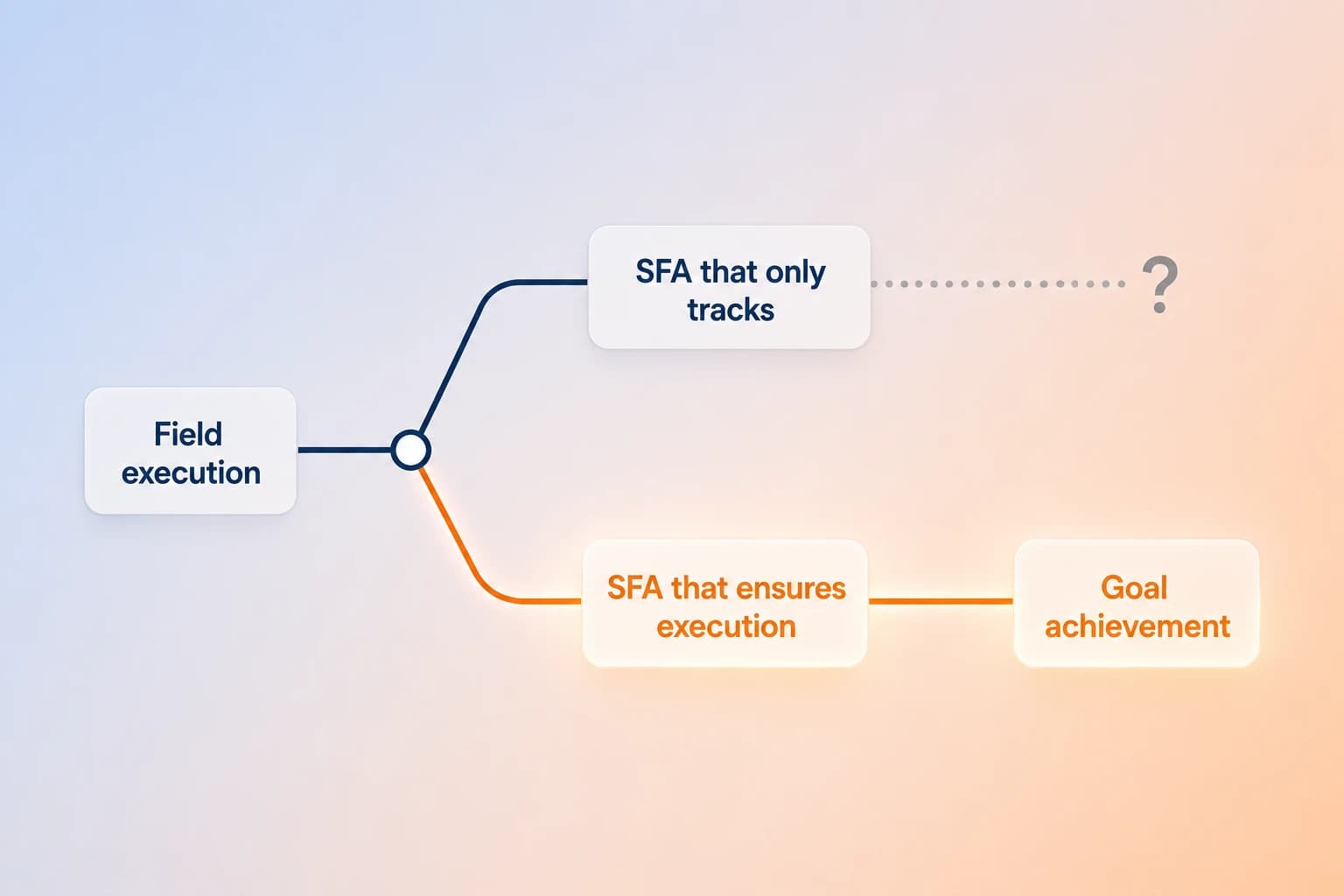
Most SFA software records what happened after the call. Good sales force automation software shapes the call before it starts, so every visit moves the brand's goal forward.
3. Hold the shelf and keep the channel close
Getting listed is not the same as getting sold.
If your pack sits where the shopper cannot see it, they buy the brand in front of them instead.
A promodiser can hold one supermarket aisle. A rep working thirty sari-sari stores a day cannot check every display, match it to the planogram and note each gap by hand. Month by month a rival takes the eye-level facings and your share of shelf slips.
The same is true of your distributors, wholesalers and the retailers they serve. They decide how much of your range actually moves. If they are not engaged, rewarded and given a reason to push you, the numbers say so.
Sales force automation software should hold execution right at the shelf and make the channel around it stronger at the same time.
4. Catch territory problems before they cost sales
Managers are not short of data.
They are buried in it.
Coverage reports, sales reports, audit reports, collection reports. All of it exists, and a manager still loses half a day working out why Cebu is behind and Davao is not.
By the time the reason is clear, the selling days are already spent.
Sales force automation software should surface the problem on its own, say why it is happening and name the next action. A manager's day belongs to fixing execution, not hunting for what broke.
How BeatRoute SFA does all of this in the Philippines
How BeatRoute SFA software widens coverage across the islands
BeatRoute pairs Route Optimization AI with the Scheduling AI Agent, so the field day is planned around the business rather than around habit.
Route Optimization AI builds the shortest workable run for each territory. The rep spends the day inside stores instead of stuck in traffic between them.
The Scheduling AI Agent reads live signals: store potential, order history, visit frequency, open tasks and the target. It then puts the stores that matter most in front of the rep. A static beat plan treats every week the same. This does not.
Together they cover more stores and lift productivity with the team you have. San Miguel, Unilab and Monde Nissin all run on BeatRoute.
How BeatRoute grows sales in every store
BeatRoute pairs the Customer Insights AI Agent with the Order AI Agent to turn a routine call into a selling one.
The Customer Insights AI Agent reads how the store has performed. What it bought, what it stopped buying, which scheme it never claimed. From that it sets the agenda for today's visit.
The Order AI Agent then suggests the packs most likely to sell in that store. Reps lift basket size, widen the range, land new SKUs and grow secondary sales without guessing.
An order is not simply recorded here. It is built to move the brand toward its goal.
How BeatRoute protects the shelf and the channel
BeatRoute's VM Audit AI Agent turns a shelf audit into a single photo. The rep shoots the shelf. The AI reads planogram violations, out-of-stock packs, rival encroachment and missing displays. The gap gets fixed on the same visit, not at month end.
BeatRoute's Loyalty & Rewards Program keeps distributors, retailers and influencers close to the brand. Points, targeted campaigns and earned rewards give a sari-sari owner in Iloilo and a supermarket buyer in Manila a reason to hold your range.
How managers fix territory problems before they cost the month
Instead of opening five dashboards, a manager asks the question in plain words and BeatRoute Copilot answers from their own data.
Copilot works on the things that quietly cost a month: store productivity sliding, a route going dormant, a scheme target falling behind. It names the cause in seconds and suggests the next action. The manager gets the truth early, and the rep gets a fix instead of a hard review.
Good SFA replaces habit in the field with guidance
A rep makes hundreds of small calls a day. Which store comes first. What to push there. Which pack to recommend. Who deserves the extra ten minutes. Left alone, those calls follow habit and convenience instead of the brand's priorities.
Good sales force automation software swaps that guesswork for guidance. Every field action then lines up with the goal you set.
Nurturemed lifted rep productivity 20% and visit adherence 20%. See it on your own routes, with your goals and your top SKUs.
Keep reading
View all →

Frequently asked questions
What is sales force automation?+
Sales force automation (SFA) is software that runs the daily work of a field sales team. It covers visit plans, order capture, in-store checks, customer records and reporting. In the provinces it also has to work with no signal, so a rep captures the order and syncs it later.
How is SFA different from a CRM?+
A CRM manages customer relationships from a desk, across marketing, sales and service. SFA runs field execution: beat plans, in-store checks, order booking and territory work. Brands selling through sari-sari stores and modern trade run SFA alongside a CRM, not instead of it.
What should an SFA platform include here?+
It needs route and beat planning, digital order booking, guided in-store checks, live dashboards and ERP and distributor integrations. It should run on any Android and take retailer orders over Viber. AI help with visit priority, SKU suggestions and store scoring is now standard.
How long does SFA software take to roll out here?+
Timelines vary by platform. BeatRoute goes live in 2 to 3 weeks on pre-built workflows and the BeatRoute Matrix integration layer. Pick a platform that bends to how your team already sells, then phase the rollout across Luzon, Visayas and Mindanao.
How do you know the SFA is working?+
Watch adoption, visit compliance, productive call ratio, lines per call and revenue per rep. Then look at coverage held, out-of-stock rates and the hours a rep no longer spends encoding reports at night.