

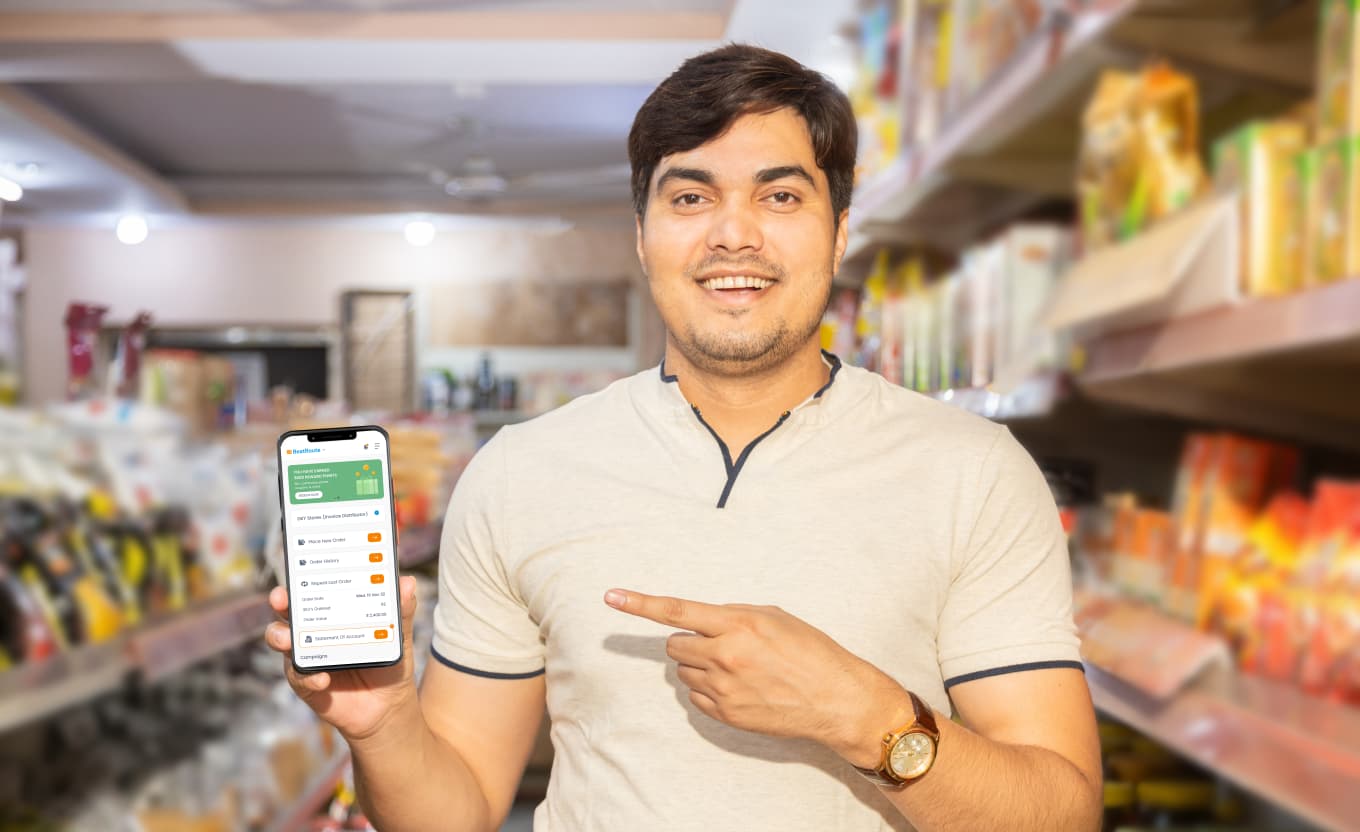
TL;DR This guide is for Philippine FMCG sales leaders who want to grow revenue from general trade, the sari-sari and neighbourhood-store channel that is the market here. It covers seven practical moves. The first three are data-driven store onboarding, AI-assisted order collection, and scheme application at the point of sale. The rest are Viber and app-based digital ordering, display-campaign enforcement, route optimisation, and daily performance coaching. BeatRoute's Order AI Agent lifts basket value across reps regardless of experience, and drives a 4-6% sales uplift by recommending the right SKUs at each outlet. It runs on any Android, even low-end devices, online and offline.
General trade is the largest and strongest channel for FMCG in the Philippines. There are around 1.3 million sari-sari stores nationwide (DTI). They carry the bulk of everyday consumer sales through tingi selling, suki relationships, and utang written in a listahan. That scale is both the opportunity and the problem. Fragmentation across 7,641 islands, manual order capture, and patchy execution separate the brands winning in general trade from those losing it quietly, store by store. BeatRoute is the SFA and distributor management (DMS) platform built to execute your sales goals. Every general trade visit ends with the right order, the right scheme, and the right merchandising.
BeatRoute helps Philippine brands drive general trade growth through automated distributor coordination and verified retail execution, on the reps' phones and in the manager's dashboard.
What is the general trade channel in the Philippines?
General trade, or traditional trade, is the oldest way products reach Filipino shoppers. The sari-sari store on the corner, the last-minute buy for most households, is the classic example. These are small, individually owned shops serving one barangay or neighbourhood, usually buying in small quantities and reselling in tingi. Modern trade, by contrast, is the supermarkets, chain pharmacies, and convenience stores.
In the Philippines, general trade is not a side channel, it is the main one. That makes the right strategic and technological moves in this channel decisive for FMCG growth. It is also why the seven techniques below are framed for how selling actually works in the trade here.
1. Intelligent store onboarding with data-driven segmentation
On average, 60-70% of retailers do not yield the sales a brand hoped for. That is because most sari-sari stores get onboarded on the gut feel of a front-line rep. With outlets fragmented and scattered across barangays and islands, onboarding by intuition leaves value on the table.
Store onboarding done right captures the data you need to segment your outlet base into groups that behave alike. For each store, capture the details that decide potential:
- Store location and the barangay it serves
- Store size and category space allocated to you
- Range of products sold and price bands offered
- Competitor brands already in the store
- Credit and suki patterns that shape reorders
Proper retailer onboarding backed by segmentation gives sales leaders a real picture of their sari-sari universe. Knowing each store's ordering and credit behaviour leads to better coverage planning, sharper scheme targeting, and smarter merchandising. It also lets you allocate manpower by outlet value instead of spreading reps thin.
2. Use AI for order collection
Around 60-70% of sales reps cannot generate the optimum order during a store visit. With an AI-based order recommendation engine, even your newest or lowest-performing rep walks in knowing what to pitch, through intelligent suggestions of what each store can actually sell. It also builds selling skill by surfacing cross-sell and upsell prompts right on the order-taking app.
The Order AI Agent analyses past order history, seasonal patterns, and neighbourhood buying behaviour to suggest the ideal basket for each outlet. This matters in a market with high frontline churn: when a rep leaves, the new one is productive from day one instead of guessing. The Order AI Agent alone drives a 4-6% sales uplift by recommending the right SKUs at each visit. See what a strong order application should do in the field.
3. Maximise scheme application during order collection
Cross-selling, upselling, and reselling are the most effective ways to grow basket size, and schemes are designed to trigger exactly that. But if the rep cannot apply the right scheme during real-time order capture, the trade spend is wasted.
Build scheme logic into the order workflow and the correct scheme surfaces automatically at the right moment. That works for volume, range, clearance, or loyalty, with pin-pointed targeting. Promotional investment reaches the sari-sari retailer instead of getting lost in the field or misapplied by a tired rep at the end of a long beat.
4. Let general trade retailers order digitally over Viber
A physical visit to every store on every cycle is not always viable. Digital ordering expands coverage without adding headcount. Enable stores to self-order through a dedicated retailer app and through the channel where Philippine trade already happens: Viber, plus Messenger and WhatsApp. Sari-sari owners already run orders, follow-ups, and utang reminders over Viber, so meeting them there removes friction instead of forcing a new habit.
BeatRoute's TeleOrder AI Agent can place orders on behalf of reps as a store nears its replenishment cycle, extending coverage to outlets a van cannot reach every week. That is real reach into the long tail, without stretching your field team thinner. It works alongside your in-store execution so digital and physical coverage tell one story.
5. Display campaigns that actually get executed
Segmentation tells you which stores deserve which campaign. Once decided, let your reps and promodisers audit brand visibility through AI-driven planograms and share-of-shelf scoring, so you can verify footfall conversion and protect the money you put into display.
An easy-to-use promoter app collects visual merchandising evidence at the point of sale, and the VM Audit AI Agent checks those images for you. The result is verified execution, outlet by outlet, instead of a manager guessing from a blurry selfie whether the display ever went up. Managers get proof of work, reps get a faster way to close the visit, hindi ito spyware.
6. Increase face time with general trade retailers
Route optimisation uses algorithms to build the most efficient beat based on the parameters you set. It sequences outlets by distance, priority, and visit windows in a way no manual plan can match. In Philippine field sales, where traffic eats selling hours and reps leave before sunrise, that sequencing is the difference between eight quality calls and four.
Effective route optimisation lets teams cover territory efficiently across long provincial beats and RORO crossings. It cuts travel time between stores and puts more of the day into face time with retailers. That shows up directly in sales from the territory. Reps also get home before dark instead of doing kayod kalabaw for coverage that never held.
7. Coach selling behaviour with daily performance visibility
Filipino reps live on commission, so clear earnings and performance visibility is not a nice-to-have, it is a retention feature. An auto-updating leaderboard weighs input activities and output KPIs. Each rep sees exactly where they stand every day, and where a few more of the right visits would move their number.
On the basis of daily and monthly performance, managers can run targeted coaching instead of blanket training. You can see which reps are slipping on which KPI and assign short digital training modules on the go, as they work their beat. Nobody has to pull the whole team off the field for an expensive in-person session. For a churning frontline, that is how new joiners get productive fast and good reps stay.
How does BeatRoute drive general trade execution in the Philippines?
BeatRoute drives general trade execution by breaking organisation-level sales goals into individual rep targets and coordinating every initiative, from visit planning to scheme activation, through intelligent workflows on a single platform. Instead of nine disconnected efforts, the rep gets one prioritised run-list and the manager gets one source of truth.
As an FMCG brand you have many levers to pull, but they only build on each other when they work together. BeatRoute's Goal-Driven AI breaks down company targets into rep-level goals and sets up a steady process for improving output. Onboarding, order AI, schemes, digital ordering, display audits, routing, and coaching then pull in the same direction.
It runs on any Android, even low-end devices, online and offline. A rep in a provincial dead zone keeps selling, and nothing waits for an end-of-day mag-encode. BeatRoute is a global platform tuned for Philippine field sales and proven in the trade here, which is why major Philippine brands like San Miguel and Monde Nissin run on it.
Book a PH-tailored demo to see how BeatRoute grows your general trade sales through a Goal-Driven approach.
Frequently asked questions
How can FMCG brands improve sari-sari store onboarding in general trade?
By replacing intuition with data. Capturing store-level details like location, size, product range, competitor presence, and credit or suki patterns during onboarding lets brands segment retailers meaningfully. Coverage, schemes, and merchandising can then be planned around each store's real potential instead of a rep's gut feel. That matters when your outlet base runs into the hundreds of thousands.
What is the most effective way to increase order value during sari-sari visits?
Training reps helps but has limits, especially with high frontline churn. The more scalable approach is embedding the Order AI Agent's suggestions into the sales workflow. The agent analyses past orders, seasonal trends, and neighbourhood buying patterns to recommend the ideal basket for each store. Every rep, regardless of experience, walks in knowing exactly what to pitch. This drives a 4-6% sales uplift on its own.
How can brands ensure schemes and promotions actually reach GT retailers?
Most schemes fail at the last mile because reps forget them or apply them wrong at the end of a long beat. Integrating scheme logic directly into the order capture workflow means the right scheme surfaces automatically at the right moment. Promotional spend then reaches the sari-sari retailer instead of getting lost in the field.
Can retailers order without waiting for a rep visit?
Yes. Sari-sari owners can place orders through a dedicated retailer app or over Viber and Messenger, the channels where Philippine trade already happens, without waiting for a van. BeatRoute's TeleOrder AI Agent can also take orders on behalf of reps as a store reaches its replenishment cycle, extending coverage to outlets a physical beat cannot reach every week.
Does it work offline in the provinces on low-end phones?
Yes. BeatRoute runs on any Android, even low-end and entry-level devices, both online and offline. A rep in a provincial dead zone can still capture orders, log visits, and audit displays, and the data syncs when signal returns. Nothing waits for an end-of-day mag-encode back at the distributor.
How do brands manage GT execution across thousands of fragmented outlets?
This is where technology becomes non-negotiable. An SFA and DMS platform brings structure to fragmented sari-sari networks through intelligent beat planning, route optimisation, and outlet-level data capture. Brands get visibility into which stores were visited, what was ordered, and where the gaps are. That holds across Luzon, Visayas, and Mindanao, with no hand-consolidated Excel and Viber follow-ups.