

TL;DR Most brands buy an order booking app to end the nightly mag-encode. The brands growing fastest in Philippine trade buy one to grow the order itself. AI recommendations mean every rep sells like your best rep, and a TeleOrder AI Agent calls the retailer when the visit never happens. Self-serve ordering on Viber covers distributors and store owners, all running offline on the low-end Androids your team already carries.
Two consumer goods brands work the same province. Same number of reps, same beat plan, the same sari-sari stores on the same corners. One grows average order value quarter after quarter. The other keeps booking the same three fast movers, over and over.
The difference is rarely the team. It is what happens in the thirty seconds while the store owner is deciding.
Most brands buy an order booking app to replace the order pad and stop the end-of-day encoding. That is worth doing, but it only moves paperwork from one place to another. The brands pulling ahead here buy an order booking app to grow the order. The right SKUs are suggested for that specific outlet, and schemes apply before the argument starts. Credit is checked while the rep is still standing at the counter, and an order is still captured on the days nobody could make the visit.
BeatRoute is the SFA and distributor management (DMS) platform for field sales and distribution. It runs across 20+ countries and 2M+ retailers, and has 20,000+ field users, distributors, and retailers in the Philippines with a team in Manila. What follows is what to look for in an order booking app, framed around how ordering actually works across Luzon, Visayas, and Mindanao.
How do you help every rep book a bigger order, not just write one down?
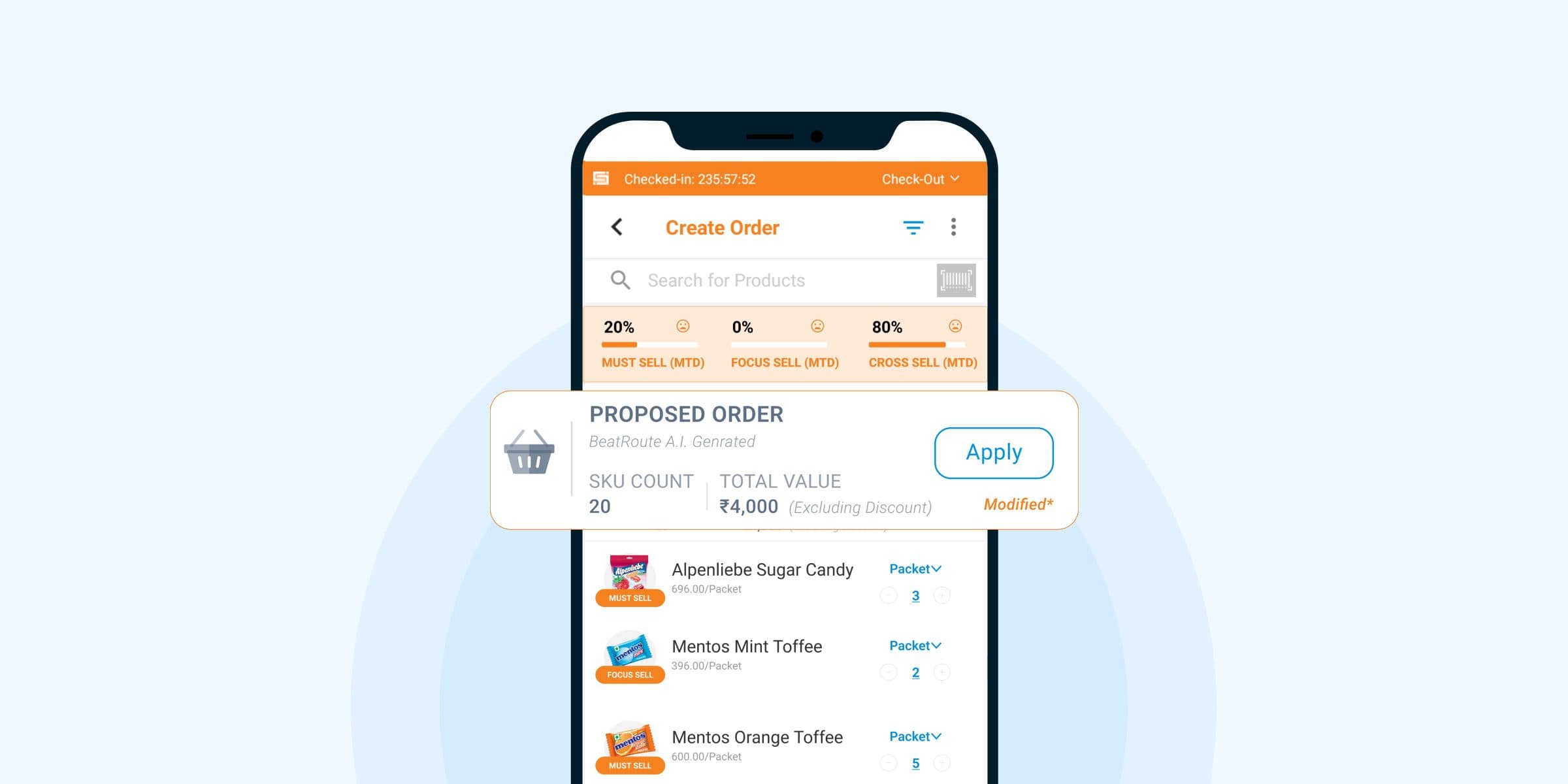
Give every rep the recommendation your best rep makes by instinct. A capable order booking app suggests the right SKUs, quantities, and schemes for that specific outlet. It reads the outlet's own purchase history, its store type, and what similar stores nearby are buying. The rep still sells. The app makes sure nothing sellable gets left out of the order.
Your strongest rep in Bulacan already knows all of this. He knows the corner store moves sachets and not the large pack. He knows the suki two blocks down will take a full case once the scheme is explained properly, and which outlets are due a repeat of the launch SKU. That knowledge sits in his head. When he resigns, it leaves with him. Philippine frontline attrition runs at about 20%, the highest in Southeast Asia, with retail turnover at 21.6% (Aon 2025). A brand that runs on rep memory rebuilds that memory every year.
BeatRoute's Order AI Agent puts that judgment into the ordering screen of the field sales app itself, for every rep on the beat.
- Outlet-level recommendations: product, basket, cross-sell, upsell, and must-sell suggestions built from purchase history, outlet type, season, and comparable stores. Priority SKUs and new launches stop getting skipped in the rush.
- Schemes and pricing on screen: live schemes, prices, and stock shown at the counter. The rep pitches with confidence instead of calling the supervisor or scrolling back through a Viber thread from last week.
- Easy from day one: the flow follows the order pad the team already uses, in English or Tagalog. Training is short, and the app does not become one more thing to complain about.
There is a rep-side reason this matters, and it is not a small one. Philippine field reps are paid on what they book, asa sa commission, hindi sa sahod. A bigger, better composed order is their earnings, not only your quota. Managers get order quality they can see across the territory. Reps get a real shot at the incentive without staying out until dark. Both halves have to be true or adoption stalls in month two.
What happens to the order when the visit never happens?
It gets picked up by phone, automatically. Routes break here for ordinary reasons. A typhoon closes the highway, a RORO crossing slips a day, or traffic eats the last three calls. The store shuts for the barangay fiesta, or a rep resigns mid-month. The TeleOrder AI Agent calls those retailers, takes the replenishment order in normal conversation, and books it straight into your system.
Around twenty typhoons cross the Philippines every year. Any coverage plan spanning Luzon, Visayas, and Mindanao has to assume some beats simply will not run this week. The outlets that suffer first are the small ones at the end of the route, the ones that never quite justify a return trip. Across 1.3 million sari-sari stores (DTI 2025), that tail is not a rounding error. It is where numeric distribution is won or lost.
The TeleOrder AI Agent covers that gap without adding visits or headcount. For the manager, coverage holds while a territory sits vacant between hires. For the rep, a flooded road stops being something to explain in the morning huddle.
Can distributors and store owners place their own orders on Viber?
Yes, and in the Philippines that is where the order already is. Trade runs on Viber: orders, follow-ups, escalations, a photo of a listahan sent at ten in the evening. The Philippines is a top-five Viber market globally and business messages on it grew 53% year on year. Taking the order inside that same thread removes the re-encoding step completely.
Channel partners do not want to wait for the next visit to replenish. Through BeatRoute's retailer and channel partner app, they place primary and secondary orders on their own terms:
- Order where they already are: a mobile app, a web portal, or Viber and Messenger. The partner can be in the warehouse, behind the counter, or riding out to the next town.
- Better baskets without a rep present: SKU and quantity suggestions drawn from what that partner actually bought before and what the brand is pushing this cycle.
- Schemes applied automatically: eligible promotions appear during ordering, so nobody has to remember which promo is live in which region this month.
- Credit visible before submit: price, availability, credit limit, and outstanding balance on screen at order time. In a trade built on suki relationships and utang, an order that quietly breaches credit is an order that gets stopped at billing and costs everyone a day.
- One place to follow the order: status, dispatch, invoice, payment, and returns in a single view instead of three follow-up calls and a chat thread.
Outside Metro Manila most of this volume still moves on wheels. The distributor van is the store's supply line, and the order, the invoice, and the collection all happen at the same stop. That is why order booking has to run on the same platform as van sales automation rather than in a separate app that reconciles later. Small grocers account for 63.5% of Philippine grocery retail (Euromonitor), so this is not a side channel to support next year. It is the market.
What has to be working underneath before any of this holds up?
Rules, schemes, and integration. An order booking app is only as strong as what it enforces at the moment of order and what it feeds afterwards. If pricing, credit limits, mandatory SKUs, and scheme eligibility are not applied on the spot, your team goes back to checking everything by hand. The rejected orders come home a week later.
When you evaluate order booking software, look past the ordering screen and ask what it does before, during, and after the order:
- Business rules applied automatically: pricing tiers, credit limits, mandatory SKUs, UOM restrictions, and approval routing, set per partner type or per region. Luzon, Visayas, and Mindanao networks can run on different terms without a separate process for each.
- Scheme management that closes the gap: schemes set up centrally, shown at order time, and applied in real time. Trade promotion value reaches the outlet instead of leaking into a dispute three weeks later.
- Integration with what you already run: orders, invoices, dispatches, stock, and payments moving both ways. It connects with SAP, Oracle, Microsoft Dynamics, and other ERP, DMS, and accounting systems. Nobody re-encodes an order that was already placed.
- Visibility a manager can act on: live dashboards on order trends, distributor performance, and execution. Behind them sits a distributor management system that shows secondary sales across the islands instead of a month-end consolidation.
- Enterprise scale, local language: multiple regions, networks, and languages including Tagalog across the apps, with support in your timezone and a Manila office behind it.
One more requirement quietly decides adoption: it has to work on any Android, even low-end devices, online and offline. Android is 88.2% of Philippine mobile (Statcounter), your reps and your distributors' staff carry entry-level handsets, and provincial signal drops without warning. An order taken in a dead zone has to save on the phone and sync the moment signal returns. If the app cannot even install on a budget handset, nothing else on this list matters.
Our orders already come in on Excel and Viber. Why change anything?
Because a spreadsheet can record an order but it can never grow one. Excel does not know this outlet has skipped the launch SKU for six weeks, cannot apply a scheme at the counter, and cannot tell you the tracker was edited after the fact. The honest status quo in most Philippine teams is a mix of order pads, timestamped selfies sent to the area manager, and a Bundy clock at the guard house. Add a hand-consolidated Excel tracker and follow-ups on Viber.
Three objections come up in every evaluation. They deserve straight answers.
- Excel is enough: it is enough to write the order down and never enough to improve it. Duplicate encoding, ghost visits, and late consolidation cost you coverage. A tracker anyone can edit is not a source of truth your planners can build a forecast on.
- The team will not learn a new app: the ordering flow follows the order pad reps already use, the interface is available in Tagalog, and reps are productive on day one. No classroom week, no long training program.
- We cannot disrupt the current system: import your existing spreadsheets and partner masters, and run alongside your ERP and Excel while the rollout proceeds. It works like Excel, except it fills itself in, and there is no rip-and-replace weekend.
The payoff shows up in hours, not in feature counts. Reps stop rebuilding the whole day from memory at nine in the evening. Supervisors stop chasing missing sheets before the Monday review. And the order data your planners open on Tuesday is the order data that was actually placed on Monday.
Is an order booking app the same as a CRM?
No. A CRM manages leads, contacts, and pipeline from a desk. Philippine field sales and distribution runs on visits, routes, outlets, distributors, vans, and credit. An order booking app books the order under your rules and pushes it to fulfillment. BeatRoute is an SFA and DMS platform with retailer engagement built in, not a CRM.
If you started this search with the word CRM you are in good company, because that is the vocabulary most teams know. Here is what actually differs once the work moves outside the office.
| What Philippine trade needs | Office CRM | Order booking on BeatRoute |
|---|---|---|
| Beat plan and outlet coverage | No route or outlet model | Beat plans, coverage, and visit proof by outlet |
| Order capture at the counter | Typed in later from notes | Guided ordering with schemes and stock on screen |
| Credit and outstanding at order time | Not enforced | Credit limit and balance checked before submit |
| Distributor and secondary sales truth | Not modeled | Distributor stock, dispatch, and secondary sales in one view |
| Provincial dead zones | Needs a live connection | Works offline on low-end Android, syncs when signal returns |
| Ordering on Viber | Not available | Viber and Messenger ordering for partners and retailers |
Put plainly: a CRM tells you who you talked to. An order booking app built on sales force automation tells you what got sold, where, and under which scheme. It also shows what that outlet should have bought instead.
A global platform that already works inside Philippine trade
Buying software here is slow, referral-led, and proof-driven, so here is the proof. BeatRoute runs 200+ enterprise brands across 20+ countries, reaching 2M+ retailers through 100K+ users and 6K+ channel partners. In the Philippines that means 20,000+ field users, distributors, and retailers, plus a Manila office in San Juan City and a local partner. Support runs in your timezone, with Tagalog across the apps.
The short version: a global platform tuned for Philippine conditions, with a working track record on the ground here. That is why brands of the scale of San Miguel, Monde Nissin, and Unilab are BeatRoute customers.
Documented results from published case studies:
- Nurturemed Pharma, Philippines: 20% higher rep productivity, 20% better visit adherence, and 20% growth in prescription-based sales.
- A premium Philippine paints brand: 30% higher sales productivity.
- Perfetti Van Melle, Indonesia: coverage tripled over three years to 300,000 outlets with no expansion of the field force. That is the regional version of the tail-outlet problem described above.
What teams tend to say once it settles in sounds like this: we finally have a single source of truth for GT and MT channels across our distributors in the Philippines.
Close the gap between the order you got and the order that was possible
Every route already produces orders. The real questions are how much of each outlet's potential those orders carry, and how many never got booked at all because the visit fell through. An order booking app that only records is leaving both on the table.
If you are evaluating one for the Philippines, test it on the hard cases. A low-end Android in a provincial dead zone, a suki with an open balance, and a distributor who wants to order on Viber at nine in the evening. Then a week when a storm takes out half the beat.
Book a PH-tailored demo and we will run your own outlets, schemes, and distributor structure through it.
Frequently asked questions
Does the order booking app work offline in the provinces?
Yes. It runs on any Android, even low-end devices, online and offline. A rep or a distributor's staff can browse SKUs, check schemes and credit, and submit an order with no signal. Everything syncs automatically once the connection returns. Android is 88.2% of Philippine mobile (Statcounter), so the app is built for the handsets your team already carries, not only for flagship phones.
Can retailers and distributors place orders through Viber?
Yes. Channel partners can order through a mobile app, a web portal, or Viber and Messenger. Philippine trade already runs on Viber for orders and follow-ups, and business messaging there grew 53% year on year. Taking the order in the same thread cuts order lag and removes the re-encoding step at the end of the day.
What is the TeleOrder AI Agent, and when does it call a retailer?
The TeleOrder AI Agent is an automated voice agent that calls retailers whose visit never happened: a closed store, a storm-hit route, a territory sitting vacant between hires. It captures replenishment needs in normal conversation and books the order into your system, so coverage holds without adding field visits.
Can it enforce credit limits before an order goes through?
Yes. Credit limits, outstanding balances, and approval rules are applied at the point of order. Orders that breach a limit can be blocked or routed for approval automatically. In a trade built on suki relationships and running balances, that stops orders being rejected later at billing and keeps collections discipline visible to both the brand and the distributor.
Is an order booking app the same as a CRM?
No. A CRM manages contacts and pipeline from a desk. An order booking app is built for distribution: guided ordering at the outlet, schemes and credit applied on the spot. It adds coverage and secondary sales tracking, and ERP or DMS sync. BeatRoute is an SFA and DMS platform with retailer engagement built in, not a CRM.
We run on Excel and Viber today. How disruptive is the switch?
Not very. Existing spreadsheets and partner masters can be imported, and the platform runs alongside your ERP and Excel during rollout, so there is no rip-and-replace. The ordering flow follows the order pad reps already use and the apps are available in Tagalog, so teams are productive from day one.