


A sales territory is the part of the map that one rep or one team answers for. In the Philippines that means the sari-sari stores, groceries and drugstores in it, the distributors that serve them and the routes reps follow. One territory sales manager owns it, quota included.
Ask that manager how the lines were drawn and the honest answer is often an Excel file from two reorgs ago. Visit reports arrive in a Viber group, and nobody is sure which barangays still get a call. A brand with forty big clients can list its territory by name. A snacks or paint brand cannot. One territory holds hundreds of small stores on a fixed cycle, so it is drawn on the ground and sized by its calls.
From Luzon region to sari-sari store: the four levels
- Region. A big block of the country, such as North Luzon, the Visayas or Mindanao. Its manager splits the yearly target across territories.
- Territory, or area. What one territory sales manager covers: a province, a few cities, or one slice of Metro Manila.
- Route. The stores one rep calls on in a day, repeated on the same weekday every week or every other week. Many teams call it a beat. A territory holds dozens of routes, and our beat plan guide explains how to build them.
- Outlet. A single sari-sari store, carinderia, hardware store or drugstore, with an owner, a pin on the map and a visit frequency.
Each distributor is assigned the territory, or the part of it, that it may serve. Pharma teams use the same levels, with PMRs calling on doctors and drugstores. Nurturemed Pharma raised PMR productivity by 20% on BeatRoute, as the Nurturemed case study shows.
Territory sales executive and manager: who does what
"Territory sales" means selling to every customer in one area, and on job sites it is also a title. Territory sales executives, or PSRs in some companies, ride the routes and book orders. The territory sales manager, or area sales manager, runs it through distributors and reps, and watches five things.
- Sell-out. Also called secondary sales, it is what stores buy from the distributor. How many stores on each route ordered this cycle is the honest test of coverage.
- Sell-in. Also called primary sales, it is what the distributor buys from the brand. Keep it in line with sell-out so stock does not pile up in the bodega.
- Distributor health. Watch stock on hand, order fill rate, promo claims and collections.
- Coverage. See whether reps finish their routes, which stores have stopped ordering and which new ones to open.
- Territory planning. Ask for a redraw when the routes no longer fit a working week.
Two questions sum it up: are reps reaching the stores on their routes, and is the distributor keeping them stocked? Seeing both every Monday fixes a weak route before it costs a month. A leading paints brand in the Philippines sells through hardware stores, chains and paint centers. With rep goals and scorecards on BeatRoute, it improved sales productivity by 30%. Read the paints brand case study.
Four ways to cut a market into territories
Pick a starting base, then test it against the workload.
- Distributor coverage.
The territory is whatever one distributor delivers to, for example "all of our Cavite distributor's stores south of the expressway". It works with one exclusive distributor per area, since quota, stock and sell-out tie to one partner. It breaks when that distributor is replaced or joined by a second. - Municipalities and barangays.
The lines follow boundaries everyone already knows, for example three neighboring municipalities in Batangas and every barangay inside them. This suits provinces where distributors overlap, because the map does not move when a partner changes. - Channel.
Traditional trade, from sari-sari stores to independent drugstores, is covered on routes inside each territory. Modern trade, meaning supermarkets, convenience stores and chain pharmacies, sits with key account managers whose branches cross territory lines. In Cebu City, the mall supermarkets go to a key account manager while the territory manager owns the sari-sari stores around them. Brands selling heavily through chains cut this way. - Product range.
Separate teams sell separate ranges, such as paint and waterproofing, so two territories share one map. It suits ranges that need a specialist, at the cost of two reps in one hardware store.
Then count the calls. Put the calls each territory needs next to the rep-days it has. A territory with fewer stores can still be heavier if its stores need a weekly call or sit across a river or a strait. A balanced territory has every route fitting in one working day and every store getting its calls each cycle. Its quota matches what the area can really buy.
Map the territory first, then assign distributors
The quick way to build territories is to load each distributor's customer list, since invoices and stock already move that way. It stops working when the setup changes. Replace the distributor in Pampanga, or appoint a second one for a new range, and the territory, its routes and its quota all need redrawing.
Hardware stores show the other problem. One store may buy paint from one distributor and adhesives from another. Built from distributor lists, the territory counts that store twice, with two visit plans and two reps claiming the sale.
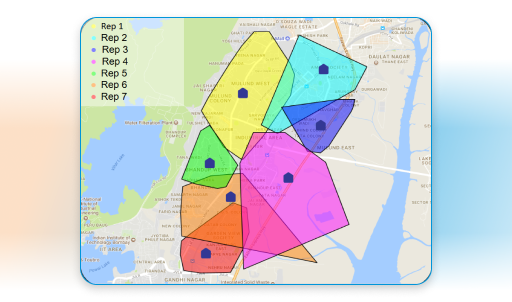
The sturdier rule: draw the geography once, pin each store once, then attach every distributor allowed to serve that area. That is how BeatRoute's Workzones are built. The map stays put while distributors join, leave or take on new ranges.
Worked example: a provincial territory, route by route
Picture two neighboring towns in one province and the barangays between them. Distributor A carries snacks across the whole territory. Distributor B carries beverages, but only in the bigger town. Three reps cover it, each working six days a week. There are 900 outlets: 100 groceries and wholesalers that get a call every week, and 800 sari-sari stores called on every two weeks. Of the 900, 300 stores in the bigger town buy from both distributors. The figures are invented, so put in your own.
| Step | The math | Result |
|---|---|---|
| Calls the territory needs | 100 groceries and wholesalers × 2, plus 800 sari-sari stores × 1 | 1,000 calls every two weeks |
| Rep-days you have | 3 reps × 12 working days | 36 rep-days every two weeks |
| Routes to build | One route for each rep-day | 36 routes, 12 per rep |
| Calls on each route | 1,000 calls spread over 36 routes | About 28: some 6 groceries or wholesalers and 22 sari-sari stores |
Next, check the clock. At about 12 minutes a call, 28 calls add up to just under six hours inside stores. A town route with stores a short walk apart fits in the day. A route through the far barangays, where the rep rides 20 minutes between stops, does not, and the last stores get skipped. Move some far stores onto a route with more town stores, or call on the smallest far ones less often.
Once every route fits a day, route optimization sets the order of stops so the rep loses the least time in traffic.
Now the 300 stores both distributors serve. Each is one outlet record with a single visit schedule, so the rep books snacks and beverages on the same call. Had the territory followed each distributor's list, those 300 stores would be 600 records on two visit plans.
Signs your territory is drawn wrong
- One rep is back at the warehouse by 2 p.m. while another never finishes a route.
The work was split by store count. Recount calls and travel time for each rep, then hand a block of stores from the busy patch to the quiet one. - The road eats more of the day than the stores do.
Routes cross the territory end to end. Regroup them around clusters of stores before you change the order of stops. - Some stores go a whole cycle without a call.
The territory needs more calls than its reps can make. Call on the smallest stores less often, or add a rep. Far barangays and island stores drop off first because they cost the most travel, so check their visit history early. - Two reps claim the same store.
The boundaries overlap or the store exists twice in the list. Settle it once on the map and the argument in the Viber group ends.
Review each territory every quarter, and sooner when a rep resigns, a distributor changes or a big outlet opens. If you are redrawing many territories at once, our guide to sales territory mapping software explains what the tools do and how to compare them. For running them day to day, read sales territory management in the Philippines.
BeatRoute suits brands whose reps sell to many retailers through distributors and want distributor management on the same platform. If that sounds like your team, request a demo and bring the store list for one territory.
Frequently asked questions
What goes into a sales territory plan?
A territory plan covers one territory for a fixed period, usually a quarter. It sets the quota per distributor and per channel and lists the stores to open. It fixes the routes and how often each store gets a call, and names the next review date.