

TL;DR Most African brands buy an order booking app to replace the carbon-copy order pad. The brands that grow buy one to grow every order, visit by visit. WhatsApp sits on 95 to 97 percent of African phones, so reaching your channel is the easy part.
Two brands sell the same category into the same streets. Same rep count, same call list, same trucks. One consistently books the bigger order. The difference is not the sales team. It is what the order booking app does while the rep is standing in the shop.
Your reps may cover provision stores in Ibadan, dukas in Nakuru, or spaza shops in the townships. The order gets written under the same pressure everywhere. Around 90 percent of Nigerian retail still moves through small independent outlets. The rep has minutes, a long SKU list, and a retailer watching the price.
That pressure got worse. The naira fell 40.9 percent in 2024. Eight major Nigerian consumer-goods firms saw costs jump 67 percent in one year. Price lists now go stale in weeks. Retailers accuse reps of cheating, and distributor margins get thinner every quarter.
African brands rarely have a demand problem. They have a visibility problem, and it starts at the order. The question is not whether the app captures orders. Every app captures orders. Ask whether it grows the order, holds the price, and still works when the signal drops.
What does an order booking app actually do in African trade?
An order booking app captures every order against live prices, schemes, stock, and credit rules. It then pushes that order into your ERP or DMS without anyone re-keying it. DMS means distribution management, the system that runs distributor stock, orders, and claims.
In African trade that job is harder than the definition suggests. Most of your volume moves through small independent shops, not supermarkets. South African traditional trade grew 9.1 percent year on year against 1.7 percent for modern trade. Egypt's 117,500 traditional grocers carry roughly 74 percent of sales, against 4,120 modern outlets.
Most of those orders are still written by hand. Van sales still runs on carbon-copy pads across the continent, and the pad leaks. Cash goes missing, routes cannot be verified, and head office finally sees a typed summary of somebody's handwriting.
How do you get every rep to book the order your best rep would book?
Your best rep already knows which basket each outlet can carry. The problem is everyone else on the team, and the fact that your best rep may leave this year. Frontline churn runs 25 to 35 percent a year, and outlet knowledge leaves with the person.
Volume is never spread evenly. In Lagos, a detergent stocked in 100,000 outlets does half its sales in just 10,000 of them. Your rep cannot tell which shop sits in that ten percent. Sachet packs and fighter brands keep adding SKUs, so the right basket changes shop by shop.
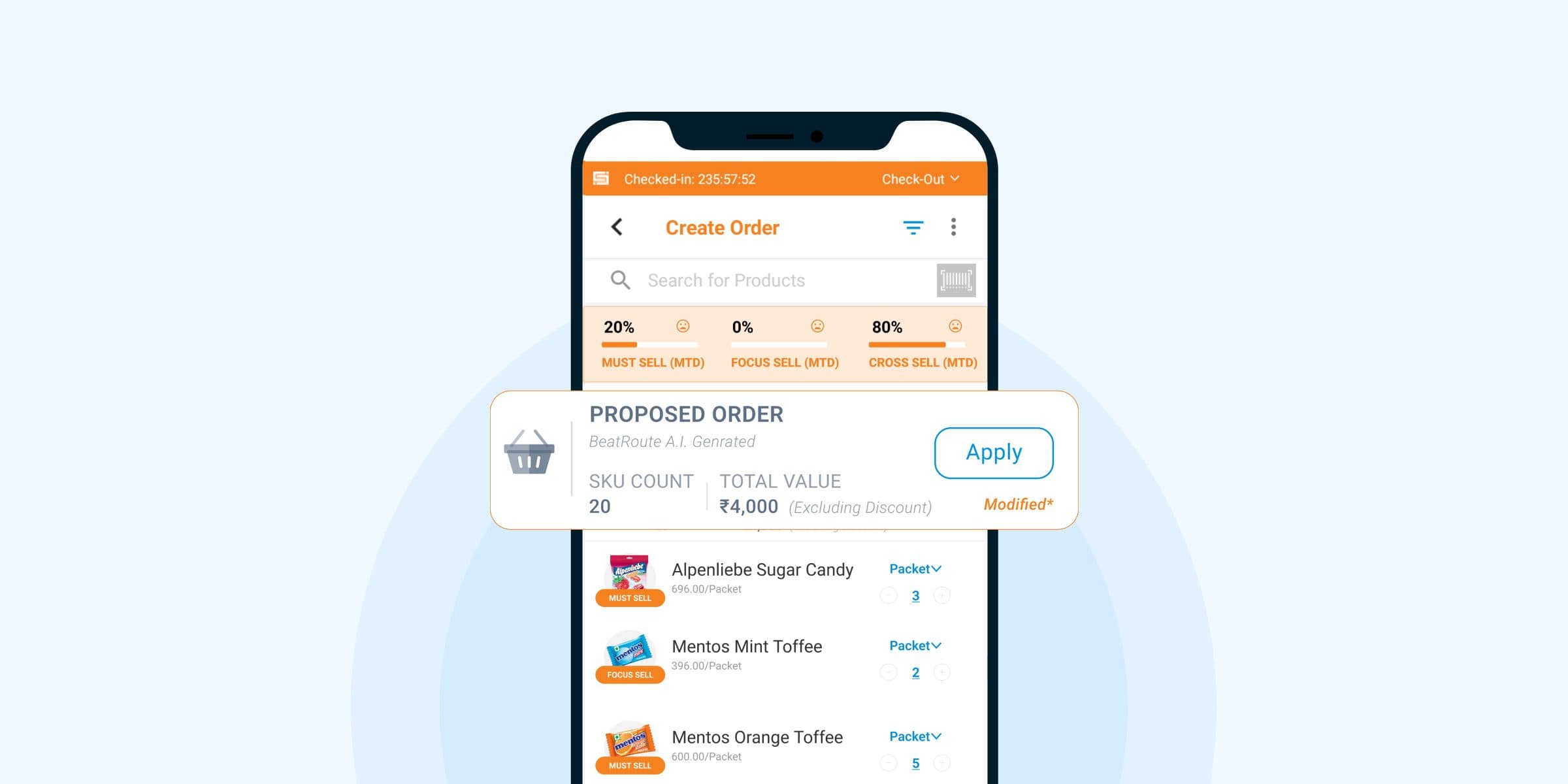
That is the gap the Order AI Agent closes. It reads purchase history, outlet type, and what similar stores buy. Then it suggests the basket, the cross-sell, and the must-sell SKUs for the shop the rep is in.
| What the rep sees at the point of order | Why it matters in the field |
|---|---|
| Basket and cross-sell suggestions built for that outlet | A rep who joined last month can sell close to the range your best rep sells |
| Must Sell and Focus Sell prompts | Lines per call rise, and new launches stop getting skipped in the rush |
| Live price by customer, channel, and region | The price quoted survives the next currency move |
| Schemes applied in the bill automatically | The retailer sees the benefit while ordering, not weeks later |
| Minimum quantities and selling units per SKU | Orders arrive fulfillable, so fewer get cut at the warehouse |
What happens to the order when your rep never gets to the shop?
A missed visit does not postpone the order, because the retailer buys from the wholesaler instead. The shopkeeper restocks at Onitsha Main Market, Gikomba in Nairobi, or Kejetia in Kumasi. Your brand loses the line to whoever had stock that morning.
Skipping the small outlet is now a rational decision. African logistics costs run about eight times the world average. Nigeria's fuel subsidy removal roughly tripled transport costs. BeatRoute research finds 30 to 40 percent of outlets underserved and 10 to 20 percent overserved.
The TeleOrder AI Agent calls the outlets your team did not reach. It talks to the retailer in Swahili, Hausa, Yoruba, isiZulu, or Amharic. It confirms quantities and writes the order into your system. Ghost visits stop being a fight, because every visit is time-stamped and geo-verified. Incentive payouts stop being argued over.
How do your distributors and retailers order when nobody visits?
Your distributors already order without you, through WhatsApp voice notes and photos of handwritten lists. Somebody retypes it into a spreadsheet at night. The order is real. The record is whatever survived the retyping. Self-serve ordering does not bypass your distributor. It gives their retailers a faster way to buy from them.
Your distributor is a business owner you court, not a department you manage. Their anxieties are specific and old. Manual claims take 8 to 12 weeks. Stock arrives in their territory from somebody else's van. Margins thin every time the currency moves.
The B2B Customer App lets them order on Android, iOS, or a WhatsApp bot with nothing to install. They see what they are buying and what it costs before confirming. A grossiste in Abidjan, a bakkal in Cairo, and a stockist in Mombasa use the same app.
| What your channel partner controls | What that fixes |
|---|---|
| Their own price and credit limit, shown before they confirm | Fewer orders rejected at the depot, and fewer angry phone calls |
| Eligible schemes applied to the order automatically | They stop discovering missed benefits at claim time |
| Order status, invoices, and statement of account in the app | They stop calling your team to ask where the truck is |
| Return requests that sync with your ERP or DMS | Disputes get a trail instead of a WhatsApp argument |
| Ordering on Android, iOS, or WhatsApp with no install | Their counter staff use the phone they already own |
Will it still book orders when the network drops?
A good order booking app works with zero signal and syncs when you are back online. That is not a footnote here. When an app dies without bars, the team is back on the pad by Wednesday. Data costs 2.4 percent of monthly income per gigabyte in sub-Saharan Africa.
The phone matters as much as the signal. A wave of first-time smartphone users is arriving on 40-dollar 4G handsets in Nigeria, Ethiopia, Tanzania, and Uganda. The app has to run on those phones and survive a full route on one charge. In South Africa, load shedding decides when anyone gets to charge.
BeatRoute books orders with no network at all and syncs them once the connection returns. Reps keep selling in a basement stockroom or on a road with no coverage. Nothing gets re-entered later. That single behaviour decides whether an order booking app survives its first month.
What has to sit underneath the order booking app?
Everything the rep does not see decides whether the order survives the trip to dispatch. Prices move with the currency, so a spreadsheet price list is wrong within weeks. Schemes vary by geography and outlet segment. Credit limits differ by distributor. None of that survives as a manual check.
The second half is integration. Your distributor management system and your ERP already hold the truth about stock, invoices, and payments. If the order booking app does not write into them, somebody re-keys it and the numbers stop agreeing.
Ask for this list in writing during the evaluation. It is the minimum an African rollout needs, and it is the part vendors skip in the demo.
| Foundation capability | What it prevents |
|---|---|
| Pricing by customer, channel, and region, applied at capture | A quoted price that no longer matches the invoice after a currency move |
| Schemes applied in the bill by geography and segment | Missed benefits that surface later as a distributor claim |
| Credit limits and approval rules enforced at the order | Orders that reach the depot and get cancelled |
| Two-way sync with SAP, Oracle, Tally, and other ERP or DMS systems | Re-keying, and two versions of the same number |
| Pre-sell and van sales order flows on one platform | One system for the truck and a separate one for the pre-seller |
| Multi-country, multi-language, multi-distributor rollout | A pilot in Kenya that cannot be repeated in Ghana |
What changes when ordering runs on one platform?
You stop recording what the retailer asked for and start growing what the outlet can carry. AAVA Brands in Nigeria reports an 18 to 20 percent lift in field productivity. Store sellouts rose 25 to 30 percent. BUA Foods runs on BeatRoute too.
Scale reassures the gatekeeper who signs off. BeatRoute is the SFA and distributor management platform for field sales and distribution. It runs for 200-plus enterprise brands in 20-plus countries and reaches over 2 million retailers. It is a global platform tailored for African trade, and the brands named above are the proof.
The order booking app is the only software your rep, your distributor, and your retailer all touch. Tolaram grew Indomie through 1,000 distributors, 25,000 wholesalers, and 600,000 retailers. That network was the asset. Fix the order, and you strengthen all three. See it run on your own SKUs and prices.
Frequently asked questions
What is an order booking app?
An order booking app is the tool used to place a sales order digitally. It applies live prices, schemes, stock, and credit rules at the moment of ordering. Field reps use it inside the outlet, and distributors order for themselves. The order then flows into your ERP or distribution management system without re-entry.
Does BeatRoute's order booking app work offline?
Yes. Reps keep booking orders with no network at all, and orders sync automatically once the connection returns. This matters on routes where coverage disappears for hours. Nothing has to be re-entered when the rep gets back to the office.
Can distributors and retailers place orders over WhatsApp?
BeatRoute's B2B Customer App runs on Android, iOS, the browser, and as a WhatsApp bot that needs no installation. A retailer with a basic phone and a WhatsApp account can order without downloading anything. The same prices, schemes, and credit rules apply on every channel.
What does the TeleOrder AI Agent do when a rep misses a visit?
The TeleOrder AI Agent watches planned visits and calls the retailer when an outlet is missed. It holds a normal conversation, confirms quantities, and records the order in your system. It also takes inbound calls from retailers who want to order without waiting.
Which African languages does the TeleOrder AI Agent speak?
It speaks Swahili, Hausa, Yoruba, isiZulu, and Amharic out of the box, alongside English. More than 70 further languages are supported. You decide which language it uses for which retailer segment.
Can the same app handle van sales and pre-sell ordering?
Yes. Order flows can be set up for pre-sell, where the order is booked now and delivered later. They can also be set up for van sales, where stock is sold straight from the truck. Both run on one platform, with the same prices, schemes, and stock rules.
Will it integrate with our SAP, Oracle, or existing DMS?
Yes. BeatRoute syncs product, pricing, and customer masters with your ERP or distribution management system. Orders, invoices, and return requests flow back the other way. Integration runs in both directions, so stock and pricing stay current in the app.
How do we stop orders going out at the wrong price when the currency moves?
Price lists are held centrally by customer, channel, and region, and applied when the order is captured. A change made at head office reaches every rep and every distributor on the next sync. Nobody sells off a printed sheet that went stale two weeks ago.
Can it enforce credit limits and show outstanding balances?
Yes. Credit limits and approval rules are applied at the point of order. An order that breaches a limit can be blocked or sent for approval. Distributors and retailers see their own statement of account in the app.
What is in it for the distributor?
The distributor gets faster claims, fewer disputes, and less time chasing dispatches by phone. Schemes apply at the moment of ordering, so the benefit is visible immediately rather than at claim time. Order status, invoices, and returns sit in one place. Nothing about it moves their retailers to somebody else.
Do reps need training to use an order booking app?
Training is short. The interface guides the rep through the order, so there is less to memorise. Reps who already use WhatsApp are usually productive within days. The app also keeps working with no network, which is what normally sends teams back to paper.
Is an order booking app the same as a CRM?
No. A CRM manages leads, contacts, and opportunities. An order booking app prices and captures real orders in the field, then moves them into fulfilment. BeatRoute is sales force automation and distributor management, not a CRM.
How is this different from a B2B marketplace?
A marketplace buys and resells stock, holding its own inventory and taking the customer relationship. An order booking app does neither. It sits on the distribution network you already have and makes those orders visible and priced correctly.